Jaguar X-Type Sedan and Estate (Wagon). Manual - part 355
 

  Index      Jaguar     Jaguar X-Type Sedan and Estate (Wagon) (2.0 L, 2.5 L and 3.0 L Gasoline; 2.0 L and 2.2 L, Diesel) - manual 2001-2009 year


Search            


Content   ..  353  354  355  356   ..


Jaguar X-Type Sedan and Estate (Wagon). Manual - part 355


Item

Part Number

Description

1

—

TCM

2

—

Anti-lock Braking System (ABS)

3

—

Engine Control Module (ECM)

4

—

D/4 switch, (test switch), sports mode switch

5

—

CAN (including torque down switch)

6

—

Line pressure solenoid

7

—

Lock-up solenoid

8

—

Shift solenoid A

9

—

Shift solenoid B

10

—

Shift solenoid C

11

—

Low clutch timing solenoid

12

—

Reduction timing solenoid

13

—

2-4 brake timing solenoid

14

—

2-4 brake duty solenoid

15

—

Transmission Fluid Temperature (TFT) sensor

16

—

Control valve

17

—

Inhibitor switch

18

—

Select lever

19

—

Turbine Shaft Speed (TSS) sensor

20

—

Intermediate Shaft Speed (ISS) sensor

21

—

Vehicle Speed (VSS) sensor

22

—

Engine

23

—

Torque converter

24

—

Fluid pump

25

—

Input shaft

26

—

Four-speed geartrain

27

—

Clutch, brake, planetary gear etc

28

—

Output gear

29

—

Idler gear

30

—

Reduction geartrain

31

—

Parking gear

32

—

Final gear and differential

33

—

Transfer case

34

—

Automatic transmission assembly

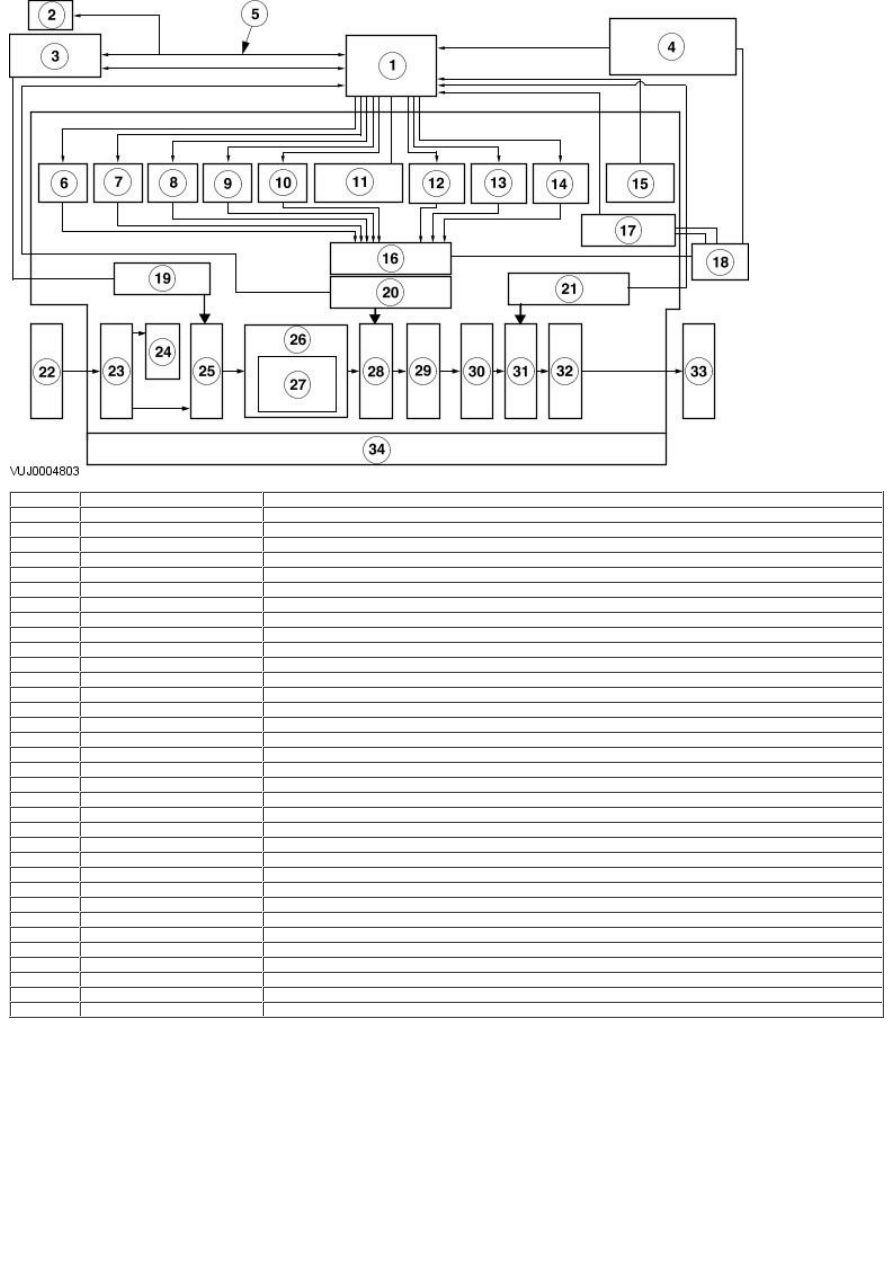
The transmission gear changes, oil pressure and lock-up operation are all electronically controlled. The TCM located in the left hand A-pillar
receives electrical signals from sensors indicating vehicle speed and throttle opening. In response to these signals the TCM selects the
appropriate gear and regulates other related conditions.

Actual transmission control changes are made by actuators (solenoids) that respond to input signals received from the TCM. These
solenoids operate in response to electrical signals they regulate the control valve operation. The control valves cause changes in the fluid
flow passages. This results in pressure changes within the transmission.

Transmission Construction

A cross-sectional view of the automatic transmission.

Item

Part Number

Description

1

—

Torque converter

2

—

Input shaft

3

—

Output gear

4

—

Low clutch

5

—

Low and reverse brake

6

—

Rear planetary pinion gear

7

—

Low one-way clutch

8

—

Rear internal gear

9

—

Rear sun gear

10

—

Front sun gear

11

—

Front internal gear

12

—

Front planetary pinion gear

13

—

2-4 brake

14

—

Reverse clutch

15

—

High clutch

16

—

Reduction gear

17

—

Idler gear

18

—

Reduction internal gear

19

—

Reduction planetary pinion gear

20

—

Reduction sun gear

21

—

Reduction brake band

22

—

Reduction one-way clutch

23

—

Direct clutch

24

—

Parking gear

25

—

Parking pawl

26

—

Final gear

27

—

Differential gear

28

—

Driveshaft

Torque Converter

Item

Part Number

Description

1

—

Converter clutch and damper

2

—

Reactor

3

—

Turbine damper

4

—

Impeller

5

—

Fluid motion

6

—

Transmission input rotation

7

—

Input shaft

8

—

Engine rotation

Torque Converter

The torque converter delivers the engine drive power to the transmission. W hen the lock-up clutch is released, the power delivery is
depended on automatic transmission fluid (ATF). When the lock-up clutch is engaged the engine power is delivered to the transmission
through the lock-up clutch.

The lock-up clutch is controlled electronically and operates in 4th and 5th gears.

A symmetrical element 1-step 2-phase torque converter is used with JF506E automatic transmission. The term "1-step" refers to the single
turbine and runner assembly and "2-step" refers to the turbine runner speed relative to the pump impeller speed. When the turbine runner
speed is lower than the pump impeller speed, the mechanism operates as a simple torque converter. W hen the turbine runner speed is
higher than pump impeller speed, the mechanism acts as a fluid coupling.

The torque converter transmits and multiplies torque. The torque converter is a four-element device:

impeller assembly
turbine and damper assembly
reactor assembly
clutch

The standard torque converter components operate as follows:

Rotation of the converter housing and impeller set the fluid in motion.
The turbine reacts to the fluid motion from the impeller, transferring rotation to the geartrain through the input shaft.
The reactor redirects fluid going back into the impeller, allowing for torque multiplication.
The clutch and damper assembly dampens powertrain torsional vibration and provides a direct mechanical connection for improved
efficiency.
Power is transmitted from the torque converter to the planetary gearsets and other components through the input shaft.

Oil Pump

Item

Part Number

Description

1

—

Oil seal

2

—

O-ring

3

—

Oil pump housing

4

—

Inner rotor

5

—

Outer rotor

6

—

Oil pump cover

7

—

Seal ring

8

—

Bolts

A trochoid oil pump is used with JF506E automatic transmission. The trochoid oil pump has the advantage of very low power loss.

Item

Part Number

Description

1

—

Outer rotor

2

—

Inner rotor

3

—

Suction port

4

—

Discharge port

The oil pump is driven by the engine. The inner rotor connects to the torque converter sleeve.

Geartrain

Power is transmitted from the torque converter to the planetary gearsets through the input shaft. Bands and clutches are used to hold and
drive certain combinations of gearsets. This results in five forward ratios and one reverse ratio, which are transmitted to the output shaft
and differential.

Gear Ratio

1st

3.801 to 1

2nd

2.131 to 1

3rd

1.364 to 1

4th

0.935 to 1

5th

0.685 to 1

Reverse

2.970 to 1

Planetary Gears


Content   ..  353  354  355  356   ..