Daewoo Tacuma: Body Repair Manual - part 11
 

  Index      Daewoo     Daewoo Tacuma - body repair manual


Search            


Content   ..  9  10  11  12   ..


Daewoo Tacuma: Body Repair Manual - part 11


4–12  FRONT

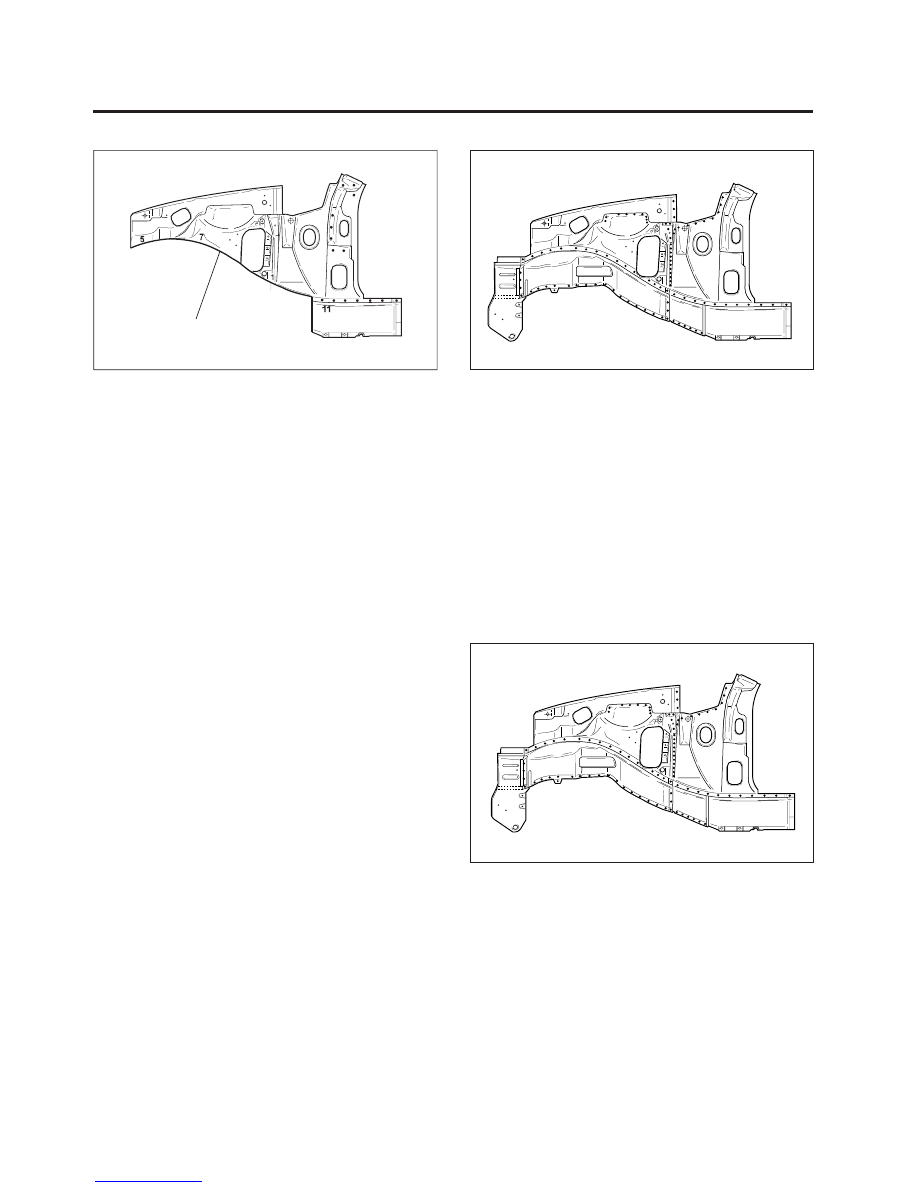
Fig. 18

6. Cut the new front longitudinal to align it with body,

then set the wheelhouse and front panel.

•

Cut the new front longitudinal with a hand saw

and it will be butt welded.

•

Grind both sides of the welding section of the front

longitudinal and wheelhouse with a disc sander
to remove the paint and expose the steel plate.

CAUTION : To prevent eye injury, wear goggles or
safety glasses whenever sanding, cutting, or grind-
ing.

•

Tighten the new front longitudinal against remain-

ing parts with the vise grips and pliers.

•

Place a jack under the front longitudinal end and

support it, and measure the positions for correct
setting.

•

Set and clamp the front panel in place with the

vise grips.

NOTE: Use of jigs is recommended for correct posi-
tions and check that the both front longitudinal and
wheelhouse are parallel.

•

Tack weld the clamped section for temporary in-

stallation.

7. Perform the main welding.

•

Weld as much as possible with the jig still

mounted.

•

Make MIG or gas welds at the butt joints at the

front longitudinal, carefully.

Fig. 19

3

5

12  

3

7

5

7

3

3

11

6

1

1

11

2

2

•

Spot weld the wheelhouse with the front longitu-

dinal flange areas and front panel.

CAUTION:  To prevent eye injury and burns when
welding, wear an approved welding helmet, gloves
and safety shoes.

•

Perform a trial welding first, and check the weld-

ing condition.

•

Increase the number of spot by 20% for areas to

be spot welded.

Fig. 20

3

5

12  

3

7

5

7

3

3

11

6

1

1

11

2

2

•

Level the weld beads at the longitudinal butt joints

area with disc sander.

•

Make the stiffener(Thickness: 2.8 mm Min., Width:

80 mm) according to the form of longitudinal butt
joint areas and weld the stiffener at the longitudi-
nal butt joint areas with MIG welder.

FRONT WHEELHOUSE

 FRONT  4–13

3

5

12  

3

7

5

7

3

3

11

6

1

1

11

2

2

Fig. 21

 8. Finish the welding areas.

•

Level the gas or MIG welded areas with disc

sander.

•

Use a hammer and dolly to even out the wheel-

house and longitudinal flanges for a close fit.

 9. Apply the sealer.

•

Apply the sealer to the joint areas of the dash

panel lower and floor panel areas.

10.Apply the undercoat.

•

Undercoat to the joint and overlapped areas of

the front floor, longitudinal under side and the
inside of front, rear wheelhouse.

11.Apply the paint.

CAUTION:

•

Ventilate when spraying paint. Most paint contains

substances that are harmful if inhaled or swal-
lowed.

Read the paint label before opening paint con-

tainer.

•

Avoid contact with skin. Wear an approved res-

pirator, gloves, eye protection and appropriate
clothing when painting.

•

Paint is flammable. Store in a safe place, and

keep it away from sparks, flames or cigarettes.

12.Coating the anti-rust agents.

•

Coating the anti-rust agents to the end of front

panel side and the front door hinge areas.

13.Install the related parts.

•

Clean the passenger compartment.

•

Wiring harness, instrument panel and related

parts.

•

Parts of the passenger compartment.

•

Chassis components.

•

Engine, radiator and related parts.

•

Aircon condenser and related parts.

•

Head lamps and fenders.

•

Heed, radiator grill, and bumper.

•

Others.

•

Install in the reverse order in which they were re-

moved.

NOTE: After install the all related parts, rub in grease
to the moving parts and replenish cooling liquid,
break oil, aircon gas and others.

14.Check and adjust

•

Check clearances and level differences.

•

Check the hood locking and unlocking condition.

•

Adjust the head lamp aim.

•

Check all operation.

•

Check for gas, oil and liquid leaks.

•

Check for water leaks in the passenger compart-

ment.

NOTE: Use specified check sheet for operation
check properly.

4–14  FRONT

4. SUPPORT CONTROL ARM

4-1. GENERAL DESCRIPTION

The support control arm is joined to the front longitudi-
nal and crossmember front floor panel. It forms the base
for the front suspension and is maintaining the rigidity
of the front parts. Pay particular attention to the posi-
tion and dimensions of the weld joints and weld care-
fully.

2

2

2

3

4

Fig. 22  Support Control Arm Welding Assembly

15

14

2

2

15

12

12

12

 FRONT  4–15

4-2. REPAIR PROCEDURE

1. Check the damaged areas.

•

Check the damaged parts and the extent of dam-

age properly.

•

The support control arm receives impact through

the front longitudinal.

Such impact generally requires replacement of all

these parts.

2. Remove the related parts.

•

Front seats.

•

Trims and carpet.

•

Wiring harness and others.

•

Parts to be removed when removing the front

longitudinal.

NOTE: Remove according to part damaged.

3. Pull out and straighten the damaged area to approxi-

mately the original shape.

NOTE: Use heat-resistant protective cover for pro-
tect painting areas, seats, carpets and other parts.

•

Before cutting off the damaged parts, pull out the

damaged area with the frame straightener and
correct the related parts such as the crossmem-
ber front floor panel and front floor panel.

•

Do not pull out more than necessary.

•

Check the clearance and level difference of the

front doors.

•

Jack up the body and place safety stands at the

four designated places of the frame door open-
ing. If necessary, place safety stands at the rear
of frame.

4. Peel off the undercoat, sealer and deadner.

•

Heat the undercoat and sealer at the welding ar-

eas of the longitudinal, cross member front floor
panel and front floor panel with a gas torch and
peel off the under with a steel spatula.

•

Peel off the deabner at the surface or front floor.

CAUTION: Be careful not to burn the fittings inside
of the passenger compartment when heating.

5. Cut and pry off the support control arm.

•

Center punch around the spot weld imprints on the

support control arm.

•

Use the special spot cutter to drill holes at the

spot weld nuggets on the center punch areas.

NOTE: When drilling holes be careful not to drill down
to the crossmember front floor panel and other re-
maining parts.

•

Cut and pry off the support control arm with an

air chisel, leaving the welding flanges intact.

•

Level and finish the burrs from the drilled holes

and pried off spot welds with disc sander.

CAUTION: To prevent eye injury, wear goggles or
safety glasses whenever sanding, cutting, or grind-
ing.

NOTE: Check again the extent of damage and crack.

Fig. 23

15

14

2

2

15

12

12

12


Content   ..  9  10  11  12   ..