AHA/ACC SCIENTIFIC STATEMENT (2024) - page 4
Circulation
AHA/ACC SCIENTIFIC STATEMENT
Supervised Exercise Training for Chronic Heart
Failure With Preserved Ejection Fraction:
A Scientific Statement From the American Heart
Association and American College of Cardiology
This statement is endorsed by the Heart Failure Society of America, the American Association of Cardiovascular and
Pulmonary Rehabilitation, and the American Association of Heart Failure Nurses.
Vandana Sachdev, MD, Chair*†; Kavita Sharma, MD, Vice Chair; Steven J. Keteyian, PhD; Charina F. Alcain, DNP, ACNP-BC;
Patrice Desvigne-Nickens, MD†; Jerome L. Fleg, MD, FAHA†; Viorel G. Florea, MD, PhD; Barry A. Franklin, PhD, FAHA;
Maya Guglin, MD, PhD; Martin Halle, MD; Eric S. Leifer, PhD†; Gurusher Panjrath, MD, FAHA; Emily A. Tinsley, PhD†;
Renee P. Wong, PhD†; Dalane W. Kitzman, MD, FAHA*; on behalf of the American Heart Association Heart Failure and
Transplantation Committee of the Council on Clinical Cardiology; Council on Arteriosclerosis, Thrombosis and Vascular Biology;
and American College of Cardiology
ABSTRACT: Heart failure with preserved ejection fraction (HFpEF) is one of the most common forms of heart failure; its
prevalence is increasing, and outcomes are worsening. Affected patients often experience severe exertional dyspnea
and debilitating fatigue, as well as poor quality of life, frequent hospitalizations, and a high mortality rate. Until recently,
most pharmacological intervention trials for HFpEF yielded neutral primary outcomes. In contrast, trials of exercise-based
interventions have consistently demonstrated large, significant, clinically meaningful improvements in symptoms, objectively
determined exercise capacity, and usually quality of life. This success may be attributed, at least in part, to the pleiotropic
effects of exercise, which may favorably affect the full range of abnormalities-peripheral vascular, skeletal muscle, and
cardiovascular-that contribute to exercise intolerance in HFpEF. Accordingly, this scientific statement critically examines the
currently available literature on the effects of exercise-based therapies for chronic stable HFpEF, potential mechanisms for
improvement of exercise capacity and symptoms, and how these data compare with exercise therapy for other cardiovascular
conditions. Specifically, data reviewed herein demonstrate a comparable or larger magnitude of improvement in exercise
capacity from supervised exercise training in patients with chronic HFpEF compared with those with heart failure with reduced
ejection fraction, although Medicare reimbursement is available only for the latter group. Finally, critical gaps in implementation
of exercise-based therapies for patients with HFpEF, including exercise setting, training modalities, combinations with other
strategies such as diet and medications, long-term adherence, incorporation of innovative and more accessible delivery
methods, and management of recently hospitalized patients are highlighted to provide guidance for future research.
Key Words: AHA Scientific Statements ◼ aged ◼ cardiac rehabilitation ◼ exercise therapy ◼ exercise tolerance ◼ heart failure
here have been several exercise-based therapeutic
primary outcomes with relatively large, clinically meaningful
trials in patients with chronic heart failure (HF) with
effect sizes. Whereas pharmacological studies focused on
T
preserved ejection fraction (HFpEF). In contrast to
clinical outcomes, the smaller exercise-based trials focused
the pharmacological trials, most of them reported positive
primarily on aerobic exercise capacity and quality of life, and
*V. Sachdev and D.W. Kitzman contributed equally.
†Disclaimer: The content of this manuscript is solely the responsibility of the authors and does not necessarily reflect the official views of the National Heart, Lung, and
Blood Institute, National Institutes of Health, or the US Department of Health and Human Services.
Supplemental Material is available at https://www.ahajournals.org/doi/suppl/10.1161/CIR.0000000000001122.
© 2023 by the American Heart Association, Inc., and the American College of Cardiology Foundation.
Circulation is available at www.ahajournals.org/journal/circ
Circulation. 2023;147:e699-e715. DOI: 10.1161/CIR.0000000000001122
April 18, 2023
e699
Sachdev et al
Supervised Exercise Training for Chronic HFpEF
none were adequately powered for events. However, exer-
mechanisms for its development and prognosis.4,5,9,10 Hy-
cise capacity (ie, cardiorespiratory fitness) is an independent,
pertension is a major risk factor for HF development and
clinically meaningful patient outcome, and its measurement
is highly prevalent in those with HFpEF. Although there
is valid, objective, and reproducible. These positive data on
is evidence that treatment of hypertension may prevent
exercise capacity for patients with chronic HFpEF provided
HFpEF development,11 there appears to be less effect
the impetus for the current American Heart Association
from blood pressure lowering on reducing morbidity and
and American College of Cardiology scientific statement,
death once HFpEF is established.11 Overweight or obe-
which describes the quantification of exercise intolerance
sity is present in >80% of patients with HFpEF,12 making
and its underlying mechanisms, critically examines currently
excess adiposity and the associated metabolic derange-
available data on exercise-based therapies, and discusses
ments the most common HFpEF phenotype. Multiple
the rationale for their promotion and wider dissemination.
lines of evidence indicate that body habitus, particularly
excess intra-abdominal fat stores,12 plays a pivotal role
in the development of obese or metabolic HFpEF and
BACKGROUND
independently influences the severity of outcomes, in-
cluding both exercise capacity and subsequent clinical
HF Definition and Classification
events.13 Approximately 25% to 50% of patients with
Ejection fraction (EF) has traditionally been used to classify
HFpEF have diabetes, and this proportion is expected to
patients with HF because of its prognostic and therapeu-
increase. Diabetes has adverse prognostic significance
tic implications. The definitions of HFpEF have varied over
in patients with HFpEF, likely because of overlapping
time and among the studies cited, including both exercise
pathophysiological sequelae, including neurohormonal
and pharmacological trials. Thus, interpretation of results
activation, inflammation, and impaired skeletal muscle
for any subgroup of HF could differ somewhat depend-
function. Coronary artery disease is common in patients
ing on study population selection criteria. Clinical trials have
with HFpEF and is associated with a greater deteriora-
used an EF ≤35% or 40% to define HF with reduced EF
tion in left ventricular systolic function and worse out-
(HFrEF). HFpEF trials have used variable EF thresholds
comes.14 Pulmonary hypertension is common in HFpEF
of >40%, 45%, or 50% for patient selection. In 2021, a
and develops as a result of elevated left atrial pressures
universal definition of HF was proposed: “HF is a clinical
and progressive pulmonary vascular disease. There is a
syndrome with symptoms and/or signs caused by a struc-
bidirectional relationship between the heart and kidney
tural and/or functional cardiac abnormality and corroborat-
dysfunction that mediates volume overload and conges-
ed by elevated natriuretic peptide levels and/or objective
tion and is correlated with poor clinical outcomes.7
evidence of pulmonary or systemic congestion.”1 In addi-
There is a high burden of sarcopenia and frailty in
tion, the following classifications were proposed and have
patients with HFpEF, and these factors are associated
been incorporated into the most recent HF guidelines2:
with worse quality of life and increased clinical events.15,16
HFrEF includes patients with an EF ≤40%; HF with mildly
Reduced physical activity with aging and low cardiorespi-
reduced EF (HFmrEF) includes those with an EF of 41%
ratory fitness are important contributors to the develop-
to 49%; and HFpEF includes those with an EF ≥50%.1
ment of HFpEF,17,18 and emerging evidence demonstrates
that among patients with HFpEF, these impairments can
19
be improved with exercise training interventions.
Epidemiology of HFpEF
HFpEF affects approximately half of all patients with
Clinical Management of HFpEF
HF (ie, >3 million Americans), with women dispropor-
tionately affected compared with men. Its prevalence is
Patients with HFpEF may have frequent episodes of
increasing relative to HFrEF,3-5 largely because of the
acute decompensation with volume overload and con-
aging of the population and an increasing burden of co-
gestion, often leading to hospitalizations.4,20 However,
morbidities that contribute to its development.4-7 HFpEF
even when their congestion has been effectively treated
has profound health consequences, including severe ex-
and they are well-compensated, stable, and nonedema-
ercise intolerance manifested by exertional dyspnea and
tous, patients with chronic, stable HFpEF often experi-
early-onset fatigue with even brief bouts of mild physical
ence severe exercise intolerance, exertional fatigue,
activity, impaired health-related quality of life, frequent
and dyspnea. Indeed, exercise intolerance is the primary
hospitalizations, loss of functional independence, in-
manifestation of chronic HFpEF and is associated with
creased death, and high healthcare use and costs.8
poor health-related quality of life4 and other adverse out-
comes. Acknowledging the importance of exercise ca-
pacity and quality of life in these patients,7 a recent US
Common Comorbidities
Food and Drug Administration statement emphasized
Comorbid medical conditions not only are highly prev-
that reducing symptoms and enhancing physical function
alent in HFpEF but also are linked to the underlying
are valid end points for HF drug development.21
e700
April 18, 2023
Circulation. 2023;147:e699-e715. DOI: 10.1161/CIR.0000000000001122
Sachdev et al
Supervised Exercise Training for Chronic HFpEF
Until recently, most HFpEF trials of pharmacologi-
Current Guidelines for HFpEF Management
cal therapy were neutral on their primary outcomes of
A new version of the American College of Cardiology/
clinical events (eg, HF hospitalizations and cardiovascu-
American Heart Association guidelines for HF manage-
lar death).4,22 In February 2021, the US Food and Drug
ment was recently released, and HFpEF treatment rec-
Administration reviewed data on the effect of sacubitril/
ommendations have been added for sodium-glucose
valsartan and spironolactone treatment for HFpEF and
cotransporter 2 inhibitors (Class of Recommendation
granted approval for the use of sacubitril/valsartan in
2a), mineralocorticoid receptor antagonists (Class of
selected patients with HFpEF based largely on the PAR-
Recommendation 2b), and angiotensin receptor nepri-
AGON-HF (Prospective Comparison of ARNI with ARB
lysin inhibitors (Class of Recommendation 2b).2 Current
Global Outcomes in HF with Preserved Ejection Fraction)
guidelines also include a Class 1 recommendation (Level
trial.22 Despite promising results from post hoc analyses
of Evidence A) for exercise training in patients with HF.2
of data from the TOPCAT trial (Treatment of Preserved
Although this recommendation does not distinguish be-
Cardiac Function Heart Failure With an Aldosterone
tween HFpEF and HFrEF, the supporting evidence for
Antagonist),23 no final determination on spironolactone
this recommendation emanates largely from studies of
use was issued. Results from 2 unequivocally positive tri-
supervised exercise training (SET) in patients with chronic
als for HFpEF, EMPEROR PRESERVED (Empagliflozin
HFrEF. Guidelines also include comorbidity management
Outcome Trial in Patients With Chronic Heart Fail-
in the treatment of HFpEF, and patients with hyperten-
ure With Preserved Ejection Fraction)24 and DELIVER
sion, obesity, and diabetes may also benefit from SET.
(Dapagliflozin Evaluation to Improve the Lives of Patients
With Preserved Ejection Fraction Heart Failure),25 were
recently published and showed a reduction in the com-
ASSESSMENT AND QUANTITATION OF
bined risk of HF hospitalizations or cardiovascular death
EXERCISE INTOLERANCE IN HFpEF
with empagliflozin and dapagliflozin treatment.
In HFpEF drug trials that evaluated exercise capacity
Aerobic exercise capacity can be quantified objectively
as a primary or secondary end point, changes in exer-
and reproducibly in patients with HFpEF as peak Vo2
cise capacity with most drugs,4 including spironolactone
by expired gas analysis.34 Peak Vo2 is physiologically
(mean difference in peak oxygen uptake [Vo2] compared
meaningful because it measures the ability to transport
with control subjects, -0.4 mL∙kg-1∙min-1; P=0.38),26
(cardiac output) and use (arteriovenous O2 difference)
sacubitril/valsartan (mean difference in 6-minute walk
oxygen. Peak Vo2 is severely reduced by ≈30% in pa-
distance [6MWD], -2.5 m; P=0.42),27 and empagliflozin
tients with HFpEF compared with age-matched healthy
(mean difference in 6MWD, 4 m; P=0.37),28 have been
individuals and is similar to that in age-matched patients
disappointing. In October 2021, the first drug trial to
with HFrEF (13-14 mL∙kg-1∙min-1).35 This reduced level
improve exercise capacity and quality of life in patients
of peak Vo2 is below established thresholds required for
with HFpEF was published. The PRESERVED-HF trial29
functional independence, including normal activities of
(Dapagliflozin in Preserved Ejection Fraction Heart Fail-
daily living such as carrying groceries.36 Peak Vo2 also
ure) showed that dapagliflozin significantly improved
has significant prognostic value in patients with HF-
the Kansas City Cardiomyopathy Questionnaire Clini-
pEF,37 potentially greater than in patients with HFrEF.38
cal Summary score by 5.8 points at 12 weeks, and an
However, in contrast to SET studies in patients with
increase (8.2%) in the 6MWD was observed. As previ-
HFrEF,39 the relationship between changes in peak Vo2
ously noted, these trials used varying EF thresholds
and clinical outcomes in HFpEF has not been examined.
(40%, 45%, 50%) for inclusion of patients.
The most commonly used practical alternative for as-
Several device-based solutions to relieve symptoms
sessing exercise performance in HFpEF is the 6MWD,
and to improve the clinical course of patients with HFpEF
demonstrating values that are comparable to those in
have been evaluated. Use of a wireless pulmonary artery
patients with HFrEF and markedly reduced relative to
pressure monitoring device reduced hospitalizations in all
control subjects. However, there are few or no data cor-
patients with HF30; an exploratory subgroup analysis found
relating this parameter with clinical event outcomes in
that this effect was also seen in patients with HFpEF.31
patients with HFpEF.40,41
Placement of an interatrial shunt device to reduce pulmo-
nary capillary wedge pressure during exercise did not reduce
HF events in patients with HFpEF.32 However, prespecified
MECHANISMS OF EXERCISE
analyses showed that latent pulmonary vascular disease in
INTOLERANCE IN CHRONIC HFpEF AND
one-third of patients identified worse outcomes, suggesting
BENEFITS FROM EXERCISE TRAINING
that two-thirds of patients may benefit.33 Despite this recent
progress in drugs and devices, a paucity of interventions for
Several pathophysiological mechanisms are responsible for
HFpEF remains, highlighting the need to evaluate poten-
the severely reduced aerobic exercise capacity in patients
tially therapeutic lifestyle interventions.
with HFpEF. These can be broadly categorized as cardiac,
Circulation. 2023;147:e699-e715. DOI: 10.1161/CIR.0000000000001122
April 18, 2023 e701
Sachdev et al
Supervised Exercise Training for Chronic HFpEF
pulmonary, vascular, and skeletal muscle. Other factors
cise intolerance in HFpEF, a reduced arteriovenous O2
that contribute to exercise intolerance in these patients
difference accounts for >50% of the reduction in peak
involve common, coexisting risk factors and comorbidities,
Vo2 and is a stronger independent predictor of peak Vo2
including sedentary behavior; atrial fibrillation, which is ac-
than exercise cardiac output.44,52 Reduced peak exercise
companied by a worse prognosis10,42; and obesity, which
arteriovenous O2 difference in HFpEF may be attributed
may be associated with increased plasma volume, cardiac
to the aforementioned convective and diffusive oxygen
remodeling, and potentially pericardial restraint.43 Excess
delivery abnormalities, as well as multiple skeletal mus-
intra-abdominal adiposity is pivotal and has been linked to
cle abnormalities that impair oxygen utilization, including
systemic inflammation, mitochondrial dysfunction, capillary
reduced muscle mass, excess adipose infiltration, and,
rarefaction, and reduced nitric oxide bioavailability.10,13
most important, impaired mitochondrial function.53-59
The strongest evidence that abnormal skeletal mus-
cle mitochondrial function contributes to aerobic exer-
Cardiac and Pulmonary Mechanisms
cise intolerance was provided by phosphorous magnetic
Impaired cardiac output reserve during exercise is attrib-
resonance spectroscopy measurement of ATP and cre-
utable to modest blunting of stroke volume augmenta-
atine phosphate concentrations and turnover rates dur-
tion and to chronotropic incompetence, which occurs in
ing and after handgrip exercise using a small mass of
up to ≈50% of patients with HFpEF.44 The blunting of
exercising muscle, a model that excluded any limitation in
stroke volume occurs despite an exaggerated increase in
cardiac output as a contributor.59 These studies showed
filling pressures with exercise.45 Left ventricular systolic
that patients with HFpEF have rapid muscle ATP deple-
and diastolic dysfunction and left atrial dysfunction may
tion, which was observed early during exercise, further
also impair exercise capacity.
excluding abnormalities in cardiac output and muscle
Chronically elevated left ventricular filling pressures
blood flow reserve as causes.
lead to pulmonary vascular remodeling and impaired gas
The presence of multiple skeletal muscle abnormali-
exchange with decreased lung diffusion capacity and
ties53,54,56,58,59 suggests that, independently of any limi-
alveolar ventilation.46 Pulmonary hypertension is present
tations in cardiac output, patients with HFpEF have a
in >50% of patients with HFpEF; right ventricular dys-
skeletal muscle myopathy similar to that described in
function is seen in approximately one-third of patients;
HFrEF.53,60 Furthermore, these abnormalities are not
and both can contribute to exercise intolerance and a
merely secondary to deconditioning because (1) they
poor prognosis.36
develop even when physical activity is maintained dur-
ing the development of HF60 and (2) the pattern of
abnormalities differs from deconditioning, particularly
Vascular Mechanisms
the fiber-type shift, which is the opposite of that seen
Exercise intolerance in patients with HFpEF is also asso-
in deconditioning. The intrinsic nature of skeletal muscle
ciated with abnormalities in central artery (ie, proximal tho-
dysfunction is consistent with the current HFpEF para-
racic aorta) distensibility, peripheral (eg, femoral, brachial)
digm that it is a systemic syndrome, likely triggered by
artery vasodilator capacity, and microvascular diffusive
circulating factors such as inflammatory cytokines that
function (O2 movement from hemoglobin to mitochon-
cause dysfunction in multiple organ systems.10
dria).47 Specifically, increased central artery stiffness cor-
relates with the observed reduction in peak Vo2.48 Among
Mechanisms of Benefits From Exercise Training
patients who are free of clinically manifest coronary ath-
erosclerosis, flow-mediated endothelial function is abnor-
Studies indicate that peripheral adaptations, particularly
mal compared with younger healthy individuals; however,
in skeletal muscle, are the primary mechanism for im-
this may be an age-related phenomenon because the re-
provement in peak Vo2 after exercise training in patients
duction in vasodilatory responsiveness is apparently not
with HFpEF.6 The reason may be that, compared with
different when patients with HFpEF are compared with
cardiac muscle, skeletal muscle is more plastic and has
healthy age-matched control subjects.49,50 Last, microvas-
potential for rapid, large improvements in function after
cular function, which influences the diffusion of O2 within
even a brief period of exercise.61
both the myocardium and skeletal muscle and is partly
Exercise has a broad range of benefits that are rel-
dependent on both local autoregulatory mechanisms and
evant to HFpEF, including anti-inflammatory, rheological,
capillary density, is reduced in individuals with HFpEF
lipid-lowering, antihypertensive, positive inotropic, posi-
compared with age-matched control subjects.51
tive lusitropic, negative chronotropic, vasodilation, diuretic,
weight-reducing, hypoglycemic, hypnotic, and antidepres-
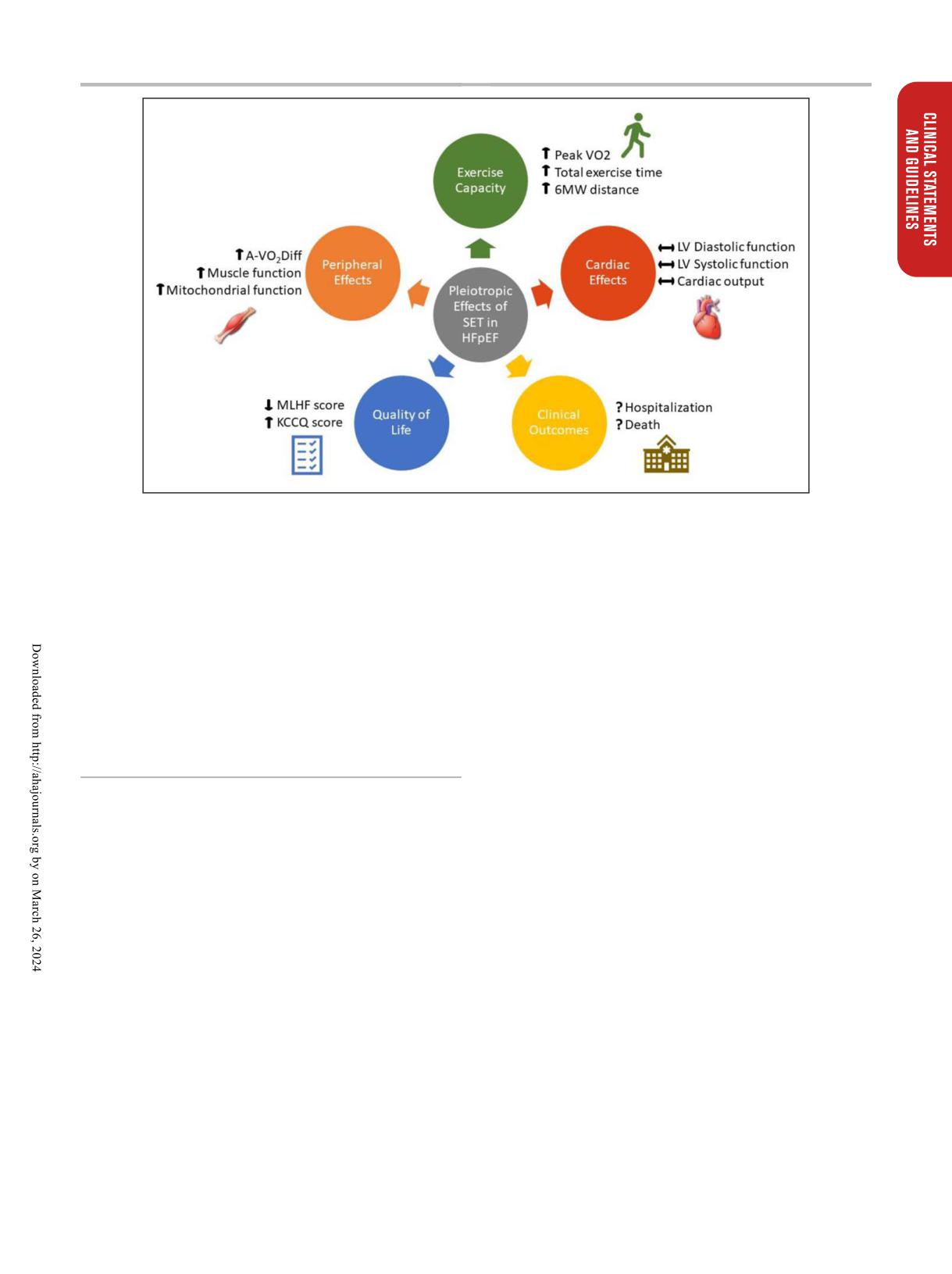
sive qualities.62 These pleiotropic systemic effects (Fig-
Skeletal Muscle Mechanisms
ure 1) are potentially well suited for the treatment of both
Although reduced exercise cardiac output is sometimes
the cardiac and, in particular, the extracardiac abnormali-
assumed to be the primary mechanism for severe exer-
ties that contribute to exercise intolerance in HFpEF.6,63
e702
April 18, 2023
Circulation. 2023;147:e699-e715. DOI: 10.1161/CIR.0000000000001122
Sachdev et al
Supervised Exercise Training for Chronic HFpEF
Figure 1. Pleiotropic effects of SET in chronic HFpEF.
A-Vo2Diff indicates arteriovenous O2 difference; HFpEF, heart failure with preserved ejection fraction; KCCQ, Kansas City Cardiomyopathy
Questionnaire; LV, left ventricular; MLHF, Minnesota Living With Heart Failure Questionnaire; and SET, supervised exercise training.
Many studies have demonstrated improvements in physi-
Of the 11 RCTs included in this review (Table 1), 8
cal function with exercise training in patients with HFpEF
had data available to calculate the effect of SET on the
and have shown favorable cardiac adaptations (increased
baseline-to-follow-up change in peak Vo2. Two of the
maximal cardiac output), peripheral vascular changes, and
studies did not have a control group,76,77 and 1 study did
skeletal muscle adaptations (increased oxidative muscle
not have a peak Vo2 measurement.75 With regard to the
fibers, reduced muscle wasting).6,61,64-66 Compared with
evolving definition of HFpEF and its classification, 6 of 8
most drugs that have failed to show benefits, exercise
trials included in the meta-analysis used the current EF
training has shown consistent improvements in exercise
classification of HFpEF. One study used an EF of 40%
capacity in patients with HFpEF.
and 1 used 45%; both of these studies included patients
with HF with mildly reduced EF and patients with HFpEF
based on current definitions.
CRITICAL ANALYSIS OF DATA FROM
AEROBIC EXERCISE TRAINING TRIALS IN
Demographics of the Patient Population and
CHRONIC HFpEF
Potential Limitations
Because earlier randomized controlled trials (RCTs)
There was substantial variation in the baseline charac-
of SET in HF were not blinded for assessment of out-
teristics of patients with chronic HFpEF who underwent
come measures,41 this scientific statement focuses on
aerobic exercise interventions. Some studies excluded
single-blinded HFpEF trials from 2010 onward (Table 1
patients with atrial fibrillation, chronic obstructive pulmo-
and Supplemental Table 1).67-77 Trials included in this
nary disease, and coronary artery disease, despite the
analysis were identified from a 2019 Cochrane review
fact that these comorbidities are common in individu-
of exercise-based cardiac rehabilitation (CR) for adults
als with HFpEF. Moreover, individuals with demographic
with HF78 and related reviews and meta-analyses from
characteristics prevalent in population studies of HFpEF
PubMed.79-83 Studies were required to have aerobic ex-
were often underrepresented, including older adults,
ercise capacity parameters as outcomes, and those that
women, individuals of lower socioeconomic status, and
enrolled both patients with HFpEF and patients with
underrepresented racial and ethnic groups. Similar to
HFrEF were excluded if results for HFpEF were not
SET studies in HFrEF, patients were clinically stable with
presented separately. Two exercise training studies were
no recent acute hospitalization. Accordingly, these exclu-
excluded because of a lack of randomization, and 5 stud-
sions limit somewhat the generalizability of the results
ies of other exercise forms (classes, functional electrical
and preclude extrapolation to patients with more severe
stimulation, tai chi, resistance training only) were exclud-
disease, particularly those with recent hospitalization who
ed (Supplemental Figure 2).
have much more severe and broader deficits in physical
Circulation. 2023;147:e699-e715. DOI: 10.1161/CIR.0000000000001122
April 18, 2023 e703

Sachdev et al
Supervised Exercise Training for Chronic HFpEF
Table 1.
RCTs of Facility-Based SET in HFpEF
Study size:
Primary
exercise/
end points
Study
control
(unless
Cardiac and
author,
(blinded:
Centers,
Patient popula-
SET pro-
otherwise
vascular end
QOL end
year
Aim of study
yes/no)
n
tion
Type of ET
gram
noted)
points
points
Kitzman
To evaluate the ef-
26 ET/27
1
EF ≥50%, NYHA
Walking
3 times per
Improved
No change in
No change
et al,67
fect of ET on peak
control
II-III, age 70±6 y,
wk for 4 mo
peak Vo2,
cardiac pa-
in MLHF or
2010
Vo2 and QOL
(yes)
17% male
ex test time,
rameters
SF36 score
6MWD
Edel-
To evaluate the effect
44 ET/20
3
EF ≥50%, NYHA
Bike+resistance
3 times per
Improved
Decreased
Improved
mann
of ET on functional
control
II-III, age 64±8 y,
wk, 35 min
peak Vo2,
E/e' and LAVI
MLHF, SF36
et al,68
capacity, cardiac
(yes)
45% male
each, for
ex test time,
score
2011
function, and QOL
6 mo
6MWD
Smart
To evaluate the effect
14 ET/16
2
EF ≥45%, NYHA
Bike
3 times per
Improved
No change in
No change in
et al,69
of ET on functional
control (echo
II-III, age 67±6 y,
wk, 30 min
peak Vo2
cardiac pa-
MLHF score
2012
capacity, cardiac
blinded, not
58% male
each, for
rameters
function, and QOL
mentioned
4 mo
for exercise
testing)
Kitzman
To evaluate the ef-
24 ET/30
1
EF ≥50%, NYHA
Walking+arm
3 times per
Improved
No change in
Improved
et al,70
fect of ET on FMD,
control
II-III, age 70±7 y,
aerobics
wk for 4 mo
peak Vo2,
FMD (primary),
SF36 score,
2013
arterial stiffness,
(yes)
28% male
ex test time,
arterial stiff-
no change in
and peak Vo2
6MWD
ness, or cardi-
MLHF score
(secondary)
ac parameters
Kalt-
To compare danc-
18 dancing,
1
EF ≥40%, NYHA
Greek dance vs
3 times per
Both danc-
None
Both danc-
satou
ing vs ET vs control
17 ET/16
II-III, age 67±7 y,
bike/treadmill+
wk, 30 min
ing and ET
ing and ET
et al,71
on functional ca-
control
100% male
resistance vs
each, for
improved
improved
2014
pacity
(yes)
control
1 mo
peak Vo2, ex
SF36 score
test time
Fu et
To explore how
30 ET/29
1
HFpEF, HFrEF, 2
Bike (3-min in-
3 times per
Improved
Decreased
Improved
al,72
aerobic interval
control (echo
control groups;
tervals)
wk, 30 min
peak Vo2
E/e' ratio
MLHF, SF36
2016
training affects cen-
blinded, not
EF ≥50%, NYHA
each, for
scores
tral and peripheral
mentioned
II-III, age 61±3 y,
3 mo
hemodynamics
for exercise
67% male
testing)
Kitzman
To determine
46 ET/46
1
EF ≥50%, NYHA
2×2 factorial:
3 times per
Improved
No change
No change
et al,73
whether caloric
control
II-III, age 67±6 y,
diet, walking,
wk, 60 min
peak Vo2,
in cardiac
in MLHF,
2016
restriction or SET
(yes)
20% male, BMI
both, control
each, for
ex test time,
function, arte-
KCCQ, or
improves exercise
≥30 kg/m2
5 mo
6MWD
rial stiffness
SF36 score
capacity and QOL
unchanged
Mueller
To compare HIIT,
58 HIIT/58
5
EF ≥50%, HF/high
HIIT cycle (4-
3 times
Improved
No change
No change in
et al,74
MCT, and guideline-
MCT/60
filling pressures and
min intervals) vs
per wk all,
peak Vo2 at
in diastolic
KCCQ score
2021
based physical
control (no)
BNP, mean age 70
MCT vs control
3 mo SET,
3 mo in HIIT
function or
at 3 mo; im-
activity on peak Vo2
y, 33% male, mean
follow-up to
and MCT
NT-proBNP
provement in
change
BMI 30 kg/m2
12 mo
groups
MCT group
at 12 mo
Alves
To investigate the
31
1
HFpEF (EF
Treadmill or bike
3 times per
Improved
EF, E/A in-
None
et al,75
effect of ET on exer-
HFpEF, 33
>55%), HFmrEF
wk for 4 mo
METs in
creased; DT
2012
cise tolerance and
HFmrEF/34
(EF 45%-54%),
HFpEF and
decreased
cardiac function
HFrEF (yes)
HFrEF (EF <45%),
HFmrEF
in HFpEF
control; age 63±10
groups
and HFmrEF
y, 71% male
groups
Angadi
To determine wheth-
9 HIIT/6
2
NYHA II-III, age
HIIT treadmill
3 times per
HIIT im-
HIIT did not
None
et al,76
er HIIT improves
MCT (yes)
69±6 y, 89% male
(2-min intervals)
wk, 60 min
proved peak
change FMD
2015
peak Vo2, endothe-
vs MCT
each, for
Vo2 (sec-
(primary), HIIT
lial dysfunction, and
8 mo
ondary)
improved dia-
diastolic dysfunction
stolic function
vs aerobic continu-
ous training
Donelli
To compare the ef-
10 HIIT/9
1
EF ≥50%, NYHA
HIIT treadmill
3 times per
Peak Vo2
E/e' ratio
MLHF score
da Sil-
fectiveness of HIIT
MCT (yes)
II-III, age 60±9 y,
(4-min intervals)
wk for 3 mo
improved
improved in
improved
veira
vs MCT in HFpEF
37% male
vs continuous
22% with
both groups
et al,77
HIIT, 11%
2020
with MCT
BMI indicates body mass index; BNP, brain natriuretic peptide; DT, deceleration time; EF, ejection fraction; ET, exercise training; ex test time, exercise test time or
duration; FMD, flow-mediated dilation; HFmrEF, heart failure with mildly reduced ejection fraction; HFpEF, heart failure with preserved ejection fraction; HFrEF, heart
failure with reduced ejection fraction; HIIT, high-intensity interval training; KCCQ, Kansas City Cardiomyopathy Questionnaire; LAVI, left atrial volume index; MCT,
moderate continuous training; MET, metabolic equivalent; MLHF, Minnesota Living With Heart Failure Questionnaire; NT-proBNP, N-terminal pro-B-type natriuretic
peptide; NYHA, New York Heart Association class; QOL, quality of life; RCT, randomized controlled trial; SET, supervised exercise training; SF36, 36-item Short Form
Health Survey; 6MWD, 6-minute walk distance; and Vo2, oxygen consumption.
e704
April 18, 2023
Circulation. 2023;147:e699-e715. DOI: 10.1161/CIR.0000000000001122
Sachdev et al
Supervised Exercise Training for Chronic HFpEF
function and may be better served by interventions other
(n=228) increased by 12% (2.0 mL∙kg-1∙min-1; from 15.7
than standard aerobic-based SET.84,85
to 17.7 mL∙kg-1∙min-1), whereas control subjects (n=212)
had a 2% decrease (0.4 mL∙kg-1∙min-1; from 16.0 to 15.6
mL∙kg-1∙min-1; P=0.001; absolute treatment effect, 2.4
Types of Exercise Used in Clinical Trials
mL∙kg-1∙min-1; DerSimonian-Laird meta-analysis treat-
Exercise studies in patients with chronic, stable HFpEF
ment effect, 2.2 mL∙kg-1∙min-1; Supplemental Figure 2).
used various approaches for training, including walk-
Previous meta-analyses79-81,93,94 reported similar training-
ing, stationary cycle ergometry, high-intensity interval
related increases in peak Vo2 ranging from 1.7 to 2.7
training (HIIT), strength training, and dancing.67-73,75-77
mL∙kg-1∙min-1. An increase of peak Vo2 >6% to 7% (≈1.0
Eleven studies47,67-72,74-77 used facility-based SET (Ta-
mL∙kg-1∙min-1) is considered a clinically meaningful im-
ble 1), and 4 studies86-89 used home-based exercise
provement in patients with HFrEF,95,96 suggesting that the
training (Supplemental Table 1). HIIT studies used
training-related increases observed with SET in HFpEF
2- to 4-minute exercise bouts with the treadmill or
are meaningful.
cycle ergometer.74,76,77 Although the training frequen-
Although 5 of the 8 trials in this meta-analysis are
cy was generally 3 sessions per week, the duration
single-center studies (Table 1), the recently published
ranged from 1 to 8 months, and the intensity of train-
multicenter OptimEx-Clin study74 (Optimising Exercise
ing, when specified, varied considerably (40%-90%
Training in Prevention and Treatment of Diastolic Heart
of exercise capacity), as did the individual session
Failure), the largest trial of exercise training for chronic,
length (25-60 min).
stable HFpEF to date (n=176), also found substantial
improvements in peak Vo2 after 3 months of HIIT (1.1
mL∙kg-1∙min-1) and moderate-intensity continuous train-
Outcome Measures in SET Trials
ing (MCT; 1.6 mL∙kg-1∙min-1) compared with control
Patients with HFpEF are often older and frail with severe,
subjects (-0.6 mL∙kg-1∙min-1). Although the trial did not
chronic symptoms that significantly compromise quality
meet its overly ambitious, large a priori threshold of a
of life. Thus, it is not surprising that they may place higher
2.5 mL∙kg-1∙min-1 improvement, there were clear ben-
value on improving symptoms rather than prolonging sur-
efits in both exercise arms, particularly with MCT, which
vival compared to other groups. In the 2017 American
may be a preferable approach in the older, frail, chronic
Heart Association statement “Prioritizing Functional Ca-
HFpEF population. This trial used an EF criterion of
pacity as a Principal End Point for Therapies Oriented to
≥50%, which is consistent with the current definition of
Older Adults With Cardiovascular Disease,” Forman et al90
HFpEF.
emphasized that a large body of literature demonstrates
In 5 studies, total exercise time was measured and
that older adults respond favorably to and value the
shown to be increased by 21% (1.9 minutes) in the
benefits of exercise training programs. Patient-reported
SET group compared with a 1% decrease (0.1 min-
surveys indicate that improved physical function and
utes) in control subjects (P=0.003). For comparative
quality of life are preferred outcomes.91 Accordingly, pri-
purposes, a 1-minute or 10% increase in exercise
mary outcome measures for most SET studies reviewed
time is considered meaningful and has been used by
here included exercise capacity, expressed as peak Vo2,
the US Food and Drug Administration for approval of
exercise test time or duration, 6MWD, or a combination
drugs for angina pectoris. In the 4 studies that mea-
of these measures.
sured 6MWD, distance in the SET group increased
9% (40 m) compared with a 3% (12 m) increase in
control subjects (P=0.03).
Meta-Analysis of the Effect of SET on Exercise
Capacity
Impact of SET on Quality of Life
For this scientific statement, we conducted a random-ef-
fects meta-analysis of 8 RCTs of aerobic exercise training
The effects of SET on general quality-of-life metrics have
that indicated that SET significantly improved peak Vo2, to-
been assessed in RCTs using the 36-item Short Form
tal exercise test time, and 6MWD. Among the patients ran-
Health Survey67,68,70-73 and on disease-specific quality of
domized to SET (n=258), baseline peak Vo2 increased by
life with the Minnesota Living With Heart Failure Ques-
14% (2.2 mL∙kg-1∙min-1; from 15.8 to 18.0 mL∙kg-1∙min-1),
tionnaire67-70,72,73,77 and Kansas City Cardiomyopathy
whereas control subjects (n=245) had a 2% decrease (0.3
Questionnaire.73 Although some studies show no change
mL∙kg-1∙min-1; from 16.2 to 15.9 mL∙kg-1∙min-1; P=0.002;
in quality-of-life measures,67,70,73 others report significant
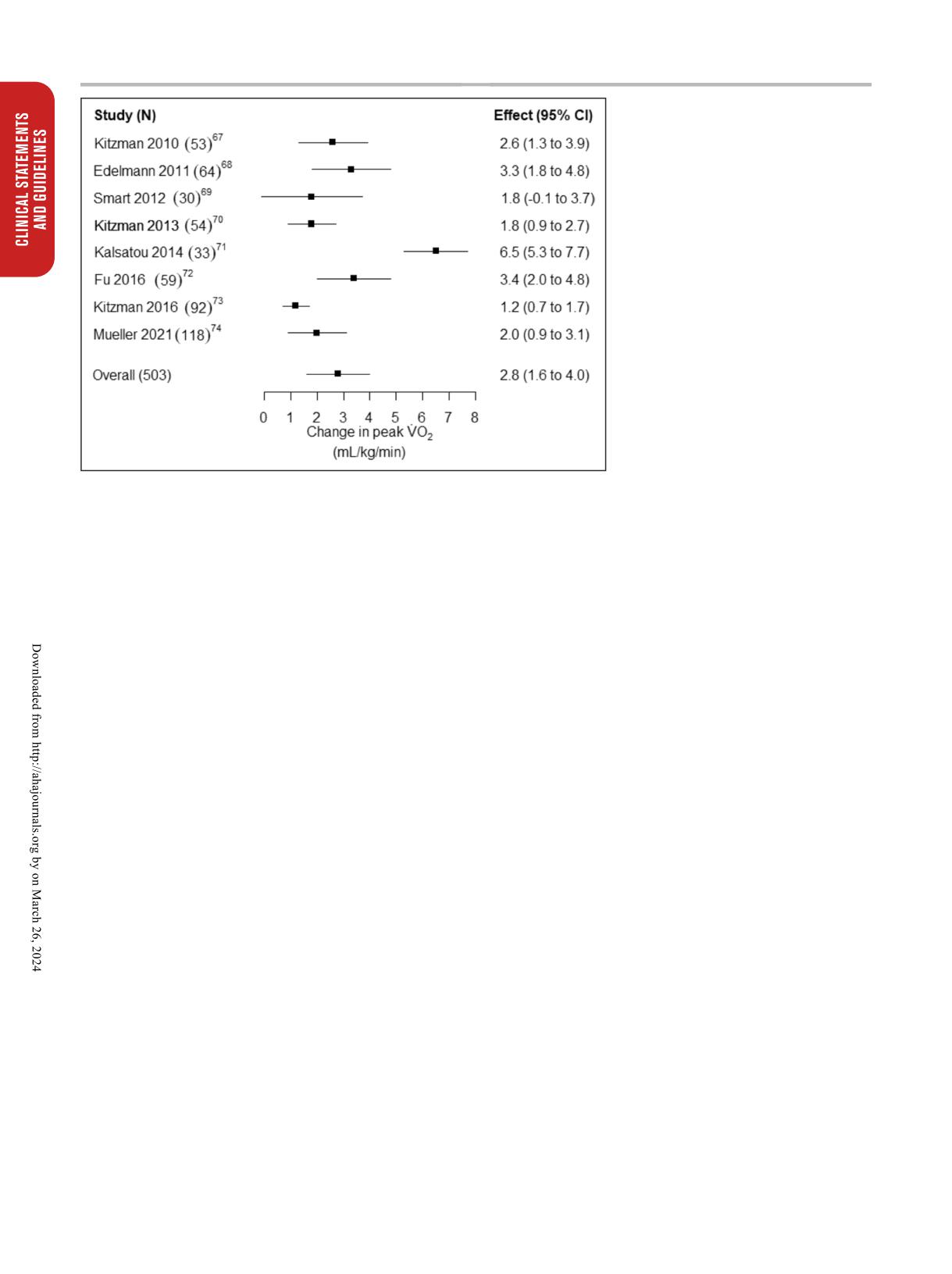
absolute treatment effect, 2.5 mL∙kg-1∙min-1; DerSimonian-
improvements after SET.68,71,72,74,77 Effect sizes from previ-
Laird92 meta-analysis treatment effect, 2.8 mL∙kg-1∙min-1;
ous meta-analyses79-81,93,94 also show varied results, with
Figure 2; Supplemental Table 1 provides details). Among
improvement (decrease) in Minnesota Living With Heart
the 6 studies that used EF ≥50% for the definition of
Failure Questionnaire scores ranging from 4.0 to 9.1
HFpEF, baseline peak Vo2 in patients randomized to SET
units from baseline to follow-up.
Circulation. 2023;147:e699-e715. DOI: 10.1161/CIR.0000000000001122
April 18, 2023 e705
Sachdev et al
Supervised Exercise Training for Chronic HFpEF
Figure 2. Forest plot of peak Vo2
increase in randomized exercise
training trials in chronic HFpEF.
HFpEF indicates heart failure with
preserved ejection fraction.
Cardiovascular and Peripheral Effects of SET
proved survival in patients with and without cardiovas-
cular disease98,99; however, this relationship has not
Multiple studies have examined the cardiovascular and pe-
been systematically examined in patients with HFpEF.
ripheral effects of SET in patients with HFpEF to better un-
To clarify this outcome, some studies of home-based
derstand the mechanisms underlying the pleiotropic effects
exercise training in HFpEF have explored its impact
(Figure 1). Among studies that examined alterations in select-
on clinical events. Although none of the studies had
ed cardiac parameters, some reported no change,67,69,70,73,74,87
adequate statistical power, a recent pilot study of 50
whereas others found improvement in diastolic function
patients86 reported fewer hospitalizations in the ex-
measures.68,72,75-77,88 In an observational study in which 7 of
ercise intervention group. Similarly, a rehabilitation
11 patients with HFpEF underwent cardiac catheterization
program that included home-based exercise in 85
before and after 12 months of SET,97 there was no discern-
patients with HFpEF showed a trend toward fewer
ible impact on left ventricular filling pressures or pressure-
cardiac events in the exercise training group.88 The
volume loops, suggesting that ventricular compliance and
inadequacy of current data highlights the need for
cardiac index remained largely unchanged.
larger-scale, longer-term studies to examine the ef-
Peripheral measures of flow-mediated dilation and
fects of SET on clinical events in HFpEF.
arterial stiffness in patients with HFpEF have dem-
onstrated abnormalities at baseline but no significant
changes in large-vessel function after SET.70,73,76 Stud-
Safety of SET in Chronic, Stable HFpEF
ies evaluating peripheral adaptations have reported
Although regular physical activity reduces the risk of car-
increases in peak arteriovenous O2 difference after
diovascular disease, vigorous physical activity, particularly
SET with no significant changes in peak exercise car-
when episodic and performed by unfit, inactive individu-
diac output or stroke volume.65,72 These findings suggest
als with known or occult coronary artery disease, can
that improvements in peak Vo2 after SET are attributable
trigger acute cardiovascular events.100 Nonetheless, the
predominantly to peripheral adaptations (eg, increased
safety of SET has been consistently demonstrated in se-
mitochondrial density and function, myoglobin content,
lected middle-aged and older patients with chronic, sta-
capillary density, blood flow redistribution) that result in
ble HFpEF. A meta-analysis of 276 patients from 6 RCTs
increased diffusion capacity and oxygen extraction by
reported no exercise-related major adverse events.79 Two
the exercising muscles.61,66 These improvements in the
of the trials noted occasional minor, although expected,
skeletal muscle myopathy of HFpEF are not unexpected
adverse exercise responses (eg, palpitations, musculo-
and represent a promising target for novel interventions
skeletal discomfort, transient hypoglycemia).68,70 Studies
because skeletal muscle has a much greater capacity for
of home-based exercise training reported no serious
repair and regeneration after SET than cardiac muscle.61
events. The safety of exercise in these studies may be at-
tributed partly to the careful selection of clinically stable
Effect of SET on Clinical Outcomes
patients with compensated chronic HF, no recent hospi-
Higher aerobic exercise capacity is associated with
talization, and monitoring and medical supervision during
fewer subsequent cardiovascular events and im-
exercise.
e706
April 18, 2023
Circulation. 2023;147:e699-e715. DOI: 10.1161/CIR.0000000000001122
Sachdev et al
Supervised Exercise Training for Chronic HFpEF
Adherence to SET and Long-Term Maintenance
Alternative Exercise Training Models: Home-
Data on patient adherence to the exercise program
Based and Hybrid Exercise Training
were provided in 7 of the 11 SET trials summarized
To the best of our knowledge, only 4 trials of home-based
here. Completion rates ranged from 84% to 90% in 5
exercise training for patients with chronic HFpEF have
studies.67,70,71,73,76 One study reported that one-third of
been published (Supplemental Table 1).86-89 All reported
patients completed >90% of sessions and half com-
improved exercise capacity and quality-of-life metrics.
pleted 70% to 90%,68 and the largest study (OptimEx-
However, because of the short duration (3-6 months)
Clin) reported that 80% of the HIIT group and 76%
and small number of exercising subjects (n=67) includ-
of the MCT group completed >70% of the exercise
ed, the safety and efficacy of these training regimens
sessions.74 Interventions to promote uptake and ad-
remain unproven. Home-based CR is a relatively new
herence to exercise-based therapy may require tar-
strategy that incorporates remote coaching and supervi-
geting of patient-specific barriers to enrollment and
sion of exercise interventions that may be used alone or
participation.101
in combination with facility-based training (hybrid CR). To
Most SET trials have been relatively short term (3-6
date, no studies have compared these 2 approaches in
months) and were unable to address long-term adher-
patients with HFpEF. Hybrid models, in which patients
ence. Indeed, an important limitation of these studies
participate initially in medically supervised followed by
is the relatively poor long-term maintenance of benefit,
home-based activities, may reduce cost and enhance ac-
partly the result of challenges associated with continued
cessibility for eligible patients.102 The widespread avail-
patient adherence.41 In the SET trial with the longest
ability of activity trackers, smartphones, telehealth, and
duration,76 an 8-month HIIT regimen improved peak Vo2,
internet-based programs markedly enhances the abil-
whereas MCT showed no improvement.76 In the recent
ity to monitor patient adherence to, responses to, and
OptimEx-Clin trial, which had a home-based exercise
progress in home-based CR programs. Future research
phase for months 4 to 12, adherence decreased to
is needed to evaluate integration of other technology ap-
56% of the HIIT group and 60% of the MCT group
plications and novel strategies and to assess their impact
completing >70% of sessions by 12 months. Long-
on patient adherence and outcomes.
term adherence to exercise training remains a critical
challenge regardless of the regimen used and should
be addressed in future studies.
CURRENT APPLICATIONS OF EXERCISE-
BASED THERAPIES FOR HFpEF AND
Effect of Combining SET and Caloric Restriction
COMPARISON WITH OTHER CONDITIONS
Given the high prevalence of the obese HFpEF pheno-
There are several types of exercise-based therapies.
type and well-documented adverse effects of excess
Self-directed exercise training is performed without
adiposity on aerobic exercise capacity, interventions
supervision and with no formal exercise prescription.
combining SET and caloric restriction may have inde-
Contemporary guidelines for all Americans recommend
pendent and additive benefits in this population. In a
≥150 min/wk of moderate-intensity physical activity
single-center 2×2 factorial trial of obese patients with
(eg, 30 minutes on 5 d/wk) and ≥2 d/wk of muscle-
HFpEF (body mass index ≥30 kg/m2) who were ≥60
strengthening activities.103 However, there are no data
years of age and randomized to caloric restriction, SET,
on the safety and efficacy of self-directed exercise in
both, or neither, Kitzman et al73 found that caloric re-
patients with HFpEF, who have far greater functional im-
striction (ie, ≈400 fewer kcal/d for 20 weeks) resulted
pairments, symptomatology, and cardiovascular risk.
in significantly greater weight loss compared with no
In clinical practice, SET is prescribed by health care
restriction (-7 kg [95% CI, -9 to -5]; P<0.001). Ex-
professionals to improve both aerobic exercise capacity
ercise also resulted in significantly greater weight loss
and quality of life. It is most often conducted in a clini-
than no exercise (-3 kg [95% CI, -5 to -1]; P<0.001)
cal setting with monitoring and typically includes at least
and significantly improved indices of inflammation
3 sessions per week of aerobic-type exercises such as
and cardiac remodeling. Peak Vo2 improved similarly
walking on a treadmill or stationary cycling. Other types
with caloric restriction (1.3 mL∙kg-1∙min-1 [95% CI,
of activities such as muscle strengthening may also be
0.8-1.8]; P<0.001) and SET (1.2 mL∙kg-1∙min-1 [95%
included, and 36 visits are generally prescribed/allowed
CI, 0.7-1.7]; P<0.001). Both diet and SET resulted in
by third-party payers within a 12-week period. Structured
significant improvement in HF-specific quality-of-life
disease management interventions are not included in
measures by the Kansas City Cardiomyopathy Ques-
this model.
tionnaire, and the combination of caloric restriction
Exercise-based CR combines SET with education
and SET doubled the improvement in peak Vo2 (2.5
that targets risk factor modification, tailored behavioral
mL∙kg-1∙min-1); exercise time and 6MWD also showed
interventions and counseling, psychosocial assessments,
large improvements.
and outcome (eg, clinical, behavioral, physiological)
Circulation. 2023;147:e699-e715. DOI: 10.1161/CIR.0000000000001122
April 18, 2023 e707
Sachdev et al
Supervised Exercise Training for Chronic HFpEF
assessment. For covered conditions, the Centers for
HF-ACTION showed a modest, statistically significant
Medicare & Medicaid Services (CMS) typically allows 36
improvement (0.6 mL∙kg-1∙min-1 [4%]) in peak Vo2 with
CR visits over a 36-week period, thus providing patients
exercise training. This effect size, which is at the lower
with more flexibility over time.
end of a clinically meaningful change, was likely attenu-
To illustrate the different SET therapies possible for
ated by suboptimal adherence; moreover, improvement in
patients with HFpEF, we describe the exercise models
quality of life was also observed.107 Although interstudy
that are currently part of guideline-based therapy and
comparisons should be interpreted with caution, SET
are covered by Medicare for 2 other patient populations
studies in HFpEF have generally shown larger increases
who present with similar clinical challenges (eg, multiple
in peak Vo2 (≈14%), above the clinically meaningful
comorbidities, exercise intolerance). Specifically, patients
threshold of a 6% to 7% increase.95 In the only trial
with chronic, stable HFrEF have been eligible for exer-
directly comparing the effects of SET in older patients
cise-based CR coverage since
2014.104 However,
with chronic HFpEF and those with chronic HFrEF, at the
patients with HFpEF were specifically excluded from
4-month follow-up, there was a large, significant peak Vo2
Medicare coverage because of insufficient evidence at
improvement in HFpEF but not in HFrEF (18.7±17.6%
that time. Patients with symptomatic peripheral artery
versus -0.3±15.4%; P<0.001).108 Overall, available data
disease (PAD) have been eligible specifically for SET
suggest that the magnitude of improvement in exercise
coverage as defined by CMS since 2017.105 It is notable
capacity from SET in patients with chronic HFpEF is at
that CMS reimbursement approvals of exercise therapy,
least as great as and potentially greater than that seen in
including exercise-based CR programs for most condi-
patients with chronic HFrEF.
tions (ie, coronary artery disease, PAD, and HFrEF), were
based primarily on SET trials alone. As described, there
Comparison of SET Trials in Chronic HFpEF
is now considerable evidence for the safety and efficacy
With Trials in PAD
of SET for patients with chronic, stable HFpEF, including
exercise capacity improvements that appear similar to or
The current status of SET for patients with HFpEF is
greater than those observed in patients with HFrEF.
chronologically similar to that for patients with PAD 4 to 5
years ago. Numerous studies had consistently demonstrat-
ed a benefit in walking distance after SET in patients with
How HFpEF and HFrEF Trials Compare
PAD and intermittent claudication (Supplemental Table 2).
After many single-site studies demonstrated the benefits
In 2017, the CMS evaluated evidence on the effects of
of SET on exercise capacity in patients with HFrEF, the
SET compared with usual care in patients with PAD and
multicenter HF-ACTION trial (Heart Failure and a Con-
found that “absolute change in maximum walking distance
trolled Trial to Investigate Outcomes of Exercise Training)
and quality of life were considered the most important out-
was implemented to determine the effect of aerobic ex-
comes in measuring the success of exercise therapy.”105
ercise training on clinical outcomes. This trial randomized
On the basis of these outcomes, the CMS approved SET
2331 patients with chronic HFrEF to usual care compared
coverage for patients with PAD and intermittent clau-
with usual care plus 36 supervised exercise sessions fol-
dication.105 The American Heart Association/American
lowed by home exercise training.41 All-cause death or hos-
College of Cardiology clinical practice guidelines also rec-
pitalization was nonsignificantly reduced in the exercise
ommend SET as first-line therapy for this patient subset to
group compared with the usual care group (hazard ratio,
improve functional status and quality of life and to reduce
0.93 [95% CI, 0.84-1.02]; P=0.13). After adjustment for
symptomatology.109 Medically supervised PAD exercise
highly prognostic baseline characteristics chosen by a pre-
programs are typically conducted in hospitals or associ-
specified, treatment-blinded selection algorithm, exercise
ated outpatient facilities, most often within the constructs
training was associated with a significant reduction in this
of a comprehensive CR service.109 The current evidence
combined end point (0.89 [95% CI, 0.81-0.99]; P=0.03).
supporting improvements in exercise capacity and qual-
Largely on the basis of these findings, the American Heart
ity of life after SET in patients with HFpEF closely paral-
Association/American College of Cardiology established
lels that for PAD and supports the rationale for extending
SET as a Class 1 recommendation for the treatment of
exercise-based therapy to patients with HFpEF.
patients with HF (regardless of EF criteria), and HFrEF
was added by the CMS as an indication for CR that is cov-
ered for Medicare beneficiaries.104 However, subsequent
IMPLEMENTATION OF CURRENT
meta-analyses in chronic HFrEF have shown conflicting
KNOWLEDGE, EXISTING GAPS, AND
results, with 1 analysis of 18 trials showing no signifi-
FUTURE RESEARCH DIRECTIONS
cant difference in death or hospitalizations106 and another
showing some reduction in hospitalizations,78 thus shifting
The strength of currently available data on SET for chronic,
the focus of SET benefits back to improvement of exer-
stable HFpEF and the paucity of effective pharmacologi-
cise capacity and quality of life.
cal therapies provide substantial rationale for increasing
e708
April 18, 2023
Circulation. 2023;147:e699-e715. DOI: 10.1161/CIR.0000000000001122
Sachdev et al
Supervised Exercise Training for Chronic HFpEF
populations; using innovative technology to facilitate
Table 2. Critical Gaps in Exercise-Based Therapy in HFpEF
cost-effectiveness; and implementing larger, longer-
Recommended focus areas for future trials
term trials to determine the potential effect of exercise-
Setting: supervised, community based, home based, or hybrid
based therapies on hospitalization, death, cardiovascular
Modalities: HIIT, continuous aerobic training, strength training, or combi-
events, and health care expenditures. Our meta-analysis
nation
included only 2 studies that enrolled both patients with
Combination with other lifestyle interventions or medications: dietary
weight loss, comprehensive CR, or ET alone
HFpEF and patients with HF with mildly reduced EF
according to current definitions. Therefore, more studies
Strategies for long-term adherence: most trials are short-term and long-
term maintenance is modest
on the HF with mildly reduced EF subgroup may help
clarify their response to SET. Although there is sufficient
Strategies to increase accessibility: particularly for underresourced populations
evidence to support improvement in exercise capacity
Minimize costs: can specific settings/modalities improve access and
minimize costs
with exercise-based treatments in patients with HFpEF,
there may also be a role for these interventions in the
Role in management of recently hospitalized, older adults: frailty, impaired
balance, and cognition may require innovative interventions
prevention of HFpEF. Further studies of SET and home-
based exercise to prevent the development of HFpEF in
Effect on clinical events (hospitalization, death): larger studies and long-
term follow-up are necessary
patients with multiple risk factors are warranted.
Preventing the development of HFpEF: supervised or home-based train-
An additional key evidence gap concerns the use of
ing in patients with multiple risk factors
exercise therapy in patients recently hospitalized with
CR indicates cardiac rehabilitation; ET, exercise training; HFpEF, heart failure
acute, decompensated HF, a high-risk population distinct
with preserved ejection fraction; and HIIT, high-intensity interval training.
from those with chronic, stable HF. Such patients have high
rates of frailty (>90%) and marked impairments in bal-
efforts to promote and implement exercise-based thera-
ance, mobility, and strength, in addition to poor endurance,20
pies for this large, inadequately treated, growing patient
which is the primary domain impairment in chronic, stable
population. Many RCTs have demonstrated that SET is
HF. Exposing such patients to standard SET can potentially
safe and effective for the entire spectrum of chronic HF,
limit efficacy and increase injuries and falls.111 In the recent
including HFpEF. Implementation efforts are warranted
REHAB-HF trial (Rehabilitation Therapy in Older Acute
and include frameworks for improving referral rates, strat-
Heart Failure Patients), which included patients with HFrEF
egies to increase access to exercise-based programs,
and HFpEF, a novel, tailored, progressive, transitional, mul-
and methods to facilitate adherence. Exercise training
tidomain physical rehabilitation intervention initiated during
is significantly underused in patients with HF, with much
hospitalization improved frailty, physical function, and qual-
lower participation among women and Black patients
ity of life but had no significant effect on rehospitalization
highlighting existing disparities.110 Several strategies have
or death.112 A secondary analysis of the trial found that at
been proposed to address this implementation gap, in-
baseline, among the 53% of patients with HFpEF, frailty,
cluding educating patients and physicians about the ben-
physical function, and quality of life were significantly worse
efits of SET, addressing logistical and social determinants
than in those with HFrEF, and benefits appeared greater in
of health challenges for patients and communities, and
patients with HFpEF.19 There also appeared to be a trend
broadening criteria for referrals and reimbursement.110
for reduced rehospitalization and death in patients with
Simultaneously, additional research is needed to
HFpEF but not in those with HFrEF.19 However, this was
extend access to exercise-based therapy for patients
an exploratory analysis of an underpowered, phase 2 trial;
with HFpEF. Although implementation of SET for chronic,
a larger trial is needed to definitively test this novel reha-
stable HFpEF appears reasonable on the basis of the
bilitation strategy for patients recently hospitalized with
considerable volume of data, available evidence on the
acute HFpEF.19 A recently instituted National Institutes of
safety and efficacy of exercise therapy in other settings
Health-sponsored multicenter, RCT (NCT05525663) is
such as community and home-based programs is more
specifically designed to address this key gap.
limited and is especially important for underrepresented
groups. The coronavirus disease 2019 (COVID-19) pan-
CONCLUSIONS
demic has increased the urgency of defining alterna-
tive rehabilitation delivery models that are effective for
Improved management of the large, inadequately treated
patients with chronic HF. These are key areas of focus
population of patients with HFpEF represents an urgent
for future research efforts. Additional important evidence
unmet need. HFpEF prevalence continues to increase
gaps include the following (Table 2): clarifying the opti-
as a result of aging of the population and the growing
mal exercise modalities; delineating the independent and
prevalence of risk factors such as obesity and diabetes.
additive benefits of combining exercise interventions with
It is now well accepted that despite similar clinical pre-
other lifestyle interventions and medications; identifying
sentations for all patients with HF, HFrEF and HFpEF
strategies to increase long-term adherence; improving
are mechanistically distinct diseases. In support of this
accessibility of these interventions to underresourced
concept is the lack of efficacy of multiple drug classes
Circulation. 2023;147:e699-e715. DOI: 10.1161/CIR.0000000000001122
April 18, 2023 e709

Sachdev et al
Supervised Exercise Training for Chronic HFpEF
in HFpEF trials although they had been proven effec-
ARTICLE INFORMATION
tive in patients with HFrEF. HFpEF is a complex and
The American Heart Association and the American College of Cardiology make
heterogeneous clinical syndrome with pathophysiologi-
every effort to avoid any actual or potential conflicts of interest that may arise as
a result of an outside relationship or a personal, professional, or business interest
cal mechanisms linked to chronic systemic inflammation
of a member of the writing panel. Specifically, all members of the writing group
and metabolic stress from comorbid conditions. Although
are required to complete and submit a Disclosure Questionnaire showing all such
outcomes remain poor for all patients with HF, population
relationships that might be perceived as real or potential conflicts of interest.
This document was approved by the American Heart Association Science Ad-
and clinical trials of chronic, stable HFpEF show lower
visory and Coordinating Committee September 12, 2022, and the American Heart
death and cardiovascular hospitalization rates compared
Association Executive Committee September 26, 2022, and the American College
with HFrEF, making a large clinical trial for these events
of Cardiology Clinical Policy Approval Committee September 26, 2022.
The American Heart Association requests that this document be cited as
in HFpEF more challenging.
follows: Sachdev V, Sharma K, Keteyian SJ, Alcain CF, Desvigne-Nickens P, Fleg
Our review demonstrates that in multiple RCTs of SET
JL, Florea VG, Franklin BA, Guglin M, Halle M, Leifer ES, Panjrath G, Tinsley EA,
in selected patients with chronic, stable HFpEF, exer-
Wong RP, Kitzman DW; on behalf of the American Heart Association Heart Fail-
ure and Transplantation Committee of the Council on Clinical Cardiology; Council
cise is safe and provides substantial, clinically relevant
on Arteriosclerosis, Thrombosis and Vascular Biology; and American College of
improvements in aerobic exercise capacity and quality of
Cardiology. Supervised exercise training for chronic heart failure with preserved
life. Surveys in older patients have shown that they value
ejection fraction: a scientific statement from the American Heart Association
and American College of Cardiology. Circulation. 2023;147:e699-e715. doi:
these as important outcomes, and these outcomes are
10.1161/CIR.0000000000001122
considered to be appropriate end points for drug devel-
This article has been copublished in the Journal of the American College of
opment by the US Food and Drug Administration. The
Cardiology.
Copies: This document is available on the websites of the American Heart
magnitude of benefits on exercise capacity and quality of
Association (professional.heart.org) and the American College of Cardiology
life appears comparable to or potentially greater than that
(www.acc.org). A copy of the document is also available at https://professional.
for other cardiovascular conditions (eg, HFrEF, PAD) for
heart.org/statements by selecting the “Guidelines & Statements” button. To
purchase additional reprints, call 215-356-2721 or email Meredith.Edelman@
which exercise-based therapies (eg, CR) are now typically
wolterskluwer.com.
covered by third-party payers such as Medicare. These
The expert peer review of AHA-commissioned documents (eg, scientific
findings highlight the importance of exercise-based ther-
statements, clinical practice guidelines, systematic reviews) is conducted by the
AHA Office of Science Operations. For more on AHA statements and guidelines
apies for chronic, stable HFpEF and for pursuing referral,
development, visit https://professional.heart.org/statements. Select the “Guide-
adherence, and coverage efforts during implementation.
lines & Statements” drop-down menu near the top of the webpage, then click
Future research should focus on maximizing the benefits
“Publication Development.”
Permissions: Multiple copies, modification, alteration, enhancement, and dis-
and accessibility of SET for chronic HFpEF; extending its
tribution of this document are not permitted without the express permission of the
availability to medically supervised group, home-based,
American Heart Association. Instructions for obtaining permission are located at
and hybrid CR settings; and addressing common barriers
Form” appears in the second paragraph (https://www.heart.org/en/about-us/
to long-term adherence.
statements-and-policies/copyright-request-form).
Disclosures
Writing Group Disclosures
Writing
Other
Speakers’
group
research
bureau/
Expert
Ownership
Consultant/
member
Employment
Research grant
support
honoraria
witness
interest
advisory board
Other
Vandana
National Heart, Lung, and
None
None
None
None
None
None
None
Sachdev
Blood Institute
Kavita
Johns Hopkins University
Amgen (research
None
Amgen*;
None
None
Alleviant (unpaid)*;
None
Sharma
School of Medicine
grant funding)†;
Bayer*;
AstraZeneca*;
AHA†
Janssen*
Bayer*; Boehringer-
Ingelheim*; Novar-
tis*; NovoNordisk*;
RIVUS*
Charina F.
University of Chicago
None
None
None
None
None
None
None
Alcain
Patrice
National Heart, Lung, and
None
None
None
None
None
None
None
Desvigne-
Blood Institute
Nickens
Jerome L.
National Heart, Lung, and
None
None
None
None
None
None
None
Fleg
Blood Institute
Viorel G.
Minneapolis VA Health Care
None
None
None
None
None
None
None
Florea
System
(Continued )
e710
April 18, 2023
Circulation. 2023;147:e699-e715. DOI: 10.1161/CIR.0000000000001122

Sachdev et al
Supervised Exercise Training for Chronic HFpEF
Writing Group Disclosures Continued
Writing
Other
Speakers’
group
research
bureau/
Expert
Ownership
Consultant/
member
Employment
Research grant
support
honoraria
witness
interest
advisory board
Other
Barry A.
Beaumont Health Preventive
None
None
None
None
None
None
None
Franklin
Cardiology and Cardiac Re-
habilitation
Maya Guglin
Indiana University
None
None
None
None
None
None
None
Martin Halle
Technische Universitaet
NIH (clinical trial)†
None
None
None
None
None
Medical Park
Muenchen (Germany)
Rehabilitation
Group (medical
supervisor)†
Steven J.
Henry Ford Health
NIH (clinical trial)†
None
None
None
None
Abt, Inc†
None
Keteyian
Dalane W.
Wake Forest University
Novo Nordisk
None
None
None
NIH*; Novo Nord-
None
Kitzman
School of Medicine
(clinical trial)†; NIH
isk†; Rivus† Boeh-
(funded clinical
ringer-Ingleheim†;
studies)†; Rivus
Astra Zeneca†
(clinical trial)†; Pfiz-
er (clinical study)†;
Astra Zeneca (clini-
cal study)†; Bayer
(clinical study)†
Eric S. Leifer
National Heart, Lung, and
None
None
None
None
None
None
None
Blood Institute
Gurusher
George Washington Uni-
None
None
None
Defen-
None
None
None
Panjrath
versity
dant†
Emily A.
National Heart, Lung, and
None
None
None
None
None
None
None
Tinsley
Blood Institute
Renee P.
National Heart, Lung, and
None
None
None
None
None
None
None
Wong
Blood Institute
This table represents the relationships of writing group members that may be perceived as actual or reasonably perceived conflicts of interest as reported on the
Disclosure Questionnaire, which all members of the writing group are required to complete and submit. A relationship is considered to be “significant” if (a) the person
receives $5000 or more during any 12-month period, or 5% or more of the person’s gross income; or (b) the person owns 5% or more of the voting stock or share of the
entity, or owns $5000 or more of the fair market value of the entity. A relationship is considered to be “modest” if it is less than “significant” under the preceding definition.
*Modest.
†Significant.
Reviewer Disclosures
Other
Speakers’
Consultant/
Research
research
bureau/
Expert
Ownership
advisory
Reviewer
Employment
grant
support
honoraria
witness
interest
board
Other
Susan D’Anna
Dartmouth Hitchcock Medical Center
None
None
None
None
None
None
None
Nasrien Ibrahim
Massachusetts General Hospital
None
None
None
None
None
None
None
Richard Josephson
University Hospitals
None
None
None
None
None
None
None
Ran Lee
Cleveland Clinic Foundation
None
None
None
None
None
None
None
Ambarish Pandey
University of Texas Southwestern
None
None
None
None
None
None
None
Medical Center
David Whellan
Thomas Jefferson University
None
None
None
None
None
None
None
This table represents the relationships of reviewers that may be perceived as actual or reasonably perceived conflicts of interest as reported on the Disclosure
Questionnaire, which all reviewers are required to complete and submit. A relationship is considered to be “significant” if (a) the person receives $5000 or more during
any 12-month period, or 5% or more of the person’s gross income; or (b) the person owns 5% or more of the voting stock or share of the entity, or owns $5000 or
more of the fair market value of the entity. A relationship is considered to be “modest” if it is less than “significant” under the preceding definition.
2. Heidenreich PA, Bozkurt B, Aguilar D, Allen LA, Byun JJ, Colvin MM,
REFERENCES
Deswal A, Drazner MH, Dunlay SM, Evers LR, et al. 2022 AHA/ACC/
HFSA guideline for the management of heart failure: a report of the
1. Bozkurt B, Coats AJ, Tsutsui H, Abdelhamid M, Adamopoulos S, Albert
American College of Cardiology/American Heart Association Joint Com-
N, Anker SD, Atherton J, Bohm M, Butler J, et al. Universal definition
mittee on Clinical Practice Guidelines [published corrections appear in
and classification of heart failure: a report of the Heart Failure Society of
Circulation. 2022;145:e1033 and Circulation. 2022;146:e185]. Circulation.
America, Heart Failure Association of the European Society of Cardiol-
2022;145:e895-e1032. doi: 10.1161/CIR.0000000000001063
ogy, Japanese Heart Failure Society and Writing Committee of the Uni-
3. Virani SS, Alonso A, Benjamin EJ, Bittencourt MS, Callaway CW, Carson AP,
versal Definition of Heart Failure. J Card Fail. 2021;27:P387-P413. doi:
Chamberlain AM, Chang AR, Cheng S, Delling FN, et al; American Heart
10.1016/j.cardfail.2021.01.022
Circulation. 2023;147:e699-e715. DOI: 10.1161/CIR.0000000000001122
April 18, 2023 e711
Sachdev et al
Supervised Exercise Training for Chronic HFpEF
Association Council on Epidemiology and Prevention Statistics Committee
with acute decompensated heart failure with preserved versus reduced
and Stroke Statistics Subcommittee. Heart disease and stroke statis-
ejection fraction. Circ Heart Fail. 2018;11:e005254. doi: 10.1161/
tics-2020 update: a report from the American Heart Association. Circula-
CIRCHEARTFAILURE.118.005254
tion. 2020;141:e139-e596. doi: 10.1161/CIR.0000000000000757
21.
US Food and Drug Administration. Treatment for heart failure: endpoints for
4.
Upadhya B, Pisani B, Kitzman DW. Evolution of a geriatric syndrome: patho-
drug development guidance for industry. 2019. Accessed September 21,
physiology and treatment of heart failure with preserved ejection fraction. J
Am Geriatr Soc. 2017;65:2431-2440. doi: 10.1111/jgs.15141
22.
Solomon SD, McMurray JJV, Anand IS, Ge J, Lam CSP, Maggioni AP,
5.
Sharma K, Kass DA. Heart failure with preserved ejection fraction: mecha-
Martinez F, Packer M, Pfeffer MA, Pieske B, et al; PARAGON-HF Inves-
nisms, clinical features, and therapies. Circ Res. 2014;115:79-96. doi:
tigators and Committees. Angiotensin-neprilysin inhibition in heart failure
10.1161/CIRCRESAHA.115.302922
with preserved ejection fraction. N Engl J Med. 2019;381:1609-1620. doi:
6.
Pandey A, Shah SJ, Butler J, Kellogg DL Jr, Lewis GD, Forman DE,
10.1056/NEJMoa1908655
Mentz RJ, Borlaug BA, Simon MA, Chirinos JA, et al. Exercise intoler-
23.
Pfeffer MA, Claggett B, Assmann SF, Boineau R, Anand IS, Clausell N,
ance in older adults with heart failure with preserved ejection fraction:
Desai AS, Diaz R, Fleg JL, Gordeev I, et al. Regional variation in patients
JACC state-of-the-art review. J Am Coll Cardiol. 2021;78:1166-1187. doi:
and outcomes in the Treatment of Preserved Cardiac Function Heart Failure
10.1016/j.jacc.2021.07.014
With an Aldosterone Antagonist (TOPCAT) trial. Circulation. 2015;131:34-
7.
Shah SJ, Borlaug BA, Kitzman DW, McCulloch AD, Blaxall BC, Agarwal R,
42. doi: 10.1161/CIRCULATIONAHA.114.013255
Chirinos JA, Collins S, Deo RC, Gladwin MT, et al. Research priorities for
24.
Anker SD, Butler J, Filippatos G, Ferreira JP, Bocchi E, Böhm M, Brunner-
heart failure with preserved ejection fraction: National Heart, Lung, and
La Rocca HP, Choi DJ, Chopra V, Chuquiure-Valenzuela E, et al; EMPEROR-
Blood Institute Working Group summary. Circulation. 2020;141:1001-
Preserved Trial Investigators. Empagliflozin in heart failure with a preserved
1026. doi: 10.1161/CIRCULATIONAHA.119.041886
ejection fraction. N Engl J Med. 2021;385:1451-1461. doi: 10.1056/
8.
Steinberg BA, Zhao X, Heidenreich PA, Peterson ED, Bhatt DL, Cannon CP,
NEJMoa2107038
Hernandez AF, Fonarow GC; Get With The Guidelines Scientific Advisory Com-
25.
Solomon SD, McMurray JJV, Claggett B, de Boer RA, DeMets D,
mittee and Investigators. Trends in patients hospitalized with heart failure and
Hernandez AF, Inzucchi SE, Kosiborod MN, Lam CSP, Martinez F, et
preserved left ventricular ejection fraction: prevalence, therapies, and outcomes.
al; DELIVER Trial Committees and Investigators. Dapagliflozin in heart
Circulation. 2012;126:65-75. doi: 10.1161/CIRCULATIONAHA.111.080770
failure with mildly reduced or preserved ejection fraction. N Engl J Med.
9.
Kitzman DW. Outcomes in patients with heart failure with preserved ejection
2022;387:1089-1098. doi: 10.1056/NEJMoa2206286
fraction: it is more than the heart. J Am Coll Cardiol. 2012;59:1006-1007.
26.
Upadhya B, Hundley WG, Brubaker PH, Morgan TM, Stewart KP, Kitzman
doi: 10.1016/j.jacc.2011.12.011
DW. Effect of spironolactone on exercise tolerance and arterial function in
10.
Shah SJ, Kitzman DW, Borlaug BA, van Heerebeek L, Zile MR, Kass DA,
older adults with heart failure with preserved ejection fraction. J Am Geriatr
Paulus WJ. Phenotype-specific treatment of heart failure with preserved
Soc. 2017;65:2374-2382. doi: 10.1111/jgs.14940
ejection fraction: a multiorgan roadmap. Circulation. 2016;134:73-90. doi:
27.
Pieske B, Wachter R, Shah SJ, Baldridge A, Szeczoedy P, Ibram G, Shi V, Zhao
10.1161/CIRCULATIONAHA.116.021884
Z, Cowie MR; PARALLAX Investigators and Committee Members. Effect of
11.
Upadhya B, Rocco M, Lewis CE, Oparil S, Lovato LC, Cushman WC, Bates
sacubitril/valsartan vs standard medical therapies on plasma NT-proBNP
JT, Bello NA, Aurigemma G, Fine LJ, et al; SPRINT Research Group. Ef-
concentration and submaximal exercise capacity in patients with heart fail-
fect of intensive blood pressure treatment on heart failure events in the
ure and preserved ejection fraction: the PARALLAX randomized clinical trial.
Systolic Blood Pressure Reduction Intervention Trial. Circ Heart Fail.
JAMA. 2021;326:1919-1929. doi: 10.1001/jama.2021.18463
2017;10:e003613. doi: 10.1161/CIRCHEARTFAILURE.116.003613
28.
Abraham WT, Lindenfeld J, Ponikowski P, Agostoni P, Butler J, Desai AS,
12.
Pandey A, Patel KV, Vaduganathan M, Sarma S, Haykowsky MJ, Berry JD,
Filippatos G, Gniot J, Fu M, Gullestad L, et al. Effect of empagliflozin on
Lavie CJ. Physical activity, fitness, and obesity in heart failure with pre-
exercise ability and symptoms in heart failure patients with reduced and
served ejection fraction. JACC Heart Fail. 2018;6:975-982. doi: 10.1016/j.
preserved ejection fraction, with and without type 2 diabetes. Eur Heart J.
jchf.2018.09.006
2021;42:700-710. doi: 10.1093/eurheartj/ehaa943
13.
Kitzman DW, Nicklas BJ. Pivotal role of excess intra-abdominal adi-
29.
Nassif ME, Windsor SL, Borlaug BA, Kitzman DW, Shah SJ, Tang F, Khariton
pose in the pathogenesis of metabolic/obese HFpEF. JACC Heart Fail.
Y, Malik AO, Khumri T, Umpierrez G, et al. The SGLT2 inhibitor dapagliflozin in
2018;6:1008-1010. doi: 10.1016/j.jchf.2018.08.007
heart failure with preserved ejection fraction: a multicenter randomized trial.
14.
Hwang SJ, Melenovsky V, Borlaug BA. Implications of coronary artery dis-
Nat Med. 2021;27:1954-1960. doi: 10.1038/s41591-021-01536-x
ease in heart failure with preserved ejection fraction. J Am Coll Cardiol.
30.
Abraham WT, Adamson PB, Bourge RC, Aaron MF, Costanzo MR,
2014;63(pt A):2817-2827. doi: 10.1016/j.jacc.2014.03.034
Stevenson LW, Strickland W, Neelagaru S, Raval N, Krueger S, et al;
15.
Bekfani T, Pellicori P, Morris DA, Ebner N, Valentova M, Steinbeck L,
CHAMPION Trial Study Group. Wireless pulmonary artery haemodynamic
Wachter R, Elsner S, Sliziuk V, Schefold JC, et al. Sarcopenia in patients with
monitoring in chronic heart failure: a randomised controlled trial. Lancet.
heart failure with preserved ejection fraction: impact on muscle strength,
2011;377:658-666. doi: 10.1016/S0140-6736(11)60101-3
exercise capacity and quality of life. Int J Cardiol. 2016;222:41-46. doi:
31.
Adamson PB, Abraham WT, Bourge RC, Costanzo MR, Hasan A, Yadav
10.1016/j.ijcard.2016.07.135
C, Henderson J, Cowart P, Stevenson LW. Wireless pulmonary artery pres-
16.
Sanders NA, Supiano MA, Lewis EF, Liu J, Claggett B, Pfeffer MA, Desai
sure monitoring guides management to reduce decompensation in heart
AS, Sweitzer NK, Solomon SD, Fang JC. The frailty syndrome and out-
failure with preserved ejection fraction. Circ Heart Fail. 2014;7:935-944.
comes in the TOPCAT trial. Eur J Heart Fail. 2018;20:1570-1577. doi:
doi: 10.1161/CIRCHEARTFAILURE.113.001229
10.1002/ejhf.1308
32.
Shah SJ, Borlaug BA, Chung ES, Cutlip DE, Debonnaire P, Fail PS, Gao
17.
Pandey A, LaMonte M, Klein L, Ayers C, Psaty BM, Eaton CB, Allen NB,
Q, Hasenfuß G, Kahwash R, Kaye DM, et al; REDUCE LAP-HF II Inves-
de Lemos JA, Carnethon M, Greenland P, et al. Relationship between physi-
tigators. Atrial shunt device for heart failure with preserved and mildly
cal activity, body mass index, and risk of heart failure. J Am Coll Cardiol.
reduced ejection fraction (REDUCE LAP-HF II): a randomised, multicen-
2017;69:1129-1142. doi: 10.1016/j.jacc.2016.11.081
tre, blinded, sham-controlled trial. Lancet. 2022;399:1130-1140. doi:
18.
Pandey A, Patel KV, Bahnson JL, Gaussoin SA, Martin CK, Balasubramanyam
10.1016/S0140-6736(22)00016-2
A, Johnson KC, McGuire DK, Bertoni AG, Kitzman D, et al; Look AHEAD
33.
Borlaug BA, Blair J, Bergmann MW, Bugger H, Burkhoff D, Bruch L,
Research Group. Association of intensive lifestyle intervention, fitness, and
Celermajer DS, Claggett B, Cleland JGF, Cutlip DE, et al; REDUCE LAP-
body mass index with risk of heart failure in overweight or obese adults with
HF-II Investigators. Latent pulmonary vascular disease may alter the re-
type 2 diabetes mellitus: an analysis from the Look AHEAD trial. Circulation.
sponse to therapeutic atrial shunt device in heart failure. Circulation.
2020;141:1295-1306. doi: 10.1161/CIRCULATIONAHA.119.044865
2022;145:1592-1604. doi: 10.1161/CIRCULATIONAHA.122.059486
19.
Mentz RJ, Whellan DJ, Reeves GR, Pastva AM, Duncan P, Upadhya B,
34.
Scott JM, Haykowsky MJ, Eggebeen J, Morgan TM, Brubaker PH, Kitzman
Nelson MB, Chen H, Reed SD, Rosenberg PB, et al. Rehabilitation in-
DW. Reliability of peak exercise testing in patients with heart failure with
tervention in older patients with acute heart failure with preserved ver-
preserved ejection fraction. Am J Cardiol. 2012;110:1809-1813. doi:
sus reduced ejection fraction. JACC Heart Fail. 2021;9:747-757. doi:
10.1016/j.amjcard.2012.08.015
10.1016/j.jchf.2021.05.007
35.
Kitzman DW, Little WC, Brubaker PH, Anderson RT, Hundley WG, Marburger
20.
Warraich HJ, Kitzman DW, Whellan DJ, Duncan PW, Mentz RJ, Pastva
CT, Brosnihan B, Morgan TM, Stewart KP. Pathophysiological characteriza-
AM, Nelson MB, Upadhya B, Reeves GR. Physical function, frailty, cog-
tion of isolated diastolic heart failure in comparison to systolic heart failure.
nition, depression, and quality of life in hospitalized adults ≥60 years
JAMA. 2002;288:2144-2150. doi: 10.1001/jama.288.17.2144
e712
April 18, 2023
Circulation. 2023;147:e699-e715. DOI: 10.1161/CIR.0000000000001122
Sachdev et al
Supervised Exercise Training for Chronic HFpEF
36.
Nayor M, Houstis NE, Namasivayam M, Rouvina J, Hardin C, Shah RV, Ho JE,
53.
Haykowsky MJ, Tomczak CR, Scott JM, Paterson DI, Kitzman DW. Deter-
Malhotra R, Lewis GD. Impaired exercise tolerance in heart failure with pre-
minants of exercise intolerance in patients with heart failure and reduced
served ejection fraction: quantification of multiorgan system reserve capac-
or preserved ejection fraction. J Appl Physiol (1985). 2015;119:739-744.
ity. JACC Heart Fail. 2020;8:605-617. doi: 10.1016/j.jchf.2020.03.008
doi: 10.1152/japplphysiol.00049.2015
37.
Shafiq A, Brawner CA, Aldred HA, Lewis B, Williams CT, Tita C, Schairer
54.
Haykowsky MJ, Brubaker PH, Morgan TM, Kritchevsky S, Eggebeen J,
JR, Ehrman JK, Velez M, Selektor Y, et al. Prognostic value of cardiopul-
Kitzman DW. Impaired aerobic capacity and physical functional perfor-
monary exercise testing in heart failure with preserved ejection fraction: the
mance in older heart failure patients with preserved ejection fraction: role
Henry Ford HospITal CardioPulmonary EXercise Testing (FIT-CPX) project.
of lean body mass. J Gerontol A Biol Sci Med Sci. 2013;68:968-975. doi:
Am Heart J. 2016;174:167-172. doi: 10.1016/j.ahj.2015.12.020
10.1093/gerona/glt011
38.
Nadruz W Jr, West E, Sengeløv M, Santos M, Groarke JD, Forman DE,
55.
Kitzman DW, Nicklas B, Kraus WE, Lyles MF, Eggebeen J, Morgan TM,
Claggett B, Skali H, Shah AM. Prognostic value of cardiopulmonary exercise
Haykowsky M. Skeletal muscle abnormalities and exercise intolerance
testing in heart failure with reduced, midrange, and preserved ejection frac-
in older patients with heart failure and preserved ejection fraction. Am J
tion. J Am Heart Assoc. 2017;6:e006000. doi: 10.1161/JAHA.117.006000
Physiol Heart Circ Physiol.
2014;306:H1364-H1370. doi:
10.1152/
39.
Swank AM, Horton J, Fleg JL, Fonarow GC, Keteyian S, Goldberg L,
ajpheart.00004.2014
Wolfel G, Handberg EM, Bensimhon D, Illiou MC, et al; HF-ACTION Inves-
56.
Molina AJ, Bharadwaj MS, Van Horn C, Nicklas BJ, Lyles MF, Eggebeen
tigators. Modest increase in peak VO2 is related to better clinical outcomes
J, Haykowsky MJ, Brubaker PH, Kitzman DW. Skeletal muscle mitochon-
in chronic heart failure patients: results from Heart Failure and a Con-
drial content, oxidative capacity, and mfn2 expression are reduced in
trolled Trial to Investigate Outcomes of Exercise Training. Circ Heart Fail.
older patients with heart failure and preserved ejection fraction and are
2012;5:579-585. doi: 10.1161/CIRCHEARTFAILURE.111.965186
related to exercise intolerance. JACC Heart Fail. 2016;4:636-645. doi:
40.
Guazzi M, Dickstein K, Vicenzi M, Arena R. Six-minute walk test and car-
10.1016/j.jchf.2016.03.011
diopulmonary exercise testing in patients with chronic heart failure: a
57.
Bhella PS, Prasad A, Heinicke K, Hastings JL, Arbab-Zadeh A, Adams-Huet
comparative analysis on clinical and prognostic insights. Circ Heart Fail.
B, Pacini EL, Shibata S, Palmer MD, Newcomer BR, et al. Abnormal haemo-
2009;2:549-555. doi: 10.1161/CIRCHEARTFAILURE.109.881326
dynamic response to exercise in heart failure with preserved ejection frac-
41.
O’Connor CM, Whellan DJ, Lee KL, Keteyian SJ, Cooper LS, Ellis SJ,
tion. Eur J Heart Fail. 2011;13:1296-1304. doi: 10.1093/eurjhf/hfr133
Leifer ES, Kraus WE, Kitzman DW, Blumenthal JA, et al; HF-ACTION
58.
Haykowsky MJ, Kouba EJ, Brubaker PH, Nicklas BJ, Eggebeen J, Kitzman
Investigators. Efficacy and safety of exercise training in patients with
DW. Skeletal muscle composition and its relation to exercise intolerance
chronic heart failure: HF-ACTION randomized controlled trial. JAMA.
in older patients with heart failure and preserved ejection fraction. Am J
2009;301:1439-1450. doi: 10.1001/jama.2009.454
Cardiol. 2014;113:1211-1216. doi: 10.1016/j.amjcard.2013.12.031
42.
Keteyian SJ, Ehrman JK, Fuller B, Pack QR. Exercise testing and exercise
59.
Weiss K, Schär M, Panjrath GS, Zhang Y, Sharma K, Bottomley PA, Golozar
rehabilitation for patients with atrial fibrillation. J Cardiopulm Rehabil Prev.
A, Steinberg A, Gerstenblith G, Russell SD, et al. Fatigability, exercise intoler-
2019;39:65-72. doi: 10.1097/HCR.0000000000000423
ance, and abnormal skeletal muscle energetics in heart failure. Circ Heart
43.
Obokata M, Reddy YNV, Pislaru SV, Melenovsky V, Borlaug BA. Evidence
Fail. 2017;10:e004129. doi: 10.1161/CIRCHEARTFAILURE.117.004129
supporting the existence of a distinct obese phenotype of heart fail-
60.
Middlekauff HR. Making the case for skeletal myopathy as the major limita-
ure with preserved ejection fraction. Circulation. 2017;136:6-19. doi:
tion of exercise capacity in heart failure. Circ Heart Fail. 2010;3:537-546.
10.1161/CIRCULATIONAHA.116.026807
doi: 10.1161/CIRCHEARTFAILURE.109.903773
44.
Haykowsky MJ, Brubaker PH, John JM, Stewart KP, Morgan TM, Kitzman
61.
Kitzman DW, Haykowsky MJ, Tomczak CR. Making the case for skeletal
DW. Determinants of exercise intolerance in elderly heart failure patients
muscle myopathy and its contribution to exercise intolerance in heart fail-
with preserved ejection fraction. J Am Coll Cardiol. 2011;58:265-274. doi:
ure with preserved ejection fraction. Circ Heart Fail. 2017;10:e004281. doi:
10.1016/j.jacc.2011.02.055
10.1161/CIRCHEARTFAILURE.117.004281
45.
Pandey A, Khera R, Park B, Haykowsky M, Borlaug BA, Lewis GD,
62.
Roberts WC. An agent with lipid-lowering, antihypertensive, positive inotropic,
Kitzman DW, Butler J, Berry JD. Relative impairments in hemodynamic
negative chronotropic, vasodilating, diuretic, anorexigenic, weight-reducing,
exercise reserve parameters in heart failure with preserved ejection frac-
cathartic, hypoglycemic, tranquilizing, hypnotic and antidepressive qualities.
tion: a study-level pooled analysis. JACC Heart Fail. 2018;6:117-126. doi:
Am J Cardiol. 1984;53:261-262. doi: 10.1016/0002-9149(84)90725-2
10.1016/j.jchf.2017.10.014
63.
Fleg JL, Cooper LS, Borlaug BA, Haykowsky MJ, Kraus WE, Levine BD,
46.
Kitzman DW, Guazzi M. Impaired alveolar capillary membrane diffusion:
Pfeffer MA, Piña IL, Poole DC, Reeves GR, et al; National Heart, Lung, and
a recently recognized contributor to exertional dyspnea in heart failure
Blood Institute Working Group. Exercise training as therapy for heart failure:
with preserved ejection fraction. JACC Heart Fail. 2016;4:499-501. doi:
current status and future directions. Circ Heart Fail. 2015;8:209-220. doi:
10.1016/j.jchf.2016.03.020
10.1161/CIRCHEARTFAILURE.113.001420
47.
Kitzman DW, Haykowsky MJ. Vascular dysfunction in heart failure with
64.
Coats AJS, Forman DE, Haykowsky M, Kitzman DW, McNeil A,
preserved ejection fraction. J Card Fail. 2016;22:12-16. doi: 10.1016/j.
Campbell TS, Arena R. Physical function and exercise training in older
cardfail.2015.11.004
patients with heart failure. Nat Rev Cardiol. 2017;14:550-559. doi:
48.
Hundley WG, Kitzman DW, Morgan TM, Hamilton CA, Darty SN, Stewart
10.1038/nrcardio.2017.70
KP, Herrington DM, Link KM, Little WC. Cardiac cycle-dependent changes
65.
Haykowsky MJ, Brubaker PH, Stewart KP, Morgan TM, Eggebeen J, Kitzman
in aortic area and distensibility are reduced in older patients with isolated
DW. Effect of endurance training on the determinants of peak exercise oxy-
diastolic heart failure and correlate with exercise intolerance. J Am Coll Car-
gen consumption in elderly patients with stable compensated heart failure
diol. 2001;38:796-802. doi: 10.1016/s0735-1097(01)01447-4
and preserved ejection fraction. J Am Coll Cardiol. 2012;60:120-128. doi:
49.
Haykowsky MJ, Herrington DM, Brubaker PH, Morgan TM, Hundley
10.1016/j.jacc.2012.02.055
WG, Kitzman DW. Relationship of flow-mediated arterial dilation and ex-
66.
Tucker WJ, Angadi SS, Haykowsky MJ, Nelson MD, Sarma S, Tomczak
ercise capacity in older patients with heart failure and preserved ejec-
CR. Pathophysiology of exercise intolerance and its treatment with exer-
tion fraction. J Gerontol A Biol Sci Med Sci. 2013;68:161-167. doi:
cise-based cardiac rehabilitation in heart failure with preserved ejection
10.1093/gerona/gls099
fraction. J Cardiopulm Rehabil Prev. 2020;40:9-16. doi: 10.1097/HCR.
50.
Hundley WG, Bayram E, Hamilton CA, Hamilton EA, Morgan TM, Darty
0000000000000481
SN, Stewart KP, Link KM, Herrington DM, Kitzman DW. Leg flow-mediated
67.
Kitzman DW, Brubaker PH, Morgan TM, Stewart KP, Little WC. Exercise
arterial dilation in elderly patients with heart failure and normal left ventricu-
training in older patients with heart failure and preserved ejection fraction:
lar ejection fraction. Am J Physiol Heart Circ Physiol. 2007;292:H1427-
a randomized, controlled, single-blind trial. Circ Heart Fail. 2010;3:659-667.
H1434. doi: 10.1152/ajpheart.00567.2006
doi: 10.1161/CIRCHEARTFAILURE.110.958785
51.
Mohammed SF, Majure DT, Redfield MM. Zooming in on the microvas-
68.
Edelmann F, Gelbrich G, Düngen HD, Fröhling S, Wachter R, Stahrenberg R,
culature in heart failure with preserved ejection fraction. Circ Heart Fail.
Binder L, Töpper A, Lashki DJ, Schwarz S, et al. Exercise training improves
2016;9:e003272. doi: 10.1161/CIRCHEARTFAILURE.116.003272
exercise capacity and diastolic function in patients with heart failure with
52.
Dhakal BP, Malhotra R, Murphy RM, Pappagianopoulos PP, Baggish AL,
preserved ejection fraction: results of the Ex-DHF (Exercise training in Dia-
Weiner RB, Houstis NE, Eisman AS, Hough SS, Lewis GD. Mechanisms
stolic Heart Failure) pilot study. J Am Coll Cardiol. 2011;58:1780-1791. doi:
of exercise intolerance in heart failure with preserved ejection fraction: the
10.1016/j.jacc.2011.06.054
role of abnormal peripheral oxygen extraction. Circ Heart Fail. 2015;8:286-
69.
Smart NA, Haluska B, Jeffriess L, Leung D. Exercise training in heart fail-
294. doi: 10.1161/CIRCHEARTFAILURE.114.001825
ure with preserved systolic function: a randomized controlled trial of the
Circulation. 2023;147:e699-e715. DOI: 10.1161/CIR.0000000000001122
April 18, 2023 e713
Sachdev et al
Supervised Exercise Training for Chronic HFpEF
effects on cardiac function and functional capacity. Congest Heart Fail.
85. Reeves GR, Whellan DJ, O’Connor CM, Duncan P, Eggebeen JD, Morgan
2012;18:295-301. doi: 10.1111/j.1751-7133.2012.00295.x
TM, Hewston LA, Pastva A, Patel MJ, Kitzman DW. A novel rehabilita-
70.
Kitzman DW, Brubaker PH, Herrington DM, Morgan TM, Stewart KP,
tion intervention for older patients with acute decompensated heart fail-
Hundley WG, Abdelhamed A, Haykowsky MJ. Effect of endurance ex-
ure: the REHAB-HF pilot study. JACC Heart Fail. 2017;5:359-366. doi:
ercise training on endothelial function and arterial stiffness in older pa-
10.1016/j.jchf.2016.12.019
tients with heart failure and preserved ejection fraction: a randomized,
86. Lang CC, Smith K, Wingham J, Eyre V, Greaves CJ, Warren FC, Green
controlled, single-blind trial. J Am Coll Cardiol. 2013;62:584-592. doi:
C, Jolly K, Davis RC, Doherty PJ, et al; REACH-HF Investigators. A ran-
10.1016/j.jacc.2013.04.033
domised controlled trial of a facilitated home-based rehabilitation interven-
71.
Kaltsatou AC, Kouidi EI, Anifanti MA, Douka SI, Deligiannis AP. Func-
tion in patients with heart failure with preserved ejection fraction and their
tional and psychosocial effects of either a traditional dancing or a formal
caregivers: the REACH-HFpEF pilot study. BMJ Open. 2018;8:e019649.
exercising training program in patients with chronic heart failure: a com-
doi: 10.1136/bmjopen-2017-019649
parative randomized controlled study. Clin Rehabil. 2014;28:128-138. doi:
87.
Palau P, Domínguez E, Núñez E, Schmid JP, Vergara P, Ramón JM,
10.1177/0269215513492988
Mascarell B, Sanchis J, Chorro FJ, Núñez J. Effects of inspiratory
72.
Fu TC, Yang NI, Wang CH, Cherng WJ, Chou SL, Pan TL, Wang JS. Aerobic
muscle training in patients with heart failure with preserved ejection
interval training elicits different hemodynamic adaptations between heart
fraction. Eur J Prev Cardiol.
2014;21:1465-1473. doi:
10.1177/
failure patients with preserved and reduced ejection fraction. Am J Phys
2047487313498832
Med Rehabil. 2016;95:15-27. doi: 10.1097/PHM.0000000000000312
88. Andryukhin A, Frolova E, Vaes B, Degryse J. The impact of a nurse-led
73.
Kitzman DW, Brubaker P, Morgan T, Haykowsky M, Hundley G, Kraus WE,
care programme on events and physical and psychosocial parameters in
Eggebeen J, Nicklas BJ. Effect of caloric restriction or aerobic exercise
patients with heart failure with preserved ejection fraction: a randomized
training on peak oxygen consumption and quality of life in obese older pa-
clinical trial in primary care in Russia. Eur J Gen Pract. 2010;16:205-214.
tients with heart failure with preserved ejection fraction: a randomized clini-
doi: 10.3109/13814788.2010.527938
cal trial. JAMA. 2016;315:36-46. doi: 10.1001/jama.2015.17346
89. Palau P, Domínguez E, López L, Ramón JM, Heredia R, González J, Santas
74.
Mueller S, Winzer EB, Duvinage A, Gevaert AB, Edelmann F, Haller B,
E, Bodí V, Miñana G, Valero E, et al. Inspiratory muscle training and func-
Pieske-Kraigher E, Beckers P, Bobenko A, Hommel J, et al; OptimEx-
tional electrical stimulation for treatment of heart failure with preserved
Clin Study Group. Effect of high-intensity interval training, moderate
ejection fraction: the TRAINING-HF trial. Rev Esp Cardiol (Engl Ed).
continuous training, or guideline-based physical activity advice on peak
2019;72:288-297. doi: 10.1016/j.rec.2018.01.010
oxygen consumption in patients with heart failure with preserved ejec-
90. Forman DE, Arena R, Boxer R, Dolansky MA, Eng JJ, Fleg JL, Haykowsky
tion fraction: a randomized clinical trial. JAMA. 2021;325:542-551. doi:
M, Jahangir A, Kaminsky LA, Kitzman DW, et al; on behalf of the
10.1001/jama.2020.26812
American Heart Association Council on Clinical Cardiology; Council
75.
Alves AJ, Ribeiro F, Goldhammer E, Rivlin Y, Rosenschein U, Viana JL,
on Cardiovascular and Stroke Nursing; Council on Quality of Care and
Duarte JA, Sagiv M, Oliveira J. Exercise training improves diastolic func-
Outcomes Research; and Stroke Council. Prioritizing functional capacity
tion in heart failure patients. Med Sci Sports Exerc. 2012;44:776-785. doi:
as a principal end point for therapies oriented to older adults with cardio-
10.1249/MSS.0b013e31823cd16a
vascular disease: a scientific statement for healthcare professionals from
76.
Angadi SS, Mookadam F, Lee CD, Tucker WJ, Haykowsky MJ,
the American Heart Association. Circulation. 2017;135:e894-e918. doi:
Gaesser GA. High-intensity interval training vs. moderate-intensity con-
10.1161/CIR.0000000000000483
tinuous exercise training in heart failure with preserved ejection frac-
91. Stanek EJ, Oates MB, McGhan WF, Denofrio D, Loh E. Preferences for
tion: a pilot study. J Appl Physiol
(1985).
2015;119:753-758. doi:
treatment outcomes in patients with heart failure: symptoms versus sur-
10.1152/japplphysiol.00518.2014
vival. J Card Fail. 2000;6:225-232. doi: 10.1054/jcaf.2000.9503
77.
Donelli da Silveira A, Beust de Lima J, da Silva Piardi D, Dos Santos Macedo
92. DerSimonian R, Laird N. Meta-analysis in clinical trials. Control Clin Trials.
D, Zanini M, Nery R, Laukkanen JA, Stein R. High-intensity interval training
1986;7:177-188. doi: 10.1016/0197-2456(86)90046-2
is effective and superior to moderate continuous training in patients with
93. Dieberg G, Ismail H, Giallauria F, Smart NA. Clinical outcomes and cardiovas-
heart failure with preserved ejection fraction: a randomized clinical trial. Eur
cular responses to exercise training in heart failure patients with preserved
J Prev Cardiol. 2020:27:1733-1743. doi: 10.1177/2047487319901206
ejection fraction: a systematic review and meta-analysis. J Appl Physiol
78.
Long L, Mordi IR, Bridges C, Sagar VA, Davies EJ, Coats AJ, Dalal H, Rees
(1985). 2015;119:726-733. doi: 10.1152/japplphysiol.00904.2014
K, Singh SJ, Taylor RS. Exercise-based cardiac rehabilitation for adults
94. Chan E, Giallauria F, Vigorito C, Smart NA. Exercise training in heart fail-
with heart failure. Cochrane Database Syst Rev. 2019;1:CD003331. doi:
ure patients with preserved ejection fraction: a systematic review and
10.1002/14651858.CD003331.pub5
meta-analysis. Monaldi Arch Chest Dis. 2016;86:759. doi: 10.4081/
79.
Pandey A, Parashar A, Kumbhani D, Agarwal S, Garg J, Kitzman D, Levine B,
monaldi.2016.759
Drazner M, Berry J. Exercise training in patients with heart failure and pre-
95. Keteyian SJ, Brawner CA, Ehrman JK, Ivanhoe R, Boehmer JP, Abraham
served ejection fraction: meta-analysis of randomized control trials. Circ Heart
WT; PEERLESS-HF Trial Investigators. Reproducibility of peak oxygen up-
Fail. 2015;8:33-40. doi: 10.1161/CIRCHEARTFAILURE.114.001615
take and other cardiopulmonary exercise parameters: implications for clini-
80.
Gomes-Neto M, Durães AR, Conceição LSR, Roever L, Liu T, Tse G,
cal trials and clinical practice. Chest. 2010;138:950-955. doi: 10.1378/
Biondi-Zoccai G, Goes ALB, Alves IGN, Ellingsen Ø, et al. Effect of aerobic
chest.09-2624
exercise on peak oxygen consumption, VE/VCO2 slope, and health-related
96. Pandey A, Kitzman DW. Searching for the optimal exercise training regimen
quality of life in patients with heart failure with preserved left ventricular
in heart failure with preserved ejection fraction. JAMA. 2021;325:537-
ejection fraction: a systematic review and meta-analysis. Curr Atheroscler
539. doi: 10.1001/jama.2020.26347
Rep. 2019;21:45. doi: 10.1007/s11883-019-0806-6
97. Fujimoto N, Prasad A, Hastings JL, Bhella PS, Shibata S, Palmer D, Levine
81.
Fukuta H, Goto T, Wakami K, Kamiya T, Ohte N. Effects of exercise training
BD. Cardiovascular effects of 1 year of progressive endurance exercise
on cardiac function, exercise capacity, and quality of life in heart failure with
training in patients with heart failure with preserved ejection fraction. Am
preserved ejection fraction: a meta-analysis of randomized controlled trials.
Heart J. 2012;164:869-877. doi: 10.1016/j.ahj.2012.06.028
Heart Fail Rev. 2019;24:535-547. doi: 10.1007/s10741-019-09774-5
98. Franklin BA, Brinks J, Sacks R, Trivax J, Friedman H. Reduced walking
82.
Leggio M, Fusco A, Loreti C, Limongelli G, Bendini MG, Mazza A, Coraci
speed and distance as harbingers of the approaching grim reaper. Am J
D, Padua L. Effects of exercise training in heart failure with preserved
Cardiol. 2015;116:313-317. doi: 10.1016/j.amjcard.2015.04.024
ejection fraction: an updated systematic literature review. Heart Fail Rev.
99. Keteyian SJ, Brawner CA, Savage PD, Ehrman JK, Schairer J, Divine G,
2020;25:703-711. doi: 10.1007/s10741-019-09841-x
Aldred H, Ophaug K, Ades PA. Peak aerobic capacity predicts prognosis in
83.
Upadhya B, Haykowsky MJ, Kitzman DW. Therapy for heart failure with pre-
patients with coronary heart disease. Am Heart J. 2008;156:292-300. doi:
served ejection fraction: current status, unique challenges, and future direc-
10.1016/j.ahj.2008.03.017
tions. Heart Fail Rev. 2018;23:609-629. doi: 10.1007/s10741-018-9714-z
100. Franklin BA, Thompson PD, Al-Zaiti SS, Albert CM, Hivert MF, Levine BD,
84.
Reeves GR, Whellan DJ, Patel MJ, O’Connor CM, Duncan P, Eggebeen JD,
Lobelo F, Madan K, Sharrief AZ, Eijsvogels TMH; on behalf of the American
Morgan TM, Hewston LA, Pastva AM, Kitzman DW. Comparison of frequen-
Heart Association Physical Activity Committee of the Council on Lifestyle
cy of frailty and severely impaired physical function in patients ≥60 years
and Cardiometabolic Health; Council on Cardiovascular and Stroke Nursing;
hospitalized with acute decompensated heart failure versus chronic stable
Council on Clinical Cardiology; and Stroke Council. Exercise-related acute
heart failure with reduced and preserved left ventricular ejection fraction.
cardiovascular events and potential deleterious adaptations following
Am J Cardiol. 2016;117:1953-1958. doi: 10.1016/j.amjcard.2016.03.046
long-term exercise training: placing the risks into perspective-an update:
e714
April 18, 2023
Circulation. 2023;147:e699-e715. DOI: 10.1161/CIR.0000000000001122
Sachdev et al
Supervised Exercise Training for Chronic HFpEF
a scientific statement from the American Heart Association. Circulation.
107. Flynn KE, Piña IL, Whellan DJ, Lin L, Blumenthal JA, Ellis SJ, Fine LJ,
2020;141:e705-e736. doi: 10.1161/CIR.0000000000000749
Howlett JG, Keteyian SJ, Kitzman DW, et al; HF-ACTION Investigators.
101. Keteyian SJ, Squires RW, Ades PA, Thomas RJ. Incorporating patients
Effects of exercise training on health status in patients with chronic heart
with chronic heart failure into outpatient cardiac rehabilitation: practical
failure: HF-ACTION randomized controlled trial. JAMA. 2009;301:1451-
recommendations for exercise and self-care counseling-a clinical re-
1459. doi: 10.1001/jama.2009.457
view. J Cardiopulm Rehabil Prev. 2014;34:223-232. doi: 10.1097/HCR.
108. Pandey A, Kitzman DW, Brubaker P, Haykowsky MJ, Morgan T, Becton
0000000000000073
JT, Berry JD. Response to endurance exercise training in older adults with
102. Thomas RJ, Beatty AL, Beckie TM, Brewer LC, Brown TM, Forman DE,
heart failure with preserved or reduced ejection fraction. J Am Geriatr Soc.
Franklin BA, Keteyian SJ, Kitzman DW, Regensteiner JG, et al. Home-
2017;65:1698-1704. doi: 10.1111/jgs.14867
based cardiac rehabilitation: a scientific statement from the American
109. Gerhard-Herman MD, Gornik HL, Barrett C, Barshes NR, Corriere MA,
Association of Cardiovascular and Pulmonary Rehabilitation, the American
Drachman DE, Fleisher LA, Fowkes FGR, Hamburg NM, Kinlay S, et al.
Heart Association, and the American College of Cardiology. Circulation.
2016 AHA/ACC guideline on the management of patients with lower
2019;140:e69-e89. doi: 10.1161/CIR.0000000000000663
extremity peripheral artery disease: executive summary: a report of the
103. Physical Activity Guidelines for Americans. 2018. Accessed September
American College of Cardiology/American Heart Association Task Force
21,
on Clinical Practice Guidelines [published correction appears in Circulation.
Activity_Guidelines_2nd_edition.pdf
2017;135:e790]. Circulation. 2017;135:e686-e725. doi: 10.1161/CIR.
104. Centers for Medicare & Medicaid Services. Decision memo for cardiac
0000000000000470
rehabilitation (CR) programs-chronic heart failure (CAG-00437N). 2014.
110. Pandey A, Keshvani N, Zhong L, Mentz RJ, Piña IL, DeVore AD, Yancy
Accessed September 21, 2022. https://www.cms.gov/medicare-cover-
C, Kitzman DW, Fonarow GC. Temporal trends and factors associated
age-database/details/nca-decision-memo.aspx?NCAId=270
with cardiac rehabilitation participation among Medicare beneficiaries
105. Centers for Medicare & Medicaid Services. Decision memo for super-
with heart failure. JACC Heart Fail. 2021;9:471-481. doi: 10.1016/j.
vised exercise therapy (SET) for symptomatic peripheral artery disease
jchf.2021.02.006
(PAD) (CAG-00449N). 2017. Accessed September 21, 2022. https://
111. Reeves GR, Whellan DJ, Duncan P, O’Connor CM, Pastva AM, Eggebeen
JD, Hewston LA, Morgan TM, Reed SD, Rejeski WJ, et al; REHAB-
aspx?NCAId=287
HF Trial Investigators. Rehabilitation Therapy in Older Acute Heart
106. Taylor RS, Walker S, Smart NA, Piepoli MF, Warren FC, Ciani O, O’Connor
Failure Patients (REHAB-HF) trial: design and rationale. Am Heart J.
C, Whellan D, Keteyian SJ, Coats A, et al; ExTraMATCH II Collaboration.
2017;185:130-139. doi: 10.1016/j.ahj.2016.12.012
Impact of exercise-based cardiac rehabilitation in patients with heart fail-
112. Kitzman DW, Whellan DJ, Duncan P, Pastva AM, Mentz RJ, Reeves
ure (ExTraMATCH II) on mortality and hospitalisation: an individual patient
GR, Nelson MB, Chen H, Upadhya B, Reed SD, et al. Physical reha-
data meta-analysis of randomised trials. Eur J Heart Fail. 2018;20:1735-
bilitation for older patients hospitalized for heart failure. N Engl J Med.
1743. doi: 10.1002/ejhf.1311
2021;385:203-216. doi: 10.1056/NEJMoa2026141
Circulation. 2023;147:e699-e715. DOI: 10.1161/CIR.0000000000001122
April 18, 2023 e715
JOURNAL OF THE AMERICAN COLLEGE OF CARDIOLOGY
VOL.
-, NO. -, 2024
ª 2024 BY THE AMERICAN COLLEGE OF CARDIOLOGY FOUNDATION AND THE
AMERICAN HEART ASSOCIATION, INC. PUBLISHED BY ELSEVIER.
PERFORMANCE AND QUALITY MEASURES
2024 ACC/AHA Clinical Performance
and Quality Measures for Adults With
Valvular and Structural Heart Disease
A Report of the American Heart Association/American College of Cardiology Joint Committee on
Performance Measures
Developed in Collaboration With the American Association for Thoracic Surgery and the Society for
Cardiovascular Angiography and Interventions
Endorsed by the American Society of Echocardiography and the Heart Rhythm Society
Writing
Hani Jneid, MD, FACC, FAHA, FSCAI, Chair*y
Arunima Misra, MD, FACC, FASE
Committee
Joanna Chikwe, MD, FACC, FAHA, Vice Chair
Manesh R. Patel, MD, FACC, FAHA{
Members
Ranya N. Sweis, MD, MS, FACC, FSCAI
Suzanne V. Arnold, MD, MHA, FAHA
Molly Szerlip, MD, FACC, FSCAI
Robert O. Bonow, MD, MS, MACC, FAHAz
Steven M. Bradley, MD, MPH, FACC, FAHA
*ACC/AHA Joint Committee on Clinical Data Standards liaison.
Edward P. Chen, MD, FAHA
ySociety for Cardiovascular Angiography and Interventions
Rebecca L. Diekemper, MPHx
representative.
Setri Fugar, MD
z2020 ACC/AHA Valvular Heart Disease Guideline liaison.
Douglas R. Johnston, MDk
xAHA/ACC joint staff representative.
kAmerican Association for Thoracic Surgery representative.
Dharam J. Kumbhani, MD, SM, MRCP, FACC, FAHA,
{AHA/ACC Joint Committee on Performance Measures liaison.
FSCAI
Roxana Mehran, MD, FACC, FAHA, MSCAI
AHA/ACC Joint
Biykem Bozkurt, MD, PhD, FACC, FAHA, Chair
Hani Jneid, MD, FACC, FAHA, FSCAI#
Committee on
Boback Ziaeian, MD, PhD, FACC, FAHA, Chair-Elect
Sabeeda Kadavath, MD
Performance
Dinesh Kalra, MD, FACC
Measures
Zaid Almarzooq, MB BCh, FACC#
Sadiya S. Khan, MD, MSc, FAHA
H. Vernon (Skip) Anderson, MD, FACC, FAHA, FSCAI
Chayakrit Krittanawong, MD#
Ingabire Grace Balinda, MD, MS, FACC
Christopher Lee, PhD, RN, FAHA
Ankeet Bhatt, MD, MBA#
Leo Lopez, MD, FACC, FAHA#
Jeffrey Bruckel, MD, MPH, FACC
Jeffrey W. Olin, DO, FACC, FAHA#
Leslie Cho, MD, FACC, FSCAI
Gurusher Panjrath, MD, FACC, FAHA
Sandeep Das, MD, MPH, FACC, FAHA#
Puja B. Parikh, MD, MPH, FACC, FAHA, FSCAI
Michael Dorsch, PharmD, MS, FACC, FAHA
Manesh R. Patel, MD, FACC, FAHA#
Daniel Duprez, MD, PhD, FACC, FAHA
Faisal Rahman, BM, BCh#
Joao F. Monteiro Ferreira, MD, PhD, FACC#
Nosheen Reza, MD, FACC
Marat Fudim, MD, MHS#
Marlene S. Williams, MD, FACC
Stacy Garcia, MBA-HCM, BSN, RN, RT(R)
Paul L. Hess, MD, MHS
#Former Joint Committee on Performance Measures member; current
member during initiation of the writing effort.
Caitlin W. Hicks, MD, MS#
**Former Joint Committee on Performance Measures chair; chair during
P. Michael Ho, MD, PhD, FACC, FAHA**
initiation of the writing effort.
ISSN 0735-1097/$36.00
2
Jneid et al
JACC VOL.
-, NO. -, 2024
2024 ACC/AHA Valvular and Structural Heart Disease Measures
-, 2024:---
TABLE OF CONTENTS
TOP 10 TAKE-HOME MESSAGES
3
4.AREAS FOR FURTHER RESEARCH
11
PREAMBLE
3
REFERENCES
12
APPENDIX A. VHD MEASURE SET
18
1.INTRODUCTION
4
Performance Measures for VHD
18
1.1 Scope of the Problem
4
Short Title: PM-1: VKA for Mechanical Heart Valves
1.2. Disclosure of Relationships With Industry and
(Outpatient Setting)
18
Other Entities
6
Short Title: PM-2: AV Intervention for Severe
Symptomatic AS (Outpatient Setting)
19
2.METHODOLOGY
6
Short Title: PM-3: AV Surgery for Chronic Severe
AR (Outpatient Setting)
20
2.1. Literature Review
6
Short Title: PM-4: TTE for Asymptomatic Chronic
2.2. Definition and Selection of Measures
7
Severe Primary MR (Inpatient and
Outpatient Setting)
21
Short Title: PM-5: Mitral Valve Intervention for
3.ACC/AHA VHD MEASURE SET
7
Chronic Severe Primary MR (Outpatient Setting)
22
3.1. Discussion of VHD Measure Set
7
Quality Measures for VHD
23
3.1.1. Retired Measures
7
Short Title: QM-1: Documentation of Risk and
3.1.2. Revised Measures
7
Heart Team Discussion Before SAVR or TAVI
3.1.3. New Measures
7
(Inpatient Setting)
23
The Measure is not a clinical practice guideline, does not establish a standard of medical care, and has not been tested for all potential
applications.
The Measure, although copyrighted, can be reproduced and distributed, without modification, for noncommercial purposes (eg, use by
health care professionals in connection with their practices). Commercial use is defined as the sale, license, or distribution of the Measure for
commercial gain or incorporation of the Measure into a product or service that is sold, licensed, or distributed for commercial gain.
Commercial uses of the Measure require a license agreement between the user and the American College of Cardiology (ACC) or the
American Heart Association (AHA). The ACC, AHA, and their members shall not be responsible for any use of the Measure.
The ACC and AHA encourage use of the Measure by other health care professionals, where appropriate.
The Measure and specifications are provided “as is” without warranty of any kind.
Limited proprietary coding is contained in the Measure specifications for convenience. Users of the proprietary code sets should obtain all
necessary licenses from the owners of these code sets. The ACC and AHA, and their members, disclaim all liability for use or accuracy of any
Current Procedural Terminology or other coding contained in the specifications.
This document underwent a 14-day peer review between April 12, 2023, and April 26, 2023, and a 30-day public comment period between
April 12, 2023, and May 12, 2023.
This document was approved by the American College of Cardiology Clinical Policy Approval Committee and the American Heart As-
sociation Science Advisory and Coordinating Committee in December 2023; and by the American College of Cardiology Science and Quality
Committee, the American Heart Association Executive Committee, the American Association for Thoracic Surgery, and the Society for
Cardiovascular Angiography and Interventions in January 2024.
The American College of Cardiology requests that this document be cited as follows: Jneid H, Chikwe J, Arnold SV, Bonow RO, Bradley SM,
Chen EP, Diekemper RL, Fugar S, Johnston DR, Kumbhani DJ, Mehran R, Misra A, Patel MR, Sweis RN, Szerlip M. 2024 ACC/AHA clinical
performance and quality measures for adults with valvular and structural heart disease: a report of the American Heart Association/
American College of Cardiology Joint Committee on Performance Measures. J Am Coll Cardiol. 2024;XX:XXX-XXX.
This article has been copublished in Circulation: Cardiovascular Quality and Outcomes.
Copies: This document is available on the websites of the American College of Cardiology (www.acc.org ) and the American Heart As-
sociation (professional.heart.org). For copies of this document, please contact Elsevier Inc.’s Reprint Department via fax (212-633-3820) or e-
mail (reprints@elsevier.com).
Permissions: Multiple copies, modification, alteration, enhancement, and/or distribution of this document are not permitted without the
express permission of the American College of Cardiology. Please contact Elsevier’s permission department at https://www.elsevier.com/
about/policies/copyright/permissions.
JACC VOL.
-, NO. -, 2024
Jneid et al
3
-, 2024:---
2024 ACC/AHA Valvular and Structural Heart Disease Measures
Short Title: QM-2: AVR for Asymptomatic AS With
and relative exceptions, which may be medical- or
LV Systolic Dysfunction (Outpatient Setting)
24
patient-related (eg, active bleeding, patient refusal).
Short Title: QM-3: TAVI for Severe Symptomatic AS
7. Of the performance measures, 4 are related to proven
>80 Years of Age (Outpatient Setting)
25
therapies (1 is a medical treatment and 3 are surgical
Short Title: QM-4: Post-AVR Echocardiogram
or catheter-based interventions), and 1 pertains to a
(Outpatient Setting)
26
diagnostic modality.
Short Title: QM-5: Adequate BP Control in AR
8. The 1 performance measure pertinent to medical
Patients (Outpatient Setting)
27
treatment pertains to the prescription of a vitamin K
Short Title: QM-6: Treatment for Symptomatic
antagonist (eg, warfarin) in patients with mechanical
Severe Rheumatic MS (Outpatient Setting)
28
prosthetic valves, which has been proven to prevent
valve thrombosis and thromboembolic events.
APPENDIX B. AUTHOR RELATIONSHIPS WITH
9. Three performance measures pertain to the imple-
INDUSTRY AND OTHER ENTITIES
mentation of an appropriate valve intervention in
(COMPREHENSIVE)
29
patients with the following: (1) severe symptomatic
aortic valve stenosis; (2) chronic severe aortic regur-
APPENDIX C. REVIEWER RELATIONSHIPS WITH
gitation (symptomatic, or asymptomatic with left
INDUSTRY AND OTHER ENTITIES
ventricular systolic dysfunction); and (3) chronic se-
(COMPREHENSIVE)
34
vere primary mitral regurgitation (symptomatic, or
asymptomatic
with
left
ventricular
systolic
dysfunction).
TOP 10 TAKE-HOME MESSAGES FOR
10. A notable quality measure is the objective documen-
ADULTS WITH VALVULAR AND STRUCTURAL
tation of risk while using a procedural risk score (eg,
HEART DISEASE
the web-based Society of Thoracic Surgeons Risk
Calculator), and documentation of a multifaceted
1. The current document includes a comprehensive list
heart valve team discussion whenever a valvular
of 11 measures (5 performance measures and 6 quality
procedure
or
surgical
intervention
is
being
measures) that can be clinically used in patients with
considered.
valvular heart disease.
2. All 5 performance measures fulfill the attributes of
performance measures (eg, high impact, targeting
PREAMBLE
meaningful gaps in care, actionable, relatively low
abstraction burden [in terms of cost, effort, and time],
The American Heart Association (AHA)/American College
unlikely to have unintended consequences with their
of Cardiology (ACC) performance measurement sets serve
implementation), and are based on Class 1 clinical
as vehicles to accelerate translation of scientific evidence
practice guideline recommendations.
into clinical practice. Measure sets developed by the AHA/
3. The 5 performance measures listed are appropriate for
ACC are intended to provide practitioners and institutions
public reporting or pay-for-performance programs.
that deliver cardiovascular services with tools to measure
4. The quality measures are not ready for public report-
the quality of care provided and identify opportunities for
ing or pay for performance but may be useful for cli-
improvement.
nicians and health care organizations for internal
Writing committees are instructed to consider the
review and quality improvement. Quality measures
methodology of performance measure development1,2
may be upgraded in the future to a performance
and to ensure that the measures developed are aligned
measure status after being assessed in real-world
with ACC/AHA clinical practice guidelines. The writing
clinical practice, or can be completely retired in
committees are also charged with constructing measures
certain instances. For example, instances in which
that maximally capture important aspects of care quality,
performance measures could be retired include very
including timeliness, safety, effectiveness, efficiency,
high levels of performance ("topping out") or new
equity, and patient-centeredness, while minimizing,
evidence showing marginal clinical impact or un-
when possible, the reporting burden imposed on hospi-
foreseen adverse consequences, such as risk aversion.
tals, practices, and practitioners.
5. All measures pertain to the outpatient setting except 1
Potential challenges from measure implementation
quality measure that applies predominantly to the
may lead to unintended consequences. The manner in
inpatient setting.
which challenges are addressed is dependent on several
6. The measures are well defined and include definite
factors, including the measure design, data collection
exclusions (eg, hospice, palliative care, comfort care)
method, performance attribution, baseline performance
4
Jneid et al
JACC VOL.
-, NO. -, 2024
2024 ACC/AHA Valvular and Structural Heart Disease Measures
-, 2024:---
rates, reporting methods, and incentives linked to these
Table 2, which provides information on the measure
reports.
number, measure title, and care setting. The detailed
The AHA/ACC Joint Committee on Performance Mea-
measure specifications (Appendix A) provide not only the
sures (Joint Committee) distinguishes performance mea-
information included in Table 2 but also provide more
sures from quality measures. Performance measures are
detailed information, including the measure description,
generally selected from the highest level of evidence,
numerator, denominator (including denominator exclu-
usually from Class 1 or 3 recommendations of clinical
sions and exceptions), rationale for the measure, guide-
practice guidelines. They are commonly used for national
line that supports the measure, measurement period,
quality improvement efforts, public reporting, and pay-
source of data, and attribution.
for-performance programs. In contrast, quality measures
The writing committee developed a comprehensive
may not have as much evidence base and generally
VHD measure set of 11 measures that includes 5 perfor-
comprise metrics that may be useful for local quality
mance measures and 6 quality measures as summarized
improvement but are not yet appropriate for public
in Table 2 and Appendix A. The writing committee be-
reporting or pay-for-performance programs. New mea-
lieves that implementation of this measure set by health
sures are initially evaluated for potential inclusion as
care practitioners and facilities will improve care and
performance measures. In some cases, a measure is
outcomes and will help measure and compare health care
insufficiently supported by the clinical practice guide-
among practitioners and facilities.
lines. In other instances, when the clinical practice
1.1. Scope of the Problem
guidelines support a measure, the writing committee may
feel it is necessary to have the measure tested to identify
VHD encompasses a large spectrum of diseases with var-
the consequences of measure implementation. Quality
iable pathophysiology, valve hemodynamics, clinical
measures then may be promoted to the status of perfor-
presentation, impact on cardiac structure and function,
mance measures as supporting evidence becomes
and outcomes. Common VHDs include-but are not
available.
limited to-aortic stenosis (AS), aortic regurgitation,
Biykem Bozkurt, MD, PhD, FACC, FAHA
mitral stenosis, mitral regurgitation (MR), tricuspid ste-
Chair, AHA/ACC Joint Committee on
nosis, tricuspid regurgitation, pulmonic stenosis, and
Performance Measures
pulmonic regurgitation. The realm of VHD expands to also
include the management of prosthetic valve disease and
1. INTRODUCTION
issues related to anticoagulation therapies, as well as
prevention and management considerations for infective
In 2021, the Joint Committee convened the writing com-
endocarditis and rheumatic fever prophylaxis. Although
mittee to begin the process of developing a performance
rheumatic valve disease has an infectious etiology at its
measure set for valvular heart disease (VHD). The writing
origin, it is a rare form of VHD in the United States, and
committee was charged with the task of developing new
most VHDs fall within the category of chronic non-
measures to evaluate the care of patients in accordance
communicable diseases. In the age of delayed degenera-
with the “2020 ACC/AHA Guideline for the Management
tive diseases, VHDs are highly prevalent and are expected
of Patients With Valvular Heart Disease.”3
to further increase in prevalence as the population ages,
This performance and quality measure set addresses
therefore representing a major cause of morbidity and
care in the inpatient and outpatient settings. All Class 1
death.
(strong) and 3 (no benefit or harmful, process to be avoi-
In a cohort of 2,500 subjects who were $65 years of age
ded) guideline-recommended treatments or care pro-
and identified from a primary care population, a com-
cesses were considered for inclusion as performance and
munity screening protocol by transthoracic echocardiog-
quality measures. The current Class of Recommendation
raphy detected newly identified VHD in 51% of subjects.4
and Level of Evidence guideline classification scheme
The most common of those were mild lesions, namely
used by the ACC and AHA in their clinical practice
aortic valve sclerosis and MR, which accounted for 56% of
guidelines is shown in Table 1. The value (benefit and
all newly identified VHDs. On the other hand, clinically
cost) of a treatment or process of care was also consid-
significant VHD (eg, undiagnosed moderate or severe le-
ered. If high-quality, published, cost-effectiveness
sions) was identified in 6.4% of subjects.4 Importantly,
studies indicated that a Class 1 guideline recommenda-
the likelihood of undiagnosed VHD was higher in the low
tion for a treatment or process of care is considered a poor
socioeconomic groups, which increases the importance of
value by ACC/AHA standards, then it was not included as
accounting for social determinants of health when
a performance measure.
screening and diagnosing various patient populations for
The performance and quality measures for VHD
VHD. Based on the findings from their community
included in the measure set are briefly summarized in
screening project, the investigators estimated that the
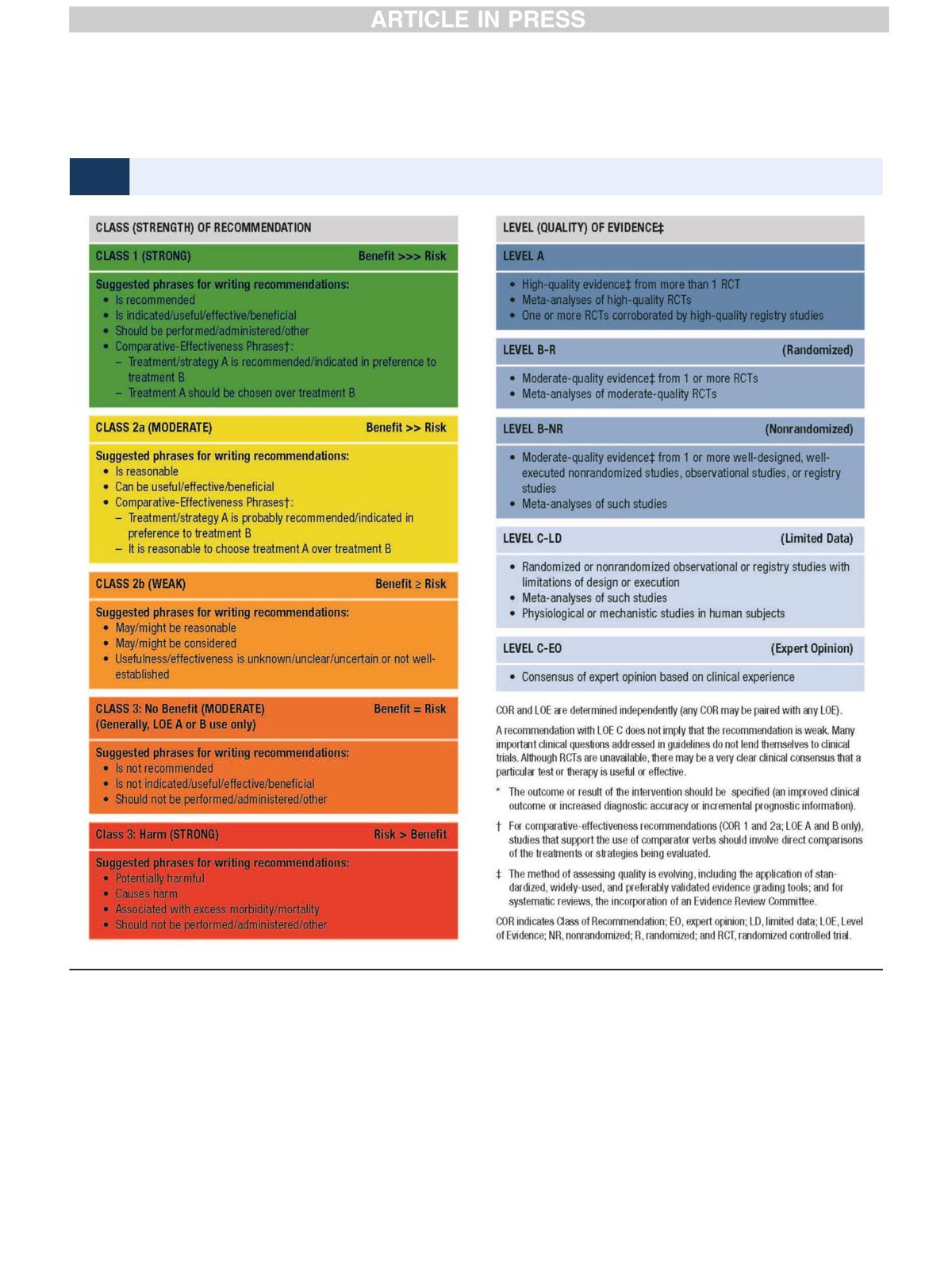
JACC VOL.
-, NO. -, 2024
Jneid et al
5
-, 2024:---
2024 ACC/AHA Valvular and Structural Heart Disease Measures
Applying American College of Cardiology/American Heart Association Class of Recommendation and Level of Evidence to
TABLE 1
Clinical Strategies, Interventions, Treatments, or Diagnostic Testing in Patient Care* (Updated May 2019)
prevalence of clinically significant VHD may double
3.4% pooled prevalence of severe AS. In another
before 2050.4 In another large nationwide registry anal-
population-based study from a single academic center in
ysis from Sweden, Andell et al5 identified all patients in
Norway, Eveborn et al7 prospectively performed-over a
Swedish hospitals with a first diagnosis of VHD between
14-year period-serial echocardiographic imaging studies
2003 and 2010. They reported a VHD incidence of 63.9 per
to examine the prevalence and progression of degenera-
100,000 person-years, with AS, MR, and aortic regurgi-
tive AS. They found an increasing prevalence of AS with
tation accounting for nearly
90% of all diagnoses.5
age: 1.3% in the 60- to 69-year age group versus 3.9% in
Notably, 69% of new VHD lesions in this study were
the 70- to 79-year age group and 9.8% in the 80- to
diagnosed in subjects $65 years of age.5 In a meta-
89-year age group.7 The investigators also found a
analysis by Osnabrugge et al,6 inclusive of 7 reports and
nonlinear progression in mean transaortic valve pressure
9,723 subjects, the investigators reported a 12.4% pooled
gradients, with substantial individual variability and an
prevalence of AS in the elderly (>75 years of age), with a
average annual increase of 3.2 mm Hg.7
6
Jneid et al
JACC VOL.
-, NO. -, 2024
2024 ACC/AHA Valvular and Structural Heart Disease Measures
-, 2024:---
Notably, outcomes associated with VHD have improved
1.2. Disclosure of Relationships With Industry and Other
markedly over time due to significant advances in diag-
Entities
nostic measures and new therapeutic approaches. The
The Joint Committee makes every effort to avoid actual,
former includes measures targeting at-risk patients and
potential, or perceived conflicts of interest that could
those with established VHD, in addition to harnessing the
arise as a result of relationships with industry or other
advances in multimodality imaging, whereas the latter is
entities (RWI). Information about the ACC/AHA policy on
promulgated by enhanced surgical techniques and novel
RWI can be found online. All members of the writing
catheter-based interventions. Surgical valve replacement
committee, as well as those selected to serve as peer re-
and repair have been long-standing mainstay treatment
viewers of this document, were required to disclose all
modalities for VHD. However, transcatheter-based thera-
current relationships and those existing within the 12
pies are rapidly evolving and have obtained progressively
months before the initiation of this writing effort. ACC/
expanded clinical therapeutic indications over the past
AHA policy also requires that the writing committee chair
decade.8-13 Surgical and transcatheter interventions are
and at least 50% of the writing committee have no rele-
performed primarily in patients with severe symptomatic
vant RWI. Writing committee members are excluded from
VHD, although evolving evidence supports its likely
writing or voting on sections to which their specific RWI
benefit in patients with severe asymptomatic VHD and
may apply.
even moderate VHD. Accurate diagnosis and periodic
Any writing committee member who develops new
monitoring are critical to assess the need and timing of
RWI during his or her tenure on the writing committee is
intervention, which may depend on a myriad of factors,
required to notify staff in writing. These statements are
such as the severity of the VHD, presence of symptoms, its
reviewed periodically by the Joint Committee and by
impact on cardiac anatomy and function (eg, left ven-
members of the writing committee. Author and peer
tricular dilation or dysfunction), as well as its effects on
reviewer RWI that are pertinent to the document are
the pulmonary circulation (eg, pulmonary hypertension).
included in the appendixes: Appendix B for comprehen-
To this effect, accurate diagnoses and classification of the
sive writing committee RWI and Appendix C for compre-
severity of VHD lesions are important. The writing com-
hensive peer reviewer RWI. Disclosure information for the
mittee for the 2020 ACC/AHA VHD guideline3 provided a
Joint Committee is also available online.
classification of the VHD stages. These stages are pro-
The work of the writing committee was supported
gressive, and continuous clinical and imaging monitoring
exclusively by the ACC and the AHA without commercial
are required. The 4 stages include: stage A (at risk for the
support. The American Association for Thoracic Surgery
development of VHD), stage B (progressive VHD: asymp-
and the Society for Cardiovascular Angiography and In-
tomatic with mild or moderate severity), stage C (severe
terventions served as collaborators on this project.
asymptomatic VHD), and stage D (severe symptomatic
Members of the writing committee volunteered their time
VHD).3
for this effort. Meetings of the writing committee were
To inform and update the practicing clinician about
confidential and attended only by writing committee
the essential elements in the diagnosis, classification,
members and staff from the ACC and AHA.
and management of patients with VHD (eg, patient ed-
ucation, periodic monitoring, medical therapy, and sur-
2. METHODOLOGY
gical and percutaneous interventions), the ACC and AHA
2.1. Literature Review
often join efforts with other societies to construct clin-
ical practice guidelines consisting of concrete and direct
In developing the updated VHD measure set, the writing
clinical recommendations. Several iterations of the VHD
committee reviewed evidence-based clinical practice
guidelines were published by the ACC and AHA over the
guidelines and scientific statements that would poten-
years,14,15 including the most recent “2020
ACC/AHA
tially impact the construct of the new measures. The
Guideline for the Management of Patients With Valvular
clinical practice guidelines and scientific statements that
Heart Disease.”3 To increase the clinical dissemination
most directly contributed to the development of these
of the most recent clinical practice guidelines3 and
measures are shown in Table 3. Notably, the “2014 AHA/
particularly to enhance the implementation of their
ACC Guideline for the Management of Patients With
evidence-based and high-impact recommendations, the
Valvular Heart Disease”15 and its 2017 focused update16
ACC and AHA have rejoined efforts to construct a set of
were not reviewed or considered, because they were
performance and quality measures for VHD and struc-
completely replaced by the “2020 ACC/AHA Guideline for
tural heart disease (SHD). These measures can be used
the Management of Patients With Valvular Heart Dis-
to assess, measure, and compare care processes of
ease.”3
Recommendations from the
“2020
AHA/ACC
patients with VHD across multiple providers and
Guideline for the Diagnosis and Treatment of Patients
institutions.
With Hypertrophic Cardiomyopathy”17 were reviewed,
JACC VOL.
-, NO. -, 2024
Jneid et al
7
-, 2024:---
2024 ACC/AHA Valvular and Structural Heart Disease Measures
TABLE 2
2024 ACC/AHA Valvular Heart Disease Measures
Care
Measure No.
Measure Title
Setting
Attribution
Measure Domain
COR/LOE
Performance Measures
PM-1
VKA for Mechanical Heart Valves
Outpatient
Individual practitioner
Treatment
COR: 1, LOE: A
PM-2
AV Intervention for Severe
Outpatient
Individual practitioner
Treatment
COR: 1, LOE: A; COR: 1,
Symptomatic AS
LOE: B-NR; COR: 1,
LOE: C-EO
PM-3
AV Surgery for Chronic Severe AR
Outpatient
Individual practitioner
Treatment
COR: 1, LOE: B-NR
PM-4
TTE for Asymptomatic Chronic Severe
Inpatient,
Individual practitioner
Monitoring
COR: 1, LOE: B-NR
Primary MR
Outpatient
PM-5
Mitral Valve Intervention for Chronic
Outpatient
Individual practitioner
Treatment
COR: 1, LOE: B-NR
Severe Primary MR
Quality Measures
QM-1
Documentation of Risk and Heart Team
Inpatient
Facility, Individual
Patient Education
COR: 1, LOE: C-EO
Discussion Before SAVR or TAVI
practitioner
and Monitoring
QM-2
AVR for Asymptomatic AS With
Outpatient
Individual practitioner
Treatment
COR: 1, LOE: B-NR
LV Systolic Dysfunction
QM-3
TAVI for Severe Symptomatic AS >80
Outpatient
Individual practitioner
Treatment
COR: 1, LOE: A; COR: 1,
Years of Age
LOE: C-EO
QM-4
Post-AVR Echocardiogram
Outpatient
Individual practitioner
Monitoring
COR: 1, LOE: B-NR
QM-5
Adequate BP Control in AR Patients
Outpatient
Individual practitioner
Treatment
COR: 1, LOE: B-NR
QM-6
Treatment for Symptomatic Severe
Outpatient
Individual practitioner
Treatment
COR: 1, LOE: A; COR: 1,
Rheumatic MS
LOE: B-NR
ACC indicates American College of Cardiology; AHA, American Heart Association; AR, aortic regurgitation; AS, aortic stenosis; AV, aortic valve; AVR, aortic valve replacement; BP, blood
pressure; COR, Class of Recommendation; LOE, Level of Evidence; LV, left ventricle/ventricular; MR, mitral regurgitation; MS, mitral stenosis; PM, performance measure; QM, quality
measure; SAVR, surgical aortic valve replacement; TAVI, transcatheter aortic valve implantation; TTE, transthoracic echocardiogram; and VKA, vitamin K antagonist.
but the consensus of the writing group was to exclude
created by the ACC and AHA in collaboration with other
measures pertinent to the hypertrophic cardiomyopathy
societies. Therefore, there are no previous measures to
from this guideline, because they were too narrowly
revise or retire.
focused and outside the scope of the current document.
3.1.2. Revised Measures
2.2. Definition and Selection of Measures
The current measure set represents the first set of per-
The writing committee considered a number of additional
formance and quality measures for VHD and SHD that are
factors, which are listed in Table 4. The potential impact,
created by the ACC and AHA in collaboration with other
appropriateness for public reporting and pay for perfor-
societies. Therefore, there are no previous measures to
mance, validity, reliability, and feasibility were consid-
revise or retire.
ered. The writing committee examined available
3.1.3. New Measures
information on current gaps in care.
After reviewing the “2020 ACC/AHA Guideline for the
3. ACC/AHA VHD MEASURE SET
Management of Patients With Valvular Heart Disease”3
and other societal position statements and documents
3.1. Discussion of VHD Measure Set
(Table 3), the writing committee initially considered a
After reviewing the existing clinical practice guidelines
preliminary set of 20 measures from definitive recom-
and scientific statements (Table 3), the writing committee
mendations with proven clinical benefit (mostly Class 1
discussed which guideline recommendations could serve
guideline recommendations), which were predominantly
as the basis for new performance or quality measures. The
pertinent to the diagnostic, monitoring, and treatment
writing committee reviewed the attributes of perfor-
domains. The initial comprehensive set included 9 per-
mance as well as the existing publicly available measure
formance measures: 2 were subsequently dropped, 2 were
sets. In the following section is a description of the new
kept with edits or modifications, and 2 were downgraded
measures that are created for both the inpatient and
to quality measures (because they were deemed to satisfy
outpatient setting.
some but not all the attributes defined in Table 4). The
final set included 5 performance measures and 6 quality
3.1.1. Retired Measures
measures, which were voted on after multiple rounds of
The current measure set represents the first set of per-
anonymous voting and meticulous consideration of the
formance and quality measures for VHD and SHD that are
attributes of performance measures. Of the initial
8
Jneid et al
JACC VOL.
-, NO. -, 2024
2024 ACC/AHA Valvular and Structural Heart Disease Measures
-, 2024:---
TABLE 3
Associated ACC/AHA Clinical Practice Guidelines and Other Clinical Guidance Documents
2020 ACC/AHA Guideline for the Management of Patients With Valvular Heart Disease3
2020 AHA/ACC Guideline for the Diagnosis and Treatment of Patients With Hypertrophic Cardiomyopathy17
2019 AATS/ACC/ASE/SCAI/STS Expert Consensus Systems of Care Document: A Proposal to Optimize Care for Patients With Valvular Heart Disease18
2019 AHA/ACC/HRS Focused Update of the 2014 AHA/ACC/HRS Guideline for the Management of Patients With Atrial Fibrillation19
2019 AHA/ACC Clinical Performance and Quality Measures for Adults With High Blood Pressure20
Guidelines for the Early Management of Patients With Acute Ischemic Stroke: 2019 Update to the 2018 Guidelines for the Early Management of Acute Ischemic Stroke21
2018 Guidelines for the Early Management of Patients With Acute Ischemic Stroke22
Surgery for Aortic Dilatation in Patients With Bicuspid Aortic Valves23
2015 American Heart Association/American Stroke Association Focused Update of the 2013 Guidelines for the Early Management of Patients With Acute Ischemic Stroke
Regarding Endovascular Treatment24
2014 AHA/ACC/HRS Guideline for the Management of Patients With Atrial Fibrillation25
Guidelines for the Prevention of Stroke in Patients With Stroke and Transient Ischemic Attack26
Percutaneous Device Closure of Patent Foramen Ovale for Secondary Stroke Prevention27
AATS indicates American Association for Thoracic Surgery; ACC, American College of Cardiology; AHA, American Heart Association; ASE, American Society of Echocardiography; HRS,
Heart Rhythm Society; SCAI, Society for Cardiovascular Angiography and Interventions; and STS, Society of Thoracic Surgeons.
comprehensive set of 20 measures, 9 measures were
All of the measures pertain to the outpatient setting,
excluded for various reasons. For example, some did not
except for 1 quality measure that applies predominantly
fit the attributes of a performance measure, or they were
to the inpatient setting.
unlikely to be upgraded in the future from a quality
All 5 performance measures fulfill the attributes of
measure. Others were considered outside the scope of the
performance measures as summarized in Table 4. All 5
current document or are covered in other performance
performance measures are high-impact measures that
measure documents. For example, statin use in patients
target meaningful gaps in the quality of care and are
with mild and moderate AS has been shown to reduce
based on Class 1 clinical practice guideline recommenda-
ischemic atherosclerotic events by 20% but not aortic
tions with a high level of evidence. They are also action-
valve-related events.30,31 This measure was deemed by
able, have a very low abstraction burden (in terms of cost,
the writing committee most suitable to be considered in a
effort, and time), and pose no unintended consequences
future atherosclerotic cardiovascular disease performance
in their implementation. Of those, 4 are related to proven
measure document. The measure related to anti-
therapies (1 is a medical treatment and 3 are surgical or
coagulation for nonvalvular atrial fibrillation (AF) has
catheter-based interventions), and 1 pertains to a diag-
been extensively covered in the performance measure
nostic modality (medical imaging test).
document in patients with AF, with 2 dedicated measures
One medical treatment performance measure pertains
related to anticoagulation prescription in the inpatient
to the prescription or treatment with a vitamin K antag-
and outpatient settings.32 In the rationales for the 2 per-
onist (eg, warfarin) in patients with mechanical prosthetic
formance measures in the aforementioned document, the
valves, which has been proven to prevent valve throm-
writing committee explicitly stated that nonvalvular AF
bosis and thromboembolic events in these patients.33-35
increases the risk of stroke 5 times while AF in the setting
Appendix A provides a summary for the rationale and
of mitral stenosis increases the risk of stroke 20 times
evidence for the measure as well as data on its construct.
over that of patients in sinus rhythm.32 A separate mea-
Direct oral anticoagulants are not adequately studied or
sure pertinent for AF in the setting of mitral stenosis is
proven as a thromboprophylaxis therapy for mechanical
likely to be topped out and of low impact, and therefore is
prosthetic valves.36 Their use is therefore not recom-
not included in the current document. The measure on
mended and does not count toward the implementation
the use of early surgery for infective endocarditis was
of this measure. On the other hand, like many perfor-
deemed to have a complex construct and to likely be too
mance and quality measures, many patients have reasons
difficult to measure, especially given issues with ascer-
to be excluded or exempted from this measure. These
taining appropriateness of surgery and its timing in these
exclusions include definite exclusions (such as being on
complex patients.
hospice, palliative, or comfort care) and relative medical-
The writing committee created a comprehensive list of
or patient-related exclusions (such as active bleeding or
11 measures that can be clinically used in patients with
patient refusal). This measure should be implemented in
VHD. This set includes 5 performance measures and 6
a shared decision-making process with the patient and
quality measures. Table 5 includes a list of the measures
the patient’s health care team (eg, the cardiologist and the
with information on the care setting and a brief rationale.
primary care professional). Therefore, the measure should

JACC VOL.
-, NO. -, 2024
Jneid et al
9
-, 2024:---
2024 ACC/AHA Valvular and Structural Heart Disease Measures
American Heart Association/American College of Cardiology Joint Committee on Performance Measures: Attributes
TABLE 4
for Performance Measures28
1. Evidence Based
High-impact area that is useful
a) For structural measures, the structure should be closely linked to a meaningful process of care that in turn is
in improving patient outcomes
linked to a meaningful patient outcome.
b) For process measures, the scientific basis for the measure should be well established, and the process should
be closely linked to a meaningful patient outcome.
c) For outcome measures, the outcome should be clinically meaningful. If appropriate, performance measures
based on outcomes should adjust for relevant clinical characteristics through the use of appropriate
methodology and high-quality data sources.
2. Measure Selection
Measure definition
a) The patient group to whom the measure applies (denominator) and the patient group for whom conformance
is achieved (numerator) are clearly defined and clinically meaningful.
Measure exceptions and exclusions
b) Exceptions and exclusions are supported by evidence.
Reliability
c) The measure is reproducible across organizations and delivery settings.
Face validity
d) The measure appears to assess what it is intended to.
Content validity
e) The measure captures most meaningful aspects of care.
Construct validity
f) The measure correlates well with other measures of the same aspect of care.
3. Measure Feasibility
Reasonable effort and cost
a) The data required for the measure can be obtained with reasonable effort and cost.
Reasonable time period
b) The data required for the measure can be obtained within the period allowed for data collection.
4. Accountability
Actionable
a) Those held accountable can affect the care process or outcome.
Unintended consequences avoided
b) The likelihood of negative unintended consequences with the measure is low.
be attributable to any of the health care professionals
edge repair,41,42 respectively. The tables in Appendix A
caring for the patient. The presence of a mechanical heart
include details on the construct of these measures, their
valve and the prescription or treatment with a vitamin K
rationale, as well as evidence pertinent to these disorders
antagonist should be documented within and abstracted
and their surgical or transcatheter treatments. In addi-
from the medical records (whether electronic health care
tion, there is clinical information providing descriptions
records data, administrative data, clinical registries, or
of common symptoms, definitions of severity of the valve
paper medical records). Different international normal-
disorder, and the respective thresholds for left ventricular
ized ratio target ranges apply to various patients. This is
systolic dysfunction (eg, ejection fraction 55% and #60%
outlined in the “2020 ACC/AHA Guideline for the Man-
for chronic severe aortic regurgitation and primary MR,
agement of Patients With Valvular Heart Disease,”3 which
respectively). To minimize the complexity of the valve
is dependent on various factors such as type of valve,
intervention measures and ensure feasibility, the writing
location of valve, comorbidities, and previous history of
committee included left ventricular ejection fraction
thromboembolic events. This performance measure does
thresholds but not left ventricular dimensions (eg, left
not, however, delve into the achieved international
ventricular end-systolic diameter
$40 mm for valve
normalized ratio targets, to simplify the construct of the
intervention in patients with chronic severe primary
measure and make it easier to implement.
MR).43 Given the complexity of the valve intervention
There are 3 performance measures pertaining to the
decision-making in these patients, these measures are
implementation of an appropriate valve intervention in
attributed to the primary cardiologist, as opposed to the
patients with 3 valvular conditions: (1) severe symptom-
primary care health care professional, who is likely to
atic AS; (2) chronic severe aortic regurgitation (symp-
refer these patients to a specialist to determine-in shared
tomatic or asymptomatic with left ventricular systolic
decision-making with the patient-the merits of the
dysfunction); and (3) chronic severe primary MR (symp-
intervention after discussing risks, benefits, alternatives,
tomatic or asymptomatic with left ventricular systolic
and patient values, as well as other preferences.
dysfunction). Based on the available evidence, the valve
Last, 1 performance measure involves a diagnostic
intervention varies according to the valve location, pa-
modality and performance of a transthoracic echocardio-
thology, and patient symptoms, and may include aortic
gram within the preceding 12 months among patients with
valve surgery or transcatheter aortic valve implanta-
established chronic severe primary MR. It is therefore
tion,37-40 or mitral valve surgery or transcatheter edge-to-
applicable to the outpatient setting where a transthoracic
10
Jneid et al
JACC VOL.
-, NO. -, 2024
2024 ACC/AHA Valvular and Structural Heart Disease Measures
-, 2024:---
TABLE 5
New Measures*
Rationale for Designating as a
Measure
Quality Measure Versus a
No.
Care Setting
Measure Title
Rationale for Creating New Measure
Performance Measure
PM-1
Outpatient
VKA for Mechanical
In patients with a mechanical valve prosthesis, there is
High impact, easy to measure, satisfies
Heart Valves
high-level evidence that therapy with an oral VKA at
the attributes of a PM.
an appropriate INR goal reduces the incidence of
valve thrombosis, thromboembolic events, and
associated morbidity.
PM-2
Outpatient
AV Intervention
Patients with severe symptomatic AS have a high risk of
High impact, easy to measure, satisfies
for Severe
death if AV intervention is not performed, as high as
the attributes of a PM.
Symptomatic AS
50% at 1 y. Both SAVR and TAVI are effective across
the spectrum of surgical risk, with significant
improvements in morbidity, death, and functional
status.
PM-3
Outpatient
AV Surgery for Chronic
Patients with chronic severe AR who either have LV
High impact, easy to measure, satisfies
Severe AR
dysfunction (EF <55%) or who develop symptoms,
the attributes of a PM.
have a high risk of death, LV decompensation, and
deterioration of functional status if AVR is not
performed.
PM-4
Inpatient,
TTE for Asymptomatic
Serial echocardiograms are essential to evaluate
Actionable, easy to measure, satisfies
Outpatient
Chronic Severe
changes in LV function and structure in patients with
the attributes of a PM.
Primary MR
asymptomatic chronic severe primary MR to guide
management decisions.
PM-5
Outpatient
Mitral Valve Intervention
Patients with chronic severe primary MR who develop
High impact, easy to measure, satisfies
for Chronic Severe
symptoms or LVEF <60% have a high risk of death,
the attributes of a PM.
Primary MR
LV decompensation, and deterioration of functional
status if mitral valve intervention is not performed.
Rationale for Designating as a
Measure
Quality Measure Versus a
No.
Care Setting
Measure Title
Rationale for Creating New Measure
Performance Measure
QM-1
Inpatient
Documentation of Risk
Clinically meaningful measure that incorporates risk
QM because of moderate abstraction
and Heart Team
assessment and shared decision-making with the
and lack of robust evidence
Discussion Before
patients before intervention.
regarding its impact.
SAVR or TAVI
QM-2
Outpatient
AVR for Asymptomatic AS
Asymptomatic patients with severe AS who have LV
Complex construct and feasibility
With LV Systolic
systolic dysfunction (EF <50%) benefit from SAVR
issues make it better fit for a QM.
Dysfunction
or TAVI in particular clinical settings (low LVEF,
cardiothoracic surgery for another indication).
QM-3
Outpatient
TAVI for Severe
TAVI is preferred to SAVR in most patients >80 y of age
May have unintended consequences if
Symptomatic AS >80
because of its safety profile and lower concern for
used as a PM (eg, some elderly
Years of Age
valve durability in this age group.
patients may still be safe for
SAVR), and as such QM is more
appropriate.
QM-4
Outpatient
Post-AVR
TTE after valve implantation or repair provides an
Clinically meaningful measure but
Echocardiogram
assessment of the procedural results and serves as a
lacks strong evidence to support
baseline against which comparison can be made for
its impact.
any change.
QM-5
Outpatient
Adequate BP Control in
Adequate BP control in asymptomatic patients with
Does not fit all attributes of a PM
AR Patients
chronic AR may help prevent structural LV
(measure feasibility).
deterioration and mitigate the occurrence of HF
symptoms.
QM-6
Outpatient
Treatment for
Treatment of patients with severe symptomatic
The measure definition is complex and
Symptomatic Severe
rheumatic MS with either PMBC or surgery has
may pose abstraction burden.
Rheumatic MS
shown significant clinical benefits.
Better fit for QM (low impact).
*The current measure set represents the first ACC/AHA VHD measure set; therefore, all the measures in the measure set are new and are included in the new measures table.
ACC indicates American College of Cardiology; AHA, American Heart Association; AR, aortic regurgitation; AS, aortic stenosis; AV, aortic valve; AVR, aortic valve replacement; BP,
blood pressure; EF, ejection fraction; HF, heart failure; INR, international normalized ratio; LV, left ventricle/ventricular; LVEF, left ventricular ejection fraction; MR, mitral regurgi-
tation; MS, mitral stenosis; PM, performance measure; PMBC, percutaneous mitral balloon commissurotomy; QM, quality measure; SAVR, surgical aortic valve replacement; TAVI,
transcatheter aortic valve implantation; TTE, transthoracic echocardiogram; VHD, valvular heart disease; and VKA, vitamin K antagonist.
JACC VOL.
-, NO. -, 2024
Jneid et al
11
-, 2024:---
2024 ACC/AHA Valvular and Structural Heart Disease Measures
echocardiogram is readily available and can be ordered by
are designed to help health care professionals reduce gaps
the cardiologist or other health care professional (thus,
in the quality of care that they provide to their patients.
attribution to a wider segment of professionals). A trans-
For more detailed information on each measure’s
thoracic echocardiogram will ascertain the severity and
construct, refer to the specifications in Appendix A.
mechanism of primary MR and assess the existence and
progression of left ventricular dysfunction or dilation (eg,
4. AREAS FOR FURTHER RESEARCH
ejection fraction or dimension), which then helps dictate
the intervention modality (eg, surgical repair, surgical
All 11 measures included in the current set are actionable,
replacement, or transcatheter edge-to-edge repair) and its
feasible, and reliable process measures with established
timing, particularly in patients who are asymptomatic.
scientific evidence and proven clinical benefit. One may
Six quality measures were selected, all of which were
argue that outcomes (eg, death, stroke, myocardial
based on Class 1 clinical practice guideline recommenda-
infarction, or reintervention) represent the ultimate
tions. These quality measures fulfill some but not all the
assessment of care. The writing committee elected not to
attributes of a performance measure. They have less
include outcome measures in this initial set of VHD
clinical impact or might be lacking in other important
measures given the heterogeneity of the VHDs and pa-
characteristics (eg, feasibility, validity, or unintended
tient populations, in addition to the lack of robust meth-
consequences) and are therefore not suitable to measure
odology for adequate adjustment for the case mix of
performance among providers and institutions or for
patients (with a few exceptions). Use of outcome mea-
public reporting. However, they can be used for internal
sures in the absence of robust adjustment models may
quality assessment and internal peer review processes.
render comparisons across institutions and providers
Many of these measures are added to clinical registries
meaningless and may create untoward and unintended
and may be upgraded in the future to a performance
consequences that would likely result in problems with
measure status after assessment in real-world practice or
implementation. Future research should focus on over-
completely retired in certain instances (eg, topped out or
coming these barriers and validating meaningful out-
emerging evidence showing marginal clinical impact).
comes for patients with VHD that can be reliably
Thus, if additional evidence supports the importance of
measured and reported.
the proposed quality measures, they may be ultimately
The current document encompasses the first set of per-
changed to performance measures. Of the 6 selected
formance and quality measures pertinent to VHD and SHD
quality measures, 4 pertain to therapeutic strategies
released by the ACC and AHA in collaboration with other
(medical, percutaneous, or surgical intervention), and the
societies. These measures should be added to future clin-
other 2 pertain to other domains (eg, patient education or
ical registries and examined for their performance in real-
monitoring). One notable quality measure involves the
world clinical practice. Notably, the current set of mea-
objective documentation of risk using a procedural risk
sures is dynamic and subject to revisions and modifications
score (eg, the web-based Society of Thoracic Surgeons
based on the availability of new clinical evidence. Future
Risk Calculator), and the documentation of a multidisci-
research should therefore focus on implementing and
plinary heart valve team discussion whenever a valvular
examining the current measures and assessing their per-
procedure or surgical intervention is being considered.
formance and utility in real-world practices. If a measure is
Although documentation of a heart team discussion and
found to be consistently topped out or performs poorly (eg,
risk stratification can be done before hospitalization, this
unintended consequences, not reliably reproducible in
is the only measure in this document pertinent to the
different clinical settings, or complex construct requiring
inpatient setting, given that risk stratification is usually a
laborious resources for abstraction), it can be dropped in
dynamic process and best reassessed before the index
the future. On the other hand, if a gap in a clinically
procedure. Although there is a paucity of high-level evi-
meaningful quality measure is evident in contemporary
dence supporting the merits of a heart team approach, the
practice and the measure is found to satisfy the attributes
writing committee agreed with the expert opinion
of a performance measure, it can be at some point elevated
expressed by the 2020 ACC/AHA VHD Guideline Writing
to a performance measure. The Society of Thoracic Sur-
Committee that a multifaceted heart team approach is
gery/ACC Transcatheter Valve Therapy Registry is a robust
important whenever a valvular procedure or surgical
clinical registry created through a collaboration of the So-
intervention is being considered, after accounting for
ciety of Thoracic Surgery and the ACC. It monitors patient
patient-specific, procedure-specific, and institution- or
safety and real-world outcomes but only includes data on
operator-specific risks and benefits.
patients undergoing transcatheter valve replacement and
Overall, the measures are structured in a typical format
repair procedures, and it is therefore not inclusive of pa-
in which the goal is to seek a higher performance score,
tients with all stages of VHD or those with severe (stages C
ideally nearing 100%. Performance and quality measures
or D) VHD who did not undergo procedures. The AHA is in
12
Jneid et al
JACC VOL.
-, NO. -, 2024
2024 ACC/AHA Valvular and Structural Heart Disease Measures
-, 2024:---
the process of developing a disease-specific database
Shae Martinez, MLS, Reference Consultant, Medical
pertinent to AS that can help examine aortic valve disease
Librarian
more comprehensively. Leveraging the resources of the
American Heart Association
AHA and ACC and other organizations, including their
Joseph C. Wu, MD, PhD, FAHA, President
registries, is therefore critically important to examine the
Nancy Brown, Chief Executive Officer
implementation and performance of these measures.
Mariell Jessup, MD, FAHA, Chief Science and Medical
Finally, new care processes and diagnostic and therapeutic
Officer
strategies should continue to be examined and considered,
Nicole Aiello Sapio, EdD, Executive Vice President, Office
especially with the emergence of new transcatheter ther-
of Science Strategies and Operations
apies or new indications of existing transcatheter therapies
Radhika Rajgopal Singh, PhD, Senior Vice President,
in the fields of VHD and SHD.
Office of Science and Medicine
PRESIDENTS AND STAFF
Prashant Nedungadi, BPharm, PhD, Vice President,
Science and Medicine, Clinical Guidelines
American College of Cardiology
Barbara Entl, MD, Science and Medicine Advisor, Office of
B. Hadley Wilson, MD, FACC, President
Science, Medicine and Health
Cathleen C. Gates, Chief Executive Officer
Courtney Goodwin, MPH, Program Manager Guidelines,
Richard J. Kovacs, MD, MACC, Chief Medical Officer
Office of Science, Medicine and Health
Mindy J. Saraco, MHA, Director, Clinical Policy and
Melanie Shahriary, RN, BSN, Senior Manager,
Guidelines
Performance Metrics Quality, Outcomes Research and
Grace D. Ronan, Senior Production and Operations
Analytics
Manager, Clinical Policy Publications
Kelly Burlison, MPH, Senior Program Development
Leah Patterson, Project Manager, Clinical Content
Manager, Healthcare Quality Measures, Quality and
Development
Health IT
American Heart Association/American College
Sana Gokak, MPH, Program Manager, Healthcare Quality
of Cardiology
Measures, Quality and Health IT
Abdul R. Abdullah, MD, Director, Guideline Science and
Jody Hundley, Senior Production and Operations Manager,
Methodology
Scientific Publications, Office of Science Operations
REFERENCES
1. Spertus JA, Eagle KA, Krumholz HM, et al. American
replacement: a meta-analysis and modeling study.
14. Bonow RO, Carabello BA, Chatterjee K, et al. ACC/
College of Cardiology and American Heart Association
J Am Coll Cardiol. 2013;62:1002-1012.
AHA 2006 guidelines for the management of patients
methodology for the selection and creation of perfor-
with valvular heart disease: a report of the American
7. Eveborn GW, Schirmer H, Heggelund G, et al. The
mance measures for quantifying the quality of cardio-
College of Cardiology/American Heart Association Task
evolving epidemiology of valvular aortic stenosis. the
vascular care. J Am Coll Cardiol. 2005;45:1147-1156.
Force on Practice Guidelines (Writing Committee to
Tromso study. Heart. 2013;99:396-400.
2. Spertus JA, Bonow RO, Chan P, et al. ACCF/AHA new
Revise the 1998 Guidelines for the Management of
insights into the methodology of performance mea-
8. Feldman T, Foster E, Glower DD, et al. Percutaneous
Patients With Valvular Heart Disease). J Am Coll Car-
surement: a report of the American College of Cardi-
repair or surgery for mitral regurgitation. N Engl J Med.
diol. 2006;48:e1-e148.
ology Foundation/American Heart Association Task
2011;364:1395-1406.
15. Nishimura RA, Otto CM, Bonow RO, et al. 2014
Force on Performance Measures. J Am Coll Cardiol.
9. Leon MB, Smith CR, Mack MJ, et al. Transcatheter or
AHA/ACC guideline for the management of patients
2010;56:1767-1782.
surgical aortic-valve replacement in intermediate-risk
with valvular heart disease: a report of the American
3. Otto CM, Nishimura RA, Bonow RO, et al. 2020 ACC/
patients. N Engl J Med. 2016;374:1609-1620.
College of Cardiology/American Heart Association Task
AHA guideline for the management of patients with
Force on Practice Guidelines. J Am Coll Cardiol.
valvular heart disease: a report of the American Col-
10. Mack MJ, Leon MB, Thourani VH, et al. Trans-
2014;63:e57-e185.
lege of Cardiology/American Heart Association Joint
catheter aortic-valve replacement with a balloon-
expandable valve in low-risk patients. N Engl J Med.
16. Nishimura RA, Otto CM, Bonow RO, et al. 2017
Committee on Clinical Practice Guidelines. J Am Coll
2019;380:1695-1705.
AHA/ACC focused update of the
2014
AHA/ACC
Cardiol. 2021;77:e25-e197.
Guideline for the Management of Patients With
4. d’Arcy JL, Coffey S, Loudon MA, et al. Large-scale
11. Popma JJ, Adams DH, Reardon MJ, et al. Trans-
Valvular Heart Disease: a report of the American Col-
community echocardiographic screening reveals a
catheter aortic valve replacement using a self-
lege of Cardiology/American Heart Association Task
major burden of undiagnosed valvular heart disease in
expanding bioprosthesis in patients with severe aortic
Force on Clinical Practice Guidelines. J Am Coll Cardiol.
older people: the OxVALVE Population Cohort Study.
stenosis at extreme risk for surgery. J Am Coll Cardiol.
2017;70:252-289.
Eur Heart J. 2016;37:3515-3522.
2014;63:1972-1981.
17. Ommen SR, Mital S, Burke MA, et al. 2020 AHA/
5. Andell P, Li X, Martinsson A, et al. Epidemiology of
12. Smith CR, Leon MB, Mack MJ, et al. Transcatheter
ACC guideline for the diagnosis and treatment of
valvular heart disease in a Swedish nationwide hospital-
versus surgical aortic-valve replacement in high-risk
patients with hypertrophic cardiomyopathy: a report
based register study. Heart. 2017;103:1696-1703.
patients. N Engl J Med. 2011;364:2187-2198.
of the American College of Cardiology/American
6. Osnabrugge RL, Mylotte D, Head SJ, et al. Aortic
13. Stone GW, Lindenfeld J, Abraham WT, et al.
Heart Association Joint Committee on Clinical Prac-
stenosis in the elderly: disease prevalence and number
Transcatheter mitral-valve repair in patients with heart
tice Guidelines. J Am Coll Cardiol. 2020;76:e159-
of
candidates
for
transcatheter
aortic
valve
failure. N Engl J Med. 2018;379:2307-2318.
e240.