Handbook of Watch and Clock Repairs (1972) - page 6
ALARM CLOCKS
165
position of the stud. The balance spring must lie quite flat when
secured in the stud hole.
Fit the balance to the movement and adjust the upper bearing
screw until end-shake of the balance staff disappears. Now
unscrew the bearing screw slightly until there is just sufficient
end-shake for free movement.
Rotate the balance until the impulse pin enters the lever and
at the same time guide the end of the spring through the index
pins and into the stud hole. The actual position of the spring to be
pinned in the stud will be indicated by the kink in the spring
caused by the previous pinning. Insert the pin into the stud and
carefully squeeze it in tightly using the thin pliers. The balance
should now be free to vibrate.
Having assembled the balance it is necessary to check the beat
of the escapement.
Move the balance wheel round with the tip of a finger and
watch the action of the escape wheel. Immediately a tooth of the
escape wheel falls away from a pallet, stop the movement of the
balance wheel and note its position. Now reverse the direction
of the balance wheel and continue moving it until a tooth of the
escape wheel falls away from the other pallet. Stop moving the
balance wheel and note its new position. If the escapement beat
is correct, the balance wheel will have moved the same distance
on each side.
Rest the centre arbor on a stake and fit the cannon pinion
by gently tapping it down with a hollow punch. The alarm wheel
is now placed in position and the alarm wheel pin fitted.
Oil the wheel train pivot bearings, the balance bearing screw
sinks and the pallets. Put one drop of oil on each pinion. Oil the
rim of the alarm wheel and the edges of the mainspring and the
alarm spring.
Now fit the hour wheel and the minute wheel and secure the
dial. Fit the hand-set button and the alarm-set button and screw
on the two winding keys.
We now have to synchronize the alarm mechanism with
the time mechanism. Remove the tension from the alarm
166
WATCH AND CLOCK REPAIRS
spring clamp by further winding the spring and then remove the
clamp.
Slowly turn the alarm-set button until the alarm wheel pin
drops into the base of the cam. This is the position at which the
alarm will operate. The alarm hand is now fitted so that it
exactly points to one particular hour, say
9 o'clock. The clock
hands must therefore indicate the same time. Fit the hour hand
to
9 and the minute hand to 3 minutes before the
12. To check
the setting turn the alarm-set hand to ring at
10 o'clock and then
operate the hand-set until the hands point to four minutes before
10 o'clock. Leave the clock to function and note the time at
which the alarm operates. Adjustments can be made by removing
the minute hand and repositioning it. The movement is now
ready for fitting back into its case.
There is an alternative method of cleaning which is quicker
but not so reliable. The movement is taken from its case and the
hands, dial balance and the lever are removed.
The mainspring and the alarm spring are wound up and the
movement is totally immersed in the cleaning fluid during the
running down of the two springs. The movement is then lifted
out of the fluid and a brush is used to clean the pivot holes in the
plates. The springs are re-wound and the movement once again
immersed in the cleaning fluid.
When the springs are fully run down, the movement is removed
surplus fluid is shaken off, the plates are wiped with a clean piece
of linen and the movement hung up to dry.
The balance and the lever are treated as previously described
and are refitted to the movement when the movement is com
pletely dry. Oiling is carried out as before.
CHAPTER TWENTY-FOUR
Electric clocks
AN electric clock consists of an electric motor, powered by an
A.C. current, driving a pair of hands by means of reduction
gearing. The speed of the electric motor will vary with the make
and also with the electrical supply for which it was designed. An
average speed is about 200 revolutions per minute.
In Chapter 4 we said that most wheel or gear trains are designed
to reduce speed and increase power but that in mechanically
powered time-pieces the reverse is the case.
Now that we are dealing with an electrically powered time
piece we find that the gear train is used in its conventional form,
i.e., to provide a reduction of speed.
The ratio of the reduction must be such as to provide two gears
with speeds of one revolution per hour and one revolution per
twenty-four hours respectively. These then will be the gears to
carry the hands.
Assuming the movement has been removed from its case, take
off the electric motor and examine the terminals and wires for
security and cleanliness. If necessary resolder the wires to make
good contact. Use a resin flux when soldering. Do not use spirits
of salts because of its corrosive properties and the problems of
washing it off.
Having made sure that the electrical connexions are good, try
the gear train for freedom. If all the gears spin freely with no
signs of harshness then refit the motor.
Support the movement over a cardboard box and connect up
to the mains supply. If the motor fails to operate then it will
have to be overhauled.
Some motors are sealed by the manufacturers with the intention
of providing a replacement unit service. Unless you are skilled in
the overhaul of electric motors it is better to return the unit to
the manufacturer or one of his agents.
167
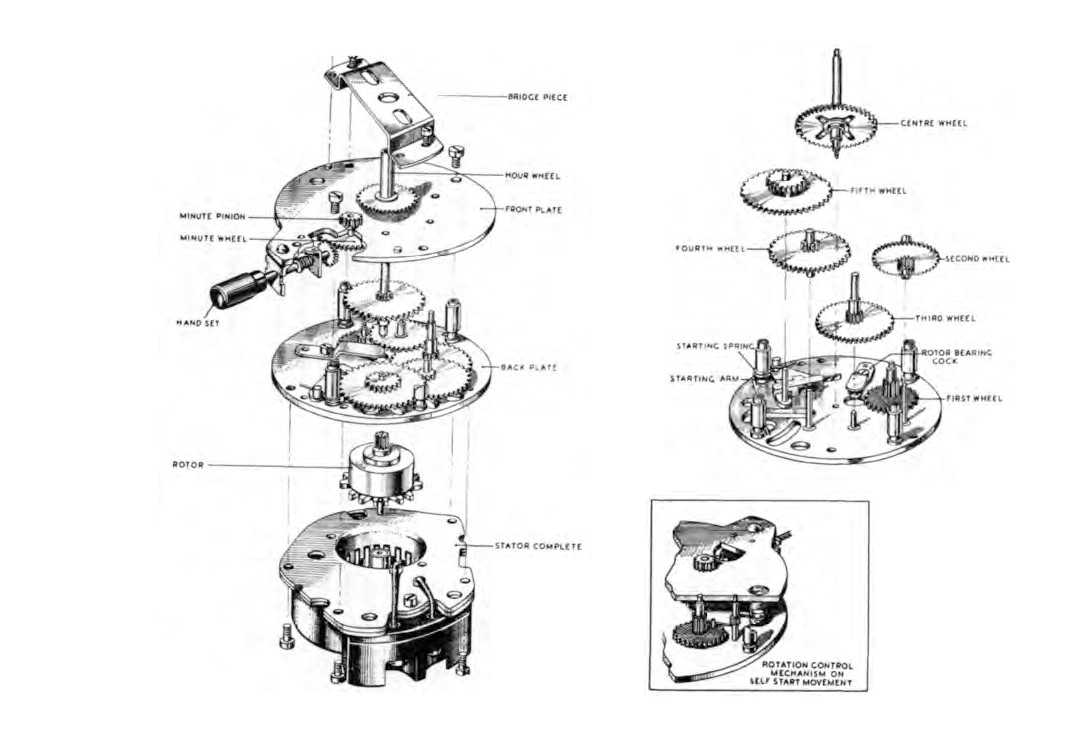
Fig. 91.
ELECTRIC CLOCKS
169
The rest of the movement can be dismantled and washed in
petrol. Polish all the parts by the chalk-brushing method and
clean out pivot holes with pegwood. Examine the gears for
broken or damaged teeth particularly the fibre wheel. Assemble
the movement and oil all bearing surfaces. The oil should be the
grade supplied for electric clocks.
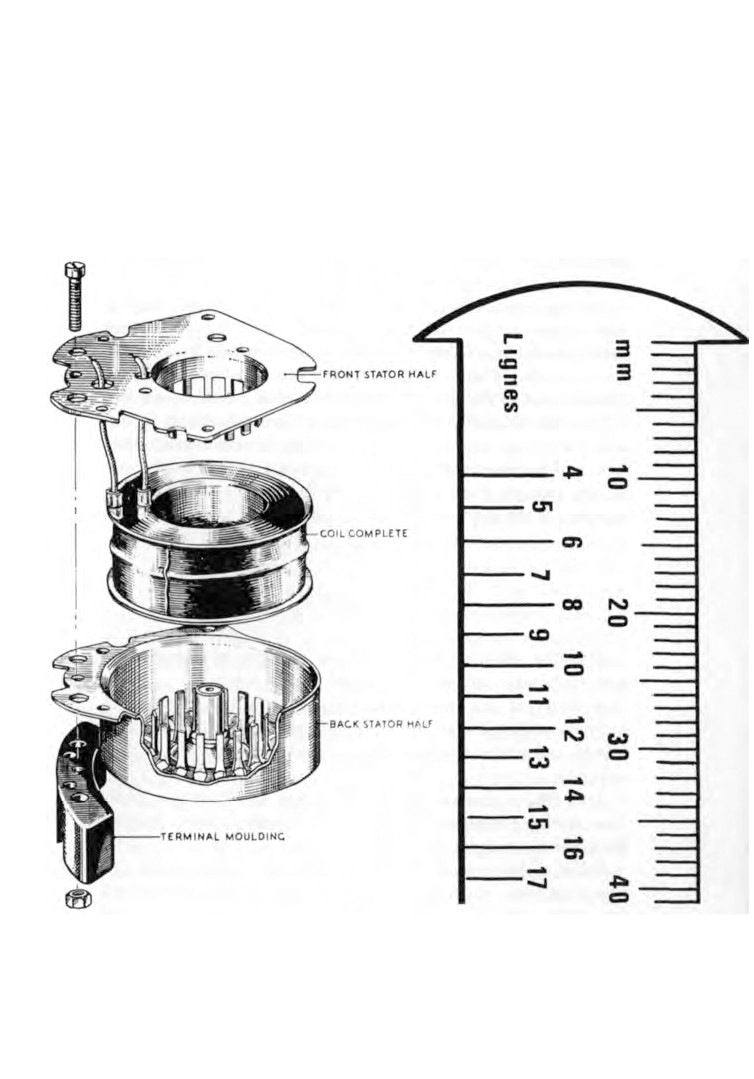
Fig. 92.
Fig. 93. Ligne gauge
170
WATCH AND CLOCK REPAIRS
The illustrations accompanying this chapter are those of the
well-known Bijou movement manufactured by Smiths Clocks
& Watches, Ltd. of England. The construction of the motor can
be clearly seen as well as the layout of the train of gears.
The majority of electric clocks are fitted with motors that
synchronize with the alternators at the power station. These
alternators run at a controlled frequency which enables very
accurate timekeeping to be maintained.
Occasionally the frequency of the alternators might drop a
little at peak periods which will cause the clock to lose. In this
event no adjustment should be made on the hand-set because the
power station will automatically regulate the situation by increas
ing the speed of the generators when the peak period is over.
When the movement is finally assembled connect it to the
electrical supply and check it before fitting it back into its case.
It must be remembered here that the hands will not commence
moving straight away as a few seconds must elapse whilst the
backlash of the gears is being taken up.
APPENDIX
Mail ordering
The first thing to know is where to write to obtain tools
and materials, and where to send repair work.
A study of the advertisements in the leading horological
journals will provide this information but a few dealers'
names and addresses have been included at the end of this
appendix.
The official journal of the American Watchmakers Insti
tute is the American Horologist & Jeweler. Other leading
horological journals are listed.
Select a few suppliers and repairers and write asking for
copies of their illustrated catalogs of tools and materials and
for details of their postal repair service. Catalogs are well
worth having.
In the world of horology spare parts for watch and clock
movements are known as materials, and those who supply
them are material dealers.
APPENDIX
171
Many repairers supply order forms printed in tabulated form
listing those parts of the movement that are required to be
forwarded when ordering specific materials. Similar instructions
are given for repair work.
Take care to carry out the instructions on the order form. This
will prevent mistakes and save time.
Great care must be exercised in preparation for postage.
Individual parts and assemblies should be wrapped separately
in tissue paper. These should be placed in a metal or strong
cardboard box.
Crumpled tissue paper can then be used to fill the space and
prevent movement.
Wrap the order form around the box and, if the first container
is very small, place it in a larger container filling the space with
crumpled newspaper.
When ordering material give as much information as you
can. Always state the caliber number of a watch movement
which will be stamped on one of the plates. Additional
information could be manufacturers' name, brand name on
dial, diameter of watch front plate in lignes or millimeters,
center sweep, small seconds, self-winding
(Fig
93), water
resistant, type of clock such as Westminster chime, striking,
grandfather, weight or spring powered, cuckoo, travel-alarm,
carriage etc. It may even be necessary to send the movement.
When working at the bench it is easy to drop a part or
it may even spring from the tweezers. Because we are work
ing with such small pieces they are not easily found. A
carpeted floor makes it almost impossible. With a smooth
polished floor you stand a better chance of finding it.
Clicksprings, set springs and small screws are the biggest
offenders. When fitting a small spring it is advisable to cover
it with one of your fingers in case it jumps and is lost. If
you do lose one then when writing for a replacement ask
for a gross of assorted sizes. They are not expensive and
who knows, you may need another before the job is finished.
Finally wrap the package in strong wrapping paper, seal
with gummed sealing tape, and send by registered mail.
Always retain the containers forwarded by the supplier.
These containers are most useful and can be used repeatedly.
172
WATCH AND CLOCK REPAIRS
Horological
Journals
American Horoligst &. Jeweler
2403 Champa Street
(monthly)
Denver
Colorado
80205
British Jeweller
(monthly) Available from:—
Canadian Jeweller
(
"
) A. A. Osborne & Son
Horological Journal
(
"
) c/o House of Clocks
Watchmaker, Jeweller &
707 So. Hill Street
Silversmith
(
"
) Los Angeles
Watchmakers of Victoria
California
90014
(Australian)
(
"
)
Jeweller & Metalworker
(bi-monthly)
List of Suppliers
The following addresses of suppliers and repairers have
been taken from ads in the American Horologist & Jeweler.
The key is as accurate as the advertisements will permit,
but no doubt many of the suppliers carry a wider range than
is indicated, e.g., tool suppliers m a y also stock w a t c h and
clock parts.
A Clock movements
Κ Watch materials
Β
"
materials
L Tools general
C
"
repairs
M
precision and lathes
D
dial repairs and refinishing
Ν Cleaning and timing machine repairs
Ε
parts made
(Wheel cutting)
Ο Catalogs or lists
F
springs
Ρ General supplier
G Watch case repairs
Q Workbenches
H " movements
(used)
R Short lengths of metal
I
"
repairs
S Part exchange equipment
J
"
band repairs
Τ Synchronized motors and timer parts
Antique Nook, The,
Gordon & Company
Η
Moses, Bob
(The
Inc.
D,F,0
769 Lindley Street
Watchmaker)
C,I,0
Box 338
Bridgeport, Conn.
06606
Box 1
Atwater, Ohio
44201
Pleasantville, N.Y.
10570
Green's Jewelers Supply L
Becker-Heckman Company
G
205 Burk Burnett Bldg.
Nordman & Aurich
L
5 Ν. Wabash Ave. Rm.
1012
4th & Main Streets
657 Mission Street
Chicago, Ill. 60602
Forth Worth, Texas
76102
San Francisco, Calif.
94105
Benders Watch Service
I
Hamlin Clock Dials
D
Osborne, A. A. & Son
B,E
205 E. Ashdale St.
299 S. Vinedo Avenue
c/o House of Clocks
Philadelphia, Pa.
19120
Pasadena, Calif.
91107
707 So. Hill Street
Los Angeles, Calif.
90014
Borel, Jules & Company
Κ
Henderson, Don Company
Ν
1110 Grand
Box 1260
Rosenthal Jewelers Supply
Kansas City, Mo.
64106
Ada, Okla.
74820
Corp.
L
139 N.E. 1st Street - Suite 620
Borel & Frei, Inc.
Κ
Herman, Ralph Clock
Miami, Fla. 33132
315 W. Fifth St.
House
B,C,0
Los Angeles, Calif.
90013
628 Coney Island Ave.
St. Louis Refining
Brooklyn, Ν.Υ.
11218
Company
C,H,I,0,P
Campbell
M,R
802 Arcade Building
1424 Barclay
Hersey Watch Timer
812 Olive St.
Springfield, Ohio 45505
Service
Ν
St. Louis, Mo. 63101
226 S. Wabash Ave.
Cleveland-Miami Band
Chicago, Ill. 60604
Smelting & Refining Co.,
Repair Co.
J
Inc.
Q
P.O. Box 1259
Horolovar Company, The
Β,Ο
P.O. Box 2010
St. Petersburg, Fla.
33731
Box 400 A
1712 Jackson
Bronxville, N.Y.
10708
Dallas, Texas
75221
Davidson Jewelers Supplies
L
861 - 6th Ave. Rm. 310
Iowa Jewelry Supply Co.
L
Swigart, E. & J. Co.
B,K
San Diego, Calif.
92101
317-320 Empire Building
34 W.
6th Street
6th & Walnut Streets
Cincinnati, Ohio 45202
Donahue, Stanley Co., Inc.
L
Des Moines, la.
50309
705 Main Street Rm. 530
Houston, Texas
77002
Κ & J Watch Service
I
Tela-Time Industries Tronix
P.O. Box
9262
Toll Corp.
L,S
Empire Clock
Denver, Colorado 80209
37 West 47th Street
New York, N.Y.
10036
Company
B,0,S
1295 Rice Street
Kilb & Company
Ο
St. Paul, Minn. 55117
623 Ν.
2nd Street
Tick Tock Shop
C,I
P.O. Drawer
8-A
P.O. Box 44181
Frei, Otto-Borel, Jules, Inc.
Κ
Milwaukee, Wisc. 53201
Cleveland, Ohio
44144
P.O. Box 796
Oakland, Calif.
94606
LaRose, S., Inc.
A,B,L.O
Wade, H. R. & Son, Inc.
L
Greensboro, No. Car 27420
608 East Central
R. Givler
C
Wichita, Kansas
67202
146
3rd
Marshall, C & Ε
L
Wadsworth, Ohio 44281
1113 West Belmont
Wisconsin Jewelers
Chicago, Ill. 60657
Supply Co.
L
Goldfarb, A. J., Inc.
Ο
Madison Bldg.
251 W. 30th St.
Mason & Sullivan Co.
A,D,0
623 N.
2nd Street
New York, Ν.Υ. 10001
Osterville, Mass.
02655
Milwaukee, Wise.
53203
Index
ALARM CLOCKS:
opening,
110-11
dismantling,
159-63
bruises, 111
escapement and balance, 160-2
hinge repairs,
111-12
pivots and holes,
162-3
snaps, 112
cleaning,
163-4
pendulum clock,
117-18
reassembly,
164-6
grandfather clock,
136-7,
140
setting the alarm,
166
carriage clock,
142-8
American Horologist and Jeweller,
alarm clock,
159
address,
172
Cement, dial, 22
Chalk as a cleaner, 22, 45-6
Chiming mechanism:
BALANCE, function of,
33
explanation of working,
132-4
dismantling and cleaning, 42-3,
dismantling,
134-5
46-8
Cleaning fluids, 22
reassembly, 54-5
Cleaning technique, watches, 45-
compensated, 93-5
50
the hairspring, 95-102
clocks,
125-6
index pins, 102
grandfather clocks,
138-9
Banking, run to, 84-7
French clocks, 156
Barrels, going and stationary,
alarm clocks,
163-4
32
Clocks, general principles, 116-17,
dismantling, 48-9
and see Alarm, Carriage,
reassembling, 53-4
Cuckoo, Electric, French,
checking true running, 71-2
Grandfather and Pendulum
loose cover, 72
clocks
fitting new spring, 72-3
Crocus powder, 22
Benzine as a cleaner, 22
Cuckoo clocks:
Blueing pan, 18, 19
exploration of working,
149-54
use of,
157
dismantling and repairs,
154-5
Bottom plate, 34
Bows, 27
Broaches, 19
DIALS, removing,
38-9
fouling the minute wheel, 39
scraping,
39-40
CANNON PINION, 34
cleaning, 49-50
slipping, 40
enamel repairs, 63
removing, 43-4
gold and silver repairs,
63-5
Cases, sealing, 56
Demagnetizers,
114-15
pocket watch, 56
Draw, the, 40, 84-7, 89
wristwatch,
109-10
Drilling, 28
174
INDEX
175
ELECTRIC CLOCKS:
Hand lifting lever,
18
explanation of working,
167,
Hands, checking, 36-7
170
removing, 37
motor and connections,
167
fitting, 61-3
cleaning, 169
Hinges, case, repairing,
111-12
Emery sticks, 22
Horological Journal, address,
172
Escapement, principles of,
33-4
Escapements, lever:
explanation of working,
79-82
INCABLOC SHOCK-ABSORBER,
faults and repairs,
82-7
106, 107-8
Escapements, pin-pallet:
Index pins,
102
checking the lock, 87-9
the draw, 89
JEWELS,
34
the shake, 89-91
adjusting pallet arms,
91-2
Escapements, recoil,
120-2
KEYLESS WORK, mechanism of,
cylinder,
143-8
66-8
Escape wheel, cleaning, 48
faults and repairs,
68-70
Eye glasses, 15-16
FILES AND FILING,
12-14
LIGNES,
29,
169
French clocks, cleaning,
156-8
Fusee chains, 32-3
MAGNETISM, 113-15
repairing,
77-8
Mainspring, watch:
principles of,
32
letting down, 41-2
GASOLINE as a cleaner, 22
removing and cleaning, 49
Glasses, fitting,
112
Graduated stake, 19
replacing,
50-1
Grandfather clocks:
qualities of,
73
correct measurements,
73-5
preliminary check,
136-7
methods
of attachment,
74,
dismantling,
137-8
75-7
cleaning,
138-9
Mainspring, clock:
reassembly,
139-41
letting down,
119-20
Gravers, 25
removing, 125
Guard pin
89, 90
replacing,
126
Methylated spirit, use of, 21
HAIRSPRING :
Monorex shock-absorber,
107,
explanation of working, 95-6
108
refitting,
96-101
Motion work, 60
repairing,
101-2
Movement, general description,
Hammers, 19-20
29-34
Handles, tool, fitting, 18-19
removing from case, 37-8
176
IN D E X
NIPPERS, top-cutting,
17
Pliers,
16-17
Polishing powder, 22
Pull-out piece, adjustment,
69-70
OIL, choice of, 21
Oilers, making and using,
14-15
Oiling technique, 51-3
RED STUFF, 22
Overhaul of watches:
Rouge, 22
preliminary check,
35-7
the hands, 37
removing the movement, 37-8
SC R E W D R IV E R S, using and
the dial,
38-40
shaping, 14
cannon pinion, 40-1
Sealing compound, 56
depthing, 41, 44
Shock-proofing :
mainspring, 41-2
the Kif Flector,
103-7
the balance, 42-3
Incabloc, 106, 107-8
wheel train, 43-5
Monorex, 107, 108
cleaning process, 45-50
Striking mechanism:
reassembly and oiling, 50-5
explanation of working,
128-30
overhaul,
129-31
Supplies, where to obtain,
170-3
PALLETS, function of,
33
strip,
120-2
solid, 121, 122
TAPER PINS, making,
13-14
Pallet arms, adjusting, 91-2
Teeth, broken, repairing, 58,
59
Pallet stones:
Tools, choice of,
11
checking the lock, 83
sets of,
20
renewing, 83-4
Top plate, 34
adjusting,
84-7
Turns, use of :
Pegwood, 21
turning, 23-8
Pendulum clocks:
drilling, 27, 28
dismantling and overhaul, 119-
Tweezers, 16, 17
125
mainspring,
119-20
pivots, 120, 125
WHEEL TRAIN, general descrip
escapement,
120-2
tion, 33
gearing mesh,
122-4
dismantling, 43-5
barrel and spring,
124-5
reassembly and oiling, 54-5
cleaning,
125-6
gear ratios, 57-8, 61
reassembly,
126-7
Weights, grandfather clock,
Pintongs, 3
136, 139
Pith holders, 18, 22
Winding mechanism, 34, 66-8
Pivot holes, cleaning, 21
faults and repairs,
68-70
enlarging,
162-3
Workbench,
9-10