Nissan Pathfinder. Manual - part 1143


  Index      Nissan     Nissan Pathfinder (2014 year) - Service and Repair Manual


Search            


Content   ..  1141  1142  1143  1144   ..


Nissan Pathfinder. Manual - part 1143


SYSTEM

TM-31

< SYSTEM DESCRIPTION >

[CVT: RE0F10E]

C

E

F

G

H

I

J

K

L

M

A

B

TM

N

O

P

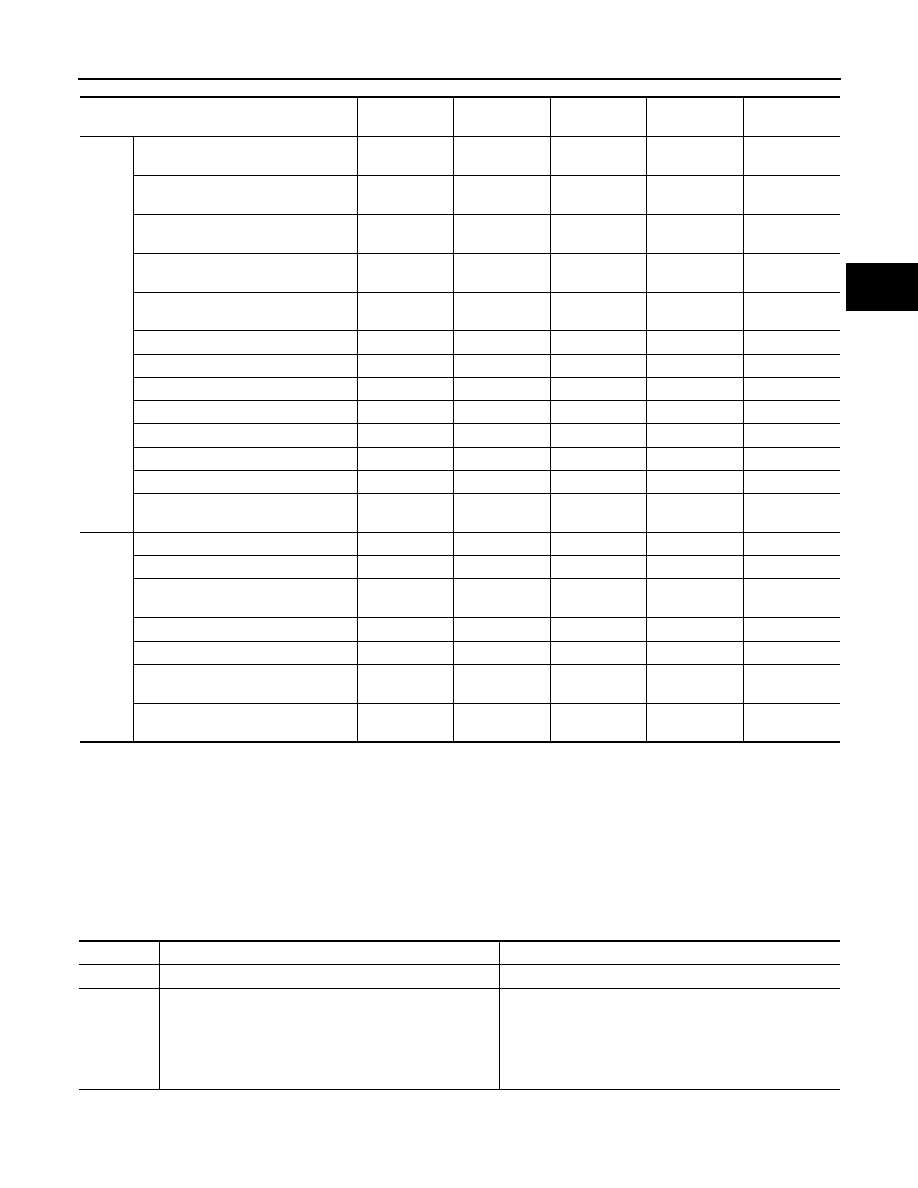
*: If these input/output signals show errors, TCM activates the fail-safe function.

CVT CONTROL SYSTEM : Fail-safe

INFOID:0000000009177508

TCM has a fail-safe mode. The mode functions so that operation can be continued even if the signal circuit of

the main electronically controlled input/output parts is damaged.

If the vehicle shows following behaviors including “poor acceleration”, a malfunction of the applicable system

is detected by TCM and the vehicle may be in a fail-safe mode. At this time, check the DTC code and perform

inspection and repair according to the malfunction diagnosis procedures. 

Fail-safe function

Control Item

Shift control

Line pressure 

control

Select control

Lock-up con-

trol

Fail-safe func-

tion*

Input

Engine torque signal
(CAN communication)

×

×

×

×

×

Engine speed signal
(CAN communication)

×

×

×

×

×

Accelerator pedal position signal
(CAN communication)

×

×

×

×

Closed throttle position signal
(CAN communication)

×

×

×

Stop lamp switch signal
(CAN communication)

×

×

×

×

Primary pressure sensor

×

Secondary pressure sensor 

×

×

×

CVT fluid temperature sensor

×

×

×

×

×

Primary speed sensor

×

×

×

×

×

Output speed sensor

×

×

×

×

Input speed sensor

×

×

×

×

×

Transmission range switch

×

×

×

×

×

Overdrive control switch
(CAN communication)

×

×

×

Output

Line pressure solenoid valve

×

×

×

×

Primary pressure solenoid valve

×

×

×

Torque converter clutch solenoid 
valve

×

×

Secondary pressure solenoid valve

×

×

×

Select solenoid valve

×

×

×

Shift position indicator
(CAN communication)

×

Overdrive control switch
(CAN communication)

×

DTC

Vehicle behavior

Conditions of vehicle

P062F

• Not changed from normal driving

—

P0705

• Shift position indicator on combination meter is not dis-

played

• Selector shock is large
• Start  is  slow
• Acceleration is slow
• Lock-up is not performed

—

TM-32

< SYSTEM DESCRIPTION >

[CVT: RE0F10E]

SYSTEM

P0706

• Shift position indicator on combination meter is not dis-

played

• Selector shock is large
• Start  is  slow
• Acceleration is slow
• Lock-up is not performed

—

P0711

• Start  is  slow
• Acceleration is slow

Engine coolant temperature when engine start:
Temp. 

≥ 10°C (50°F)

• Selector shock is large
• Start  is  slow
• Acceleration is slow

Engine coolant temperature when engine start:
−35°C (−31°F) ≤ Temp. < 10°C (50°F)

• Selector shock is large
• Start  is  slow
• Acceleration is slow

Engine coolant temperature when engine star:
Temp. < 

−35°C (−31°F)

P0712

• Start  is  slow
• Acceleration is slow

Engine coolant temperature when engine start:
Temp. 

≥ 10°C (50°F)

• Selector shock is large
• Start  is  slow
• Acceleration is slow

Engine coolant temperature when engine start:
−35°C (−31°F) ≤ Temp. < 10°C (50°F)

• Selector shock is large
• Start  is  slow
• Acceleration is slow

Engine coolant temperature when engine star:
Temp. < 

−35°C (−31°F)

P0713

• Start  is  slow
• Acceleration is slow

Engine coolant temperature when engine start:
Temp. 

≥ 10°C (50°F)

• Selector shock is large
• Start  is  slow
• Acceleration is slow

Engine coolant temperature when engine start:
−35°C (−31°F) ≤ Temp. < 10°C (50°F)

• Selector shock is large
• Start  is  slow
• Acceleration is slow

Engine coolant temperature when engine star:
Temp. < 

−35°C (−31°F)

P0715

• Start  is  slow
• Acceleration is slow
• Lock-up is not performed

—

P0717

• Start  is  slow
• Acceleration is slow
• Lock-up is not performed

—

P0740

• Start  is  slow
• Acceleration is slow
• Lock-up is not performed

—

P0743

• Start  is  slow
• Acceleration is slow
• Lock-up is not performed

—

P0744

• Start  is  slow
• Acceleration is slow
• Lock-up is not performed

—

P0746

• Selector shock is large
• Start  is  slow
• Acceleration is slow
• Lock-up is not performed

—

DTC

Vehicle behavior

Conditions of vehicle

SYSTEM

TM-33

< SYSTEM DESCRIPTION >

[CVT: RE0F10E]

C

E

F

G

H

I

J

K

L

M

A

B

TM

N

O

P

P0776

• Selector shock is large
• Start  is  slow
• Acceleration is slow
• Lock-up is not performed
• Vehicle speed is not increased

When a malfunction occurs on the low oil pressure side

• Selector shock is large
• Start  is  slow
• Acceleration is slow
• Lock-up is not performed

When a malfunction occurs on the high oil pressure side

P0778

• Selector shock is large
• Start  is  slow
• Acceleration is slow
• Lock-up is not performed

—

P0779

• Selector shock is large
• Start  is  slow
• Acceleration is slow
• Lock-up is not performed

P0841

• Not changed from normal driving

P0847

• Not changed from normal driving

—

P0848

• Not changed from normal driving

—

P084C

• Not changed from normal driving

P084D

• Not changed from normal driving

P0863

• Selector shock is large
• Start  is  slow
• Acceleration is slow
• Lock-up is not performed

—

P0890

• Selector shock is large
• Start  is  slow
• Acceleration is slow
• Lock-up is not performed
• Vehicle speed is not increased

P0962

• Selector shock is large
• Start  is  slow
• Acceleration is slow
• Lock-up is not performed

—

P0963

• Selector shock is large
• Start  is  slow
• Acceleration is slow
• Lock-up is not performed

—

P0965

• Selector shock is large
• Start  is  slow
• Acceleration is slow
• Lock-up is not performed

When a malfunction occurs on the low oil pressure side

• Selector shock is large
• Lock-up is not performed

When a malfunction occurs on the high oil pressure side

P0966

• Selector shock is large
• Start  is  slow
• Acceleration is slow
• Lock-up is not performed

—

P0967

• Selector shock is large
• Start  is  slow
• Acceleration is slow
• Lock-up is not performed

—

P2765

• Start  is  slow
• Acceleration is slow
• Lock-up is not performed

—

DTC

Vehicle behavior

Conditions of vehicle

TM-34

< SYSTEM DESCRIPTION >

[CVT: RE0F10E]

SYSTEM

CVT CONTROL SYSTEM : Protection Control 

INFOID:0000000009177509

The TCM becomes the protection control status temporarily to protect the safety when the safety of TCM and

transmission is lost. It automatically returns to the normal status if the safety is secured.

The TCM has the following protection control.

CONTROL FOR WHEEL SPIN

TORQUE IS REDUCED WHEN DRIVING WITH THE REVERSE GEAR

CONTROL WHEN FLUID TEMPERATURE IS HIGH

P2813

• Selector shock is large
• Start  is  slow
• Acceleration is slow
• Vehicle speed is not increased

When a malfunction occurs on the low oil pressure side

• Selector shock is large

When a malfunction occurs on the high oil pressure side

P2814

• Selector shock is large

—

P2815

• Selector shock is large

—

U0073

• Selector shock is large
• Start  is  slow
• Acceleration is slow
• Lock-up is not performed

—

U0100

• Selector shock is large
• Start  is  slow
• Acceleration is slow
• Lock-up is not performed

—

U0102

• Not changed from normal driving

—

U0140

• Not changed from normal driving

—

U0141

• Not changed from normal driving

—

U0155

• Not changed from normal driving

—

U0300

• Selector shock is large
• Start  is  slow
• Acceleration is slow
• Lock-up is not performed

—

U1000

• Not changed from normal driving

—

U1117

• Not changed from normal driving

—

DTC

Vehicle behavior

Conditions of vehicle

Control

When a wheel spin is detected, the engine output and gear ratio are limited and the line pressure is increased.
Limits engine output when a wheel spin occurs in any of right and left drive wheels.

Vehicle behavior in 
control 

If the accelerator is kept depressing during wheel spin, the engine revolution and vehicle speed are limited to 
a certain degree. 

Normal return condi-
tion

Wheel spin convergence returns the control to the normal control.

Control

Engine output is controlled according to a vehicle speed while reversing the vehicle.

Vehicle behavior in 
control 

Power performance may be lowered while reversing the vehicle.

Normal return condi-
tion

Torque returns to normal by positioning the selector lever in a range other than “R” position.

Control

When the CVT fluid temperature is high, the gear shift permission maximum revolution and the maximum 
torque are reduced than usual to prevent increase of the oil temperature. 


Content   ..  1141  1142  1143  1144   ..