Mitsubishi Galant. Manual - part 241
 

  Index      Mitsubishi     Mitsubishi Galant - service repair manual 2001 year


Search            


Content   ..  239  240  241  242   ..


Mitsubishi Galant. Manual - part 241


MULTIPORT FUEL INJECTION(MFI) DIAGNOSIS

TSB Revision

MULTIPORT FUEL INJECTION (MFI) <3.0L>

13B-189

STEP 7. Check for open circuit or short circuit to ground 
between left bank heated oxygen sensor (rear) connector 
B-29 terminal 3 and PCM connector C-39 terminal 26.
Q: Is the harness wire in good condition?

YES : Replace the PCM. Then go to Step 12.
NO :  Repair it. Then go to Step 12.

STEP 8. Check connector C-39 at PCM for damage.
Q: Is the connector in good condition?

YES : Go to Step 9.
NO :  Repair or replace it. Refer to GROUP 00E, Harness 

Connector Inspection (

P.00E-2

). Then go to Step 12.

AK000619 AC

CONNECTOR:B-29

AK000280

CONNECTOR : C-39

PCM

AW

AK000280

CONNECTOR : C-39

PCM

AW

MULTIPORT FUEL INJECTION(MFI) DIAGNOSIS

TSB Revision

MULTIPORT FUEL INJECTION (MFI) <3.0L>

13B-190

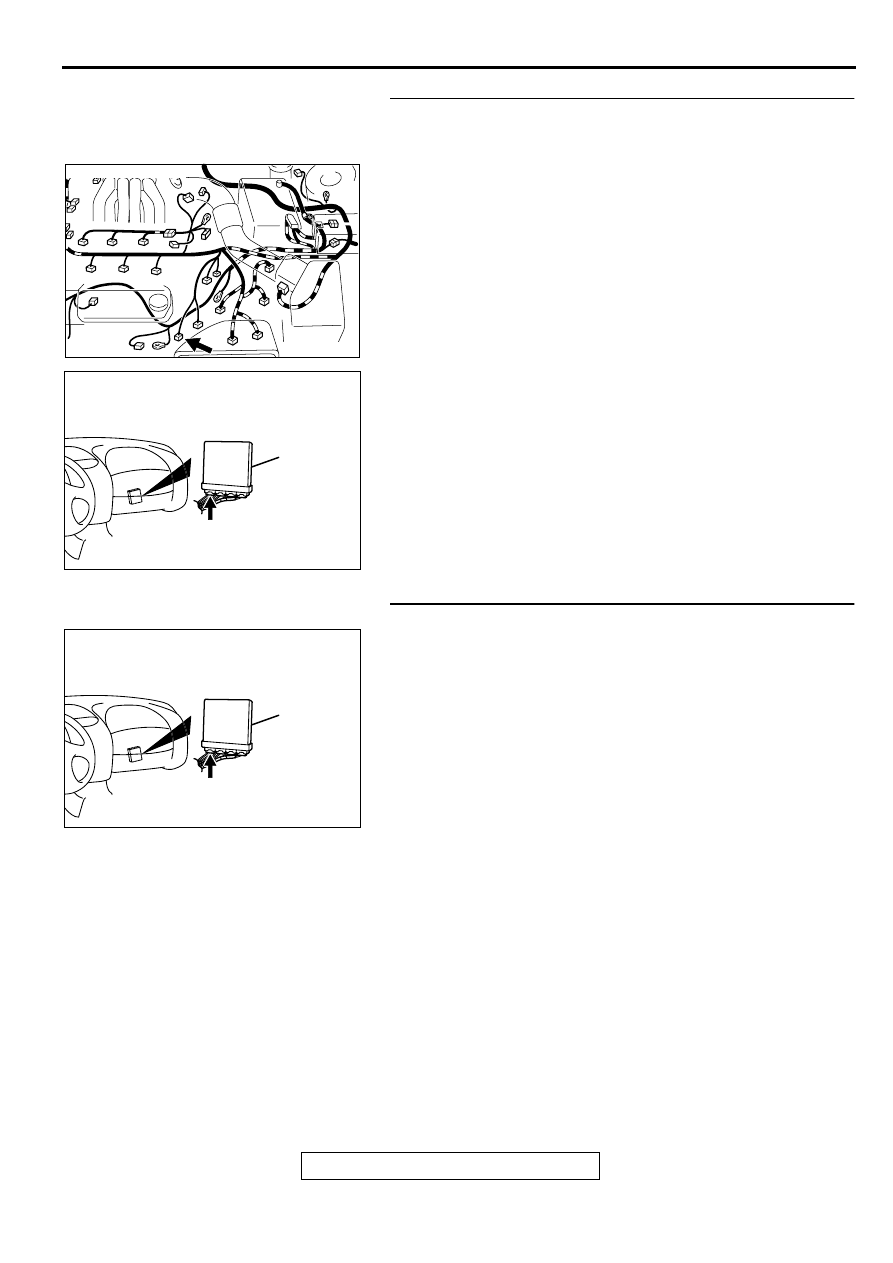
STEP 9. Check for harness damage between MFI relay 
connector A-21X terminal 1 and left bank heated oxygen 
sensor (rear) connector B-29 terminal 1.
Q: Is the harness wire in good condition?

YES : Go to Step 10.
NO :  Repair it. Then go to Step 12.

STEP 10. Check for harness damage between left bank 
heated oxygen sensor (rear) connector B-29 terminal 3 and 
PCM connector C-39 terminal 26.
Q: Is the harness wire in good condition?

YES : Go to Step 11.
NO :  Repair it. Then go to Step 12.

AK000555AB

CONNECTOR : A-21X

MFI RELAY

AK000619 AC

CONNECTOR:B-29

AK000619 AC

CONNECTOR:B-29

AK000280

CONNECTOR : C-39

PCM

AW

MULTIPORT FUEL INJECTION(MFI) DIAGNOSIS

TSB Revision

MULTIPORT FUEL INJECTION (MFI) <3.0L>

13B-191

STEP 11. Check the trouble symptoms.
(1) Carry out a test drive with the drive cycle pattern. Refer to, 

Procedure 6 

−

 Other Monitor(

P.13B-4

).

(2) Check the diagnostic trouble code (DTC).

Q: Is the DTC P0161 is output?

YES : Replace the PCM. Then go to Step 12.
NO :  It can be assumed that this malfunction is intermittent. 

Refer to GROUP 00, How to Use Troubleshooting/
Inspection Service Points (

P.00-8

).

STEP 12. Test the OBD-II drive cycle.
(1) Carry out a test drive with the drive cycle pattern. Refer to, 

Procedure 6 

−

 Other Monitor(

P.13B-4

).

(2) Check the diagnostic trouble code (DTC).

Q: Is the DTC P0161 is output?

YES : Retry the troubleshooting.
NO :  The inspection is complete.

DTC P0171: System too Lean (bank 1)

System too Lean (bank 1) Circuit

•

Refer to, DTC P0201,P0203,P0205 

−

 Injector 

Circuit (

P.13B-212

).

CIRCUIT OPERATION

•

Refer to, DTC P0201,P0203,P0205 

−

 Injector 

Circuit (

P.13B-212

).

TECHNICAL DESCRIPTION

•

If a malfunction occurs in the fuel system, the fuel 
trim value becomes too large.

•

The PCM checks whether the fuel trim value is 
within a specified range.

DTC SET CONDITIONS

Check Area

•

Engine coolant temperature is lower than 
approximately 100

°

 C (212

°

 F) when the engine 

is started.

•

Intake air temperature is lower than 60

°

 C (140

°


F) when the engine is started.

•

Under the closed loop air/fuel ratio control.

•

Intake air temperature is higher than -10

° 

C (14

° 

F).

•

Barometric pressure is higher than 76kPa (11 
psi).

•

Volume air flow sensor output frequency is 100 
Hz or more.

Judgment Criteria

•

Long-term fuel trim has continued to be higher 
than +12.5 for 5 seconds.

or

•

Short-term fuel trim has continued to be higher 
than +7.4 for 5 seconds.

Check Area

•

Engine coolant temperature is lower than 
approximately 100

°

 C (212

°

 F) when the engine 

is started.

•

Intake air temperature is lower than 60

°

 C (140

°


F) when the engine is started.

•

Under the closed loop air/fuel ratio control.

•

Intake air temperature is higher than -10

° 

C (14

° 

F).

•

Barometric pressure is higher than 76kPa (11 
psi).

•

Volume air flow sensor output frequency is 100 
Hz or less.

Judgment Criteria

•

Long-term fuel trim has continued to be higher 
than +12.5 for 5 seconds.

or

•

Short-term fuel trim has continued to be higher 
than +12.4 for 5 seconds.

Check Area

•

Engine coolant temperature is higher than 
approximately 100

°

 C (212

°

 F) when the engine 

is started.

MULTIPORT FUEL INJECTION(MFI) DIAGNOSIS

TSB Revision

MULTIPORT FUEL INJECTION (MFI) <3.0L>

13B-192

•

Intake air temperature is higher than 60

°

 C (140

°


F) when the engine is started.

•

Under the closed loop air/fuel ratio control.

•

Intake air temperature is higher than -10

° 

C (14

° 

F).

•

Barometric pressure is higher than 76kPa (11 
psi).

•

Volume air flow sensor output frequency is 100 
Hz or more.

Judgment Criteria

•

Long-term fuel trim has continued to be higher 
than +12.5 for 5 seconds.

or

•

Short-term fuel trim has continued to be higher 
than +17.4 for 5 seconds.

Check Area

•

Engine coolant temperature is higher than 
approximately 100

°

 C (212

°

 F) when the engine 

is started.

•

Intake air temperature is higher than 60

°

 C (140

°


F) when the engine is started.

•

Under the closed loop air/fuel ratio control.

•

Intake air temperature is higher than -10

° 

C (14

° 

F).

•

Barometric pressure is higher than 76kPa (11 
psi).

•

Volume air flow sensor output frequency is 100 
Hz or less.

Judgment Criteria

•

Long-term fuel trim has continued to be higher 
than +12.5 for 5 seconds.

or

•

Short-term fuel trim has continued to be higher 
than +22.4 for 5 seconds.

Check Area

•

Under the closed loop air/fuel ratio control.

•

The right bank heated oxygen sensor (front) is 
active.

Judgment Criteria

•

Long-term fuel trim has continued to be higher 
than +12.5 for 5 seconds.

or

•

Short-term fuel trim has continued to be higher 
than +25.0 for 5 seconds.

TROUBLESHOOTING HINTS (The most likely 
causes for this code to be set are:)

•

Volume air flow sensor failed.

•

Injector (Number 1, 3, 5) failed.

•

Incorrect fuel pressure

•

Air drawn in from gaps in gasket, seals, etc.

•

Right bank heated oxygen sensor failed.

•

Engine coolant temperature sensor failed.

•

Intake air temperature sensor failed.

•

Barometric pressure sensor failed.

•

Use of incorrect or contaminated fuel.

•

PCM failed.

DIAGNOSIS

Required Special Tools
MB991502: Scan Tool (MUT-II)

STEP 1. Check the exhaust leaks.

Q: Are there any abnormalities?

YES : Go to Step 2.
NO :  Repair it. Then go to Step 16.

STEP 2. Check the intake system vacuum leak.

Q: Are there any abnormalities?

YES : Go to Step 3.
NO :  Repair it. Then go to Step 16.


Content   ..  239  240  241  242   ..