Moroccan Arabic Textbook (2011) - page 2
123
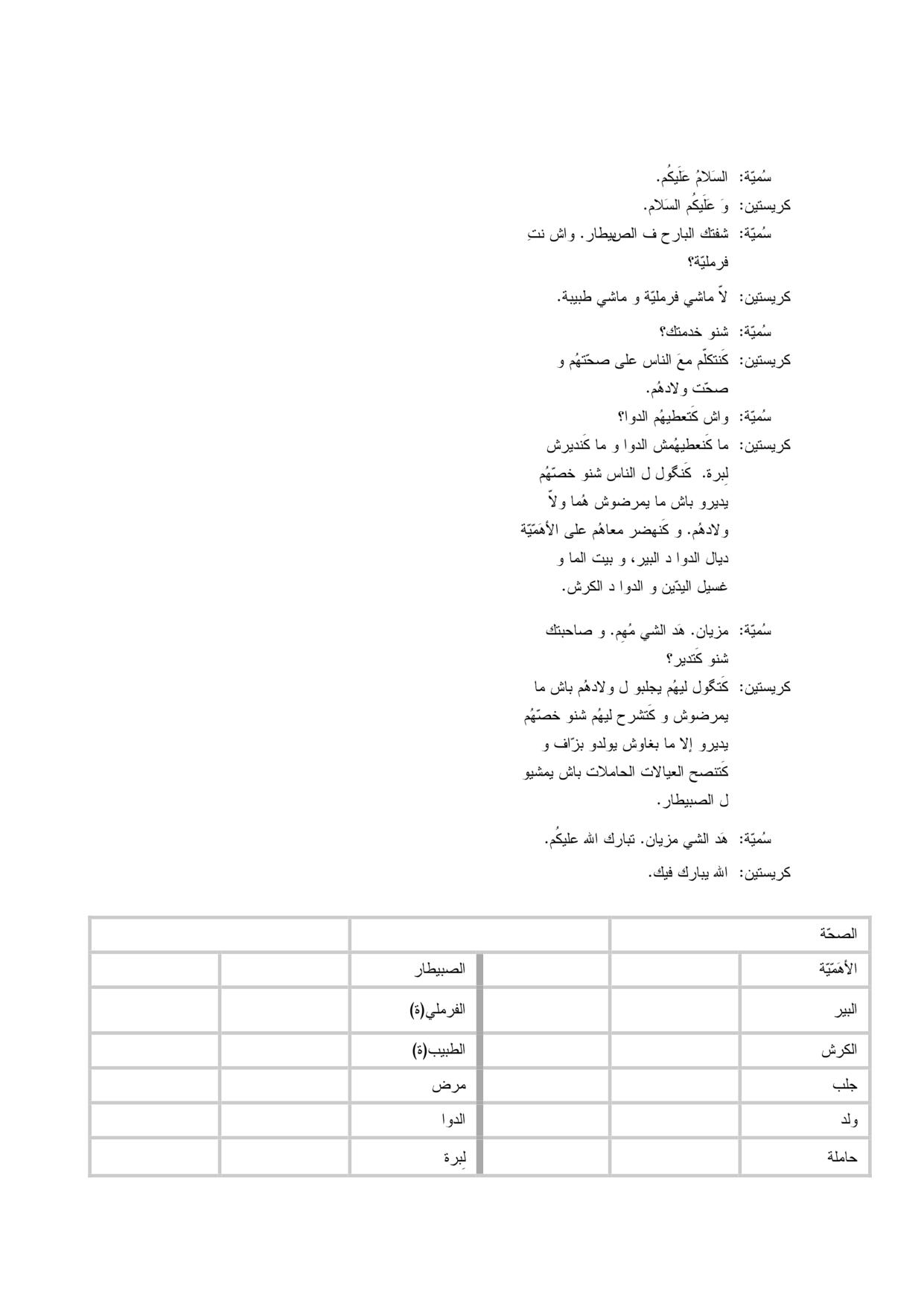
Health
Dialogue
Sumiya: s-salamu عalaykum.
Christine: wa عalaykum s-salam.
Sumiya:
šftk l-barн f s-sbitar.
weš nti frmliya?
Christine: lla maši frmliya u maši
tbiba.
Sumiya: šnu xdmtk?
Christine: kan-tkllm mعa n-nas عla
sннthum u sннt wladhum.
Sumiya: weš kat-عtihum d-dwa?
Christine:
ma-kan-عtihum-š d-dwa u
ma-kan-dir-š libra.
kan-gul l n-nas šnu xsshum
y-diru baš ma-y-mrdu-š
huma wlla wladhum. u
kan-hdr mعahum عla
l-'ahammiya dyal d-dwa d
l-bir, u bit l-ma u ġsil
l-yddin u d-dwa d l-krš.
Sumiya: mzyan. had š-ši muhim. u
saнbtk šnu kat-dir?
Christine: kat-gul lihum y-jlbu l
wladhum baš ma-y-mrdu-š u
kat-šrн lihum šnu xsshum
y-diru ila ma-bġau-š
y-wldu bzzaf u kat-nsн
l-عyalat l-нamlat baš
y-mšiu l s-sbitar.
Sumiya: had š-ši mzyan. tbark lla
عlikum.
Christine: lla y-bark fik.
Vocabulary and Expressions
health
s-sннa
health clinic
s-sbitar
the importance
l-'ahammiya
the (water)
nurse
l-frmli(ya)
l-bir
well
doctor
t-tbib(a)
diarrhea
l-krš
to be sick
mrd
to immunize
jlb
medicines
d-dwa
to give birth
wld
the shot
libra
pregnant
нamla
124 • Moroccan Arabic
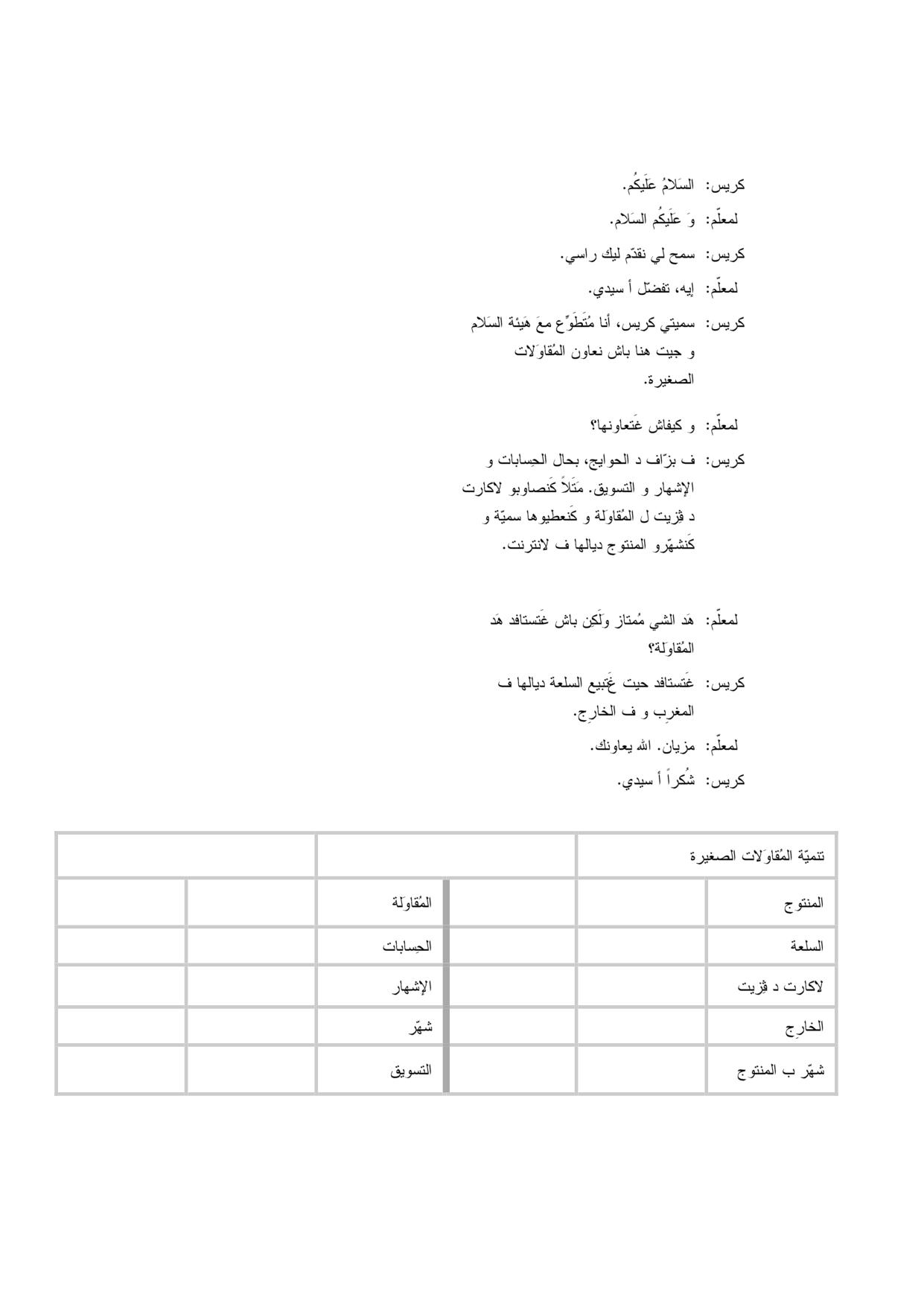
Small Business Development
Dialogue
Chris: s-salamu عalaykum.
l-mعllm: wa عalaykum s-salam.
Chris: smн li n-qddm lik rasi.
l-mعllm: iyeh, tfddl a sidi.
Chris: smiti Chris, ana
mutatawwiع mعa hay'at
s-salam u jit hna baš
n-عawn l-muqawalat
s-sġira.
l-mعllm: u kifaš ġat-عawnha?
Chris: f bzzaf d l-нwayj, bнal
l-нisabat u l-'išhar u
t-tswiq. matalan
kan-sawbu lakart d vizit
l l-muqawala u
kan-عtiuha smiya u
kan-šhhru l-mntuj dyalha
f l-internet.
l-mعllm: had š-ši mumtaz welakin
baš ġat-stafd had
l-muqawala?
Chris: ġat-stafd нit ġat-biع
s-slعa dyalha f l-mġrib
u f l-xarij.
l-mعllm: mzyan. lla y-عawnk.
Chris: šukran a sidi.
Vocabulary and Expressions
tnmiyat l-muqawalat
small business development
s-sġira
enterprise /
l-muqawala
products
l-mntuj
firm
accountancy
l-нisabat
merchandise
s-slعa
lakart d
advertisement
l-'išhar
business card
vizit
to advertise
šhhr
abroad
l-xarij
to advertise
šhhr b
marketing
t-tswiq
the products
l-mntuj
125
Renting a House
Objective: By the end of the chapter, you will be able to:
• speak about renting and furnishing houses
Finding a House
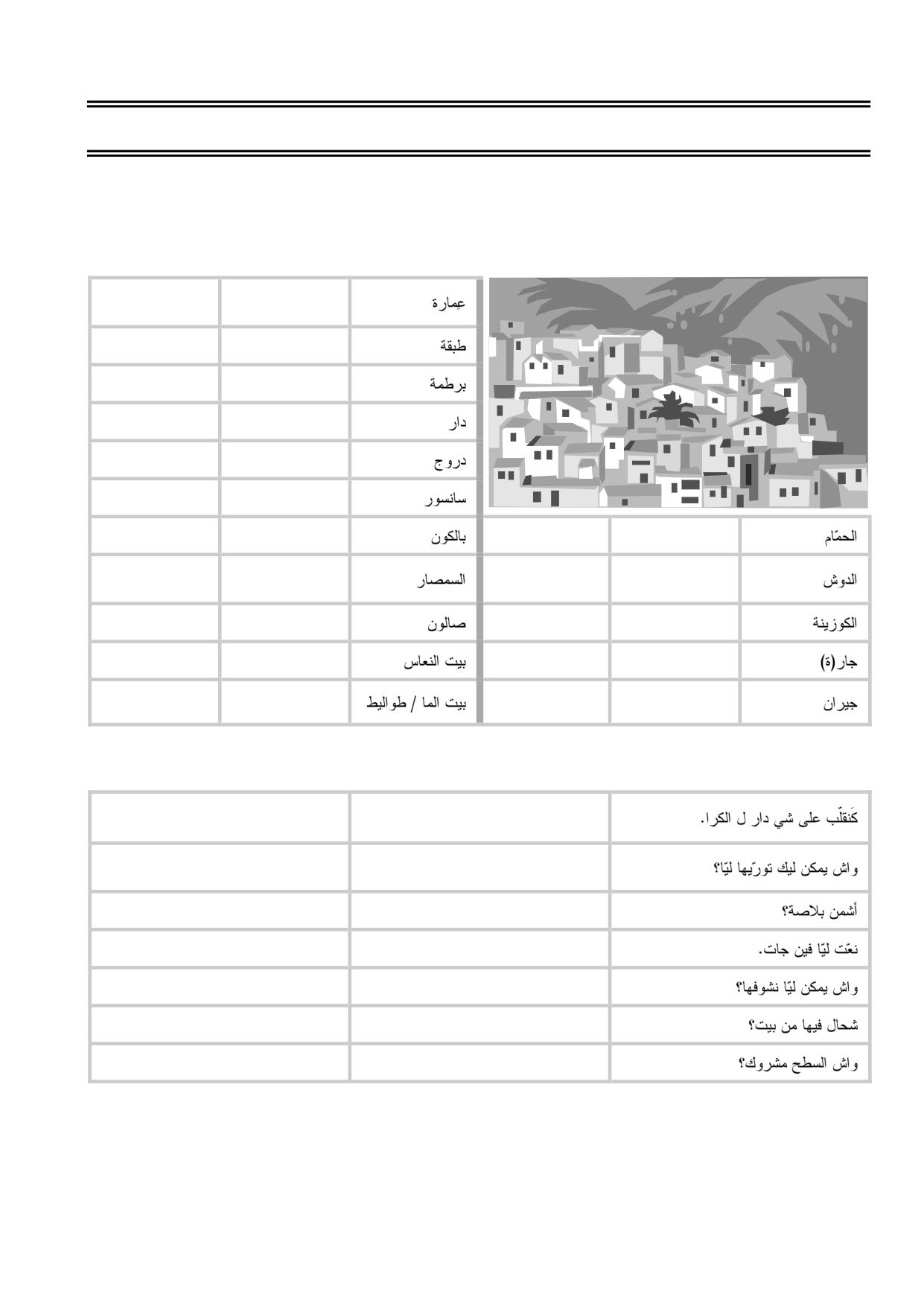
Vocabulary
building /
عimara
block of flats
floor
tbqa
apartment
brtma
house
dar
stairs
druj
elevator
sansur
balcony
balkun
bath
l-нmmam
rental agent
s-smsar
shower
d-duš
(in cities)
living room
salun
kitchen
l-kuzina
bedroom
bit n-nعas
neighbor
jar(a)
bit l-ma /
bathroom
neighbors
jiran
twalet
Expressions
kan-qllb عla ši dar l
I‟m looking for a house to rent.
l-kra.
weš ymkn lik t-wrriha
Can you show it to me?
liya?
Where is it located?
ašmn blasa?
Give me directions to it.
nععt liya fin jat.
Can I see it?
weš ymkn liya n-šufha?
How many rooms does it have?
šнal fiha mn bit?
Is the roof for common use?
weš s-stн mšruk?
126 • Moroccan Arabic
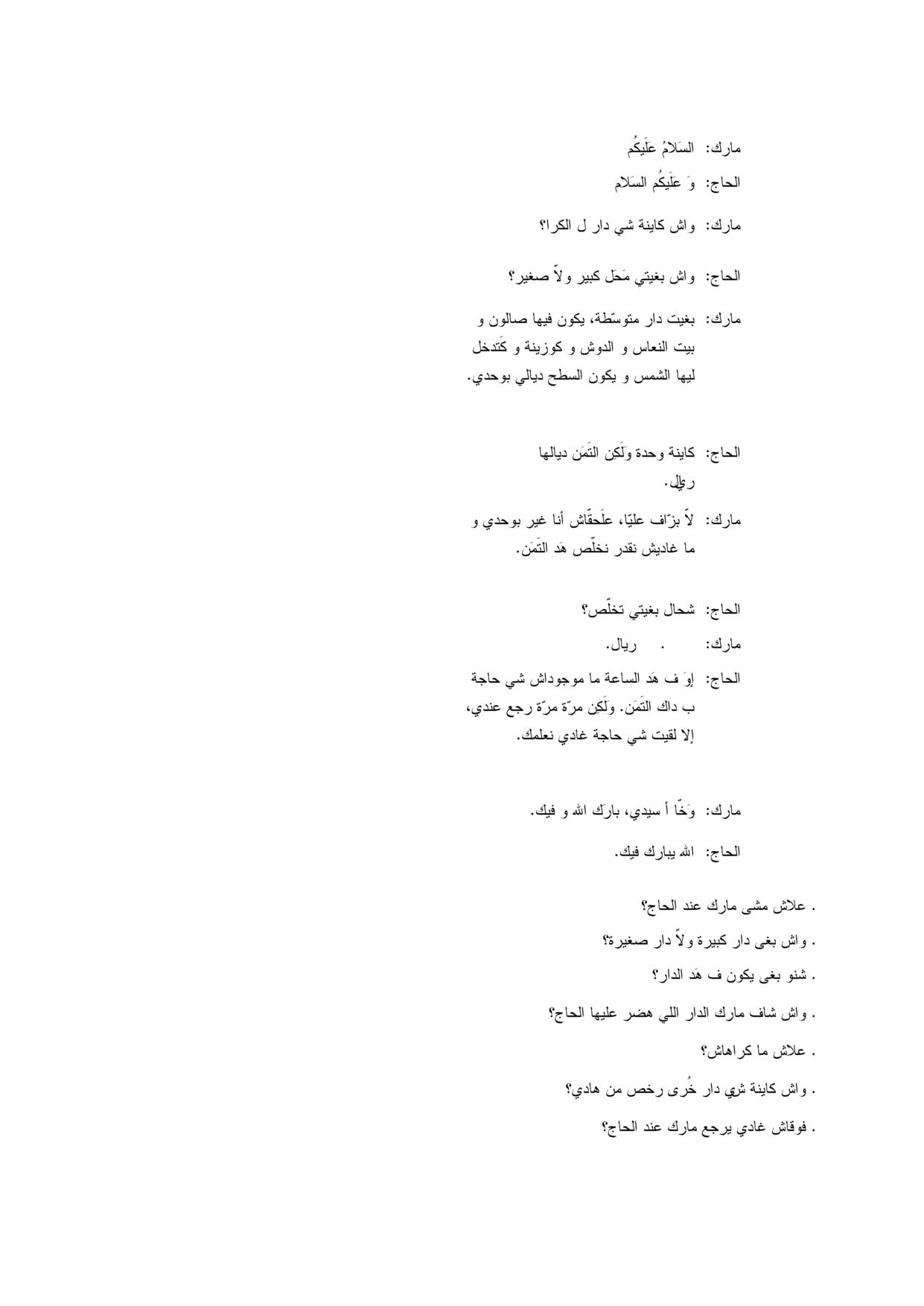
Dialogue
Mark: s-salamu عalaykum
l-нaj: wa عalaykum s-salam
Mark:
weš kayna ši dar l
l-kra?
l-нaj: weš bġiti maнal kbir
wlla sġir?
Mark:
bġit dar mtwssta, y-kun
fiha salun u bit n-nعas
u d-duš u kuzina u
kat-dxl liha š-šms u
y-kun s-stн dyali
b-wнdi.
l-нaj: kayna wнda welakin
20.000
t-taman dyalha 20.000
ryal.
Mark: lla bzzaf عliya,
عlaнqqaš ana ġir b-wнdi
u ma-ġadi-š n-qdr n-xlls
had t-taman.
l-нaj: šнal bġiti t-xlls?
Mark:
10.000 ryal.
10 000
l-нaj: iwa f had s-saعa
ma-mujuda-š ši нaja b
dak t-taman. welakin
mrra mrra rjع عndi, ila
lqit ši нaja ġadi
n-عlmk.
Mark: waxxa a sidi, barak lla
u fik.
l-нaj: lla y-bark fik.
1. عlaš mša Mark عnd l-нaj?
1
2. weš bġa dar kbira wlla dar sġira?
2
3. šnu bġa y-kun f had d-dar?
3
4. weš šaf Mark d-dar l-li hdr
4
عliha l-нaj?
5. عlaš ma-kraha-š?
5
6. weš kayna ši dar xora rxs
6
mn hadi?
7. fuqaš ġadi y-rjع Mark عnd l-нaj?
7
127
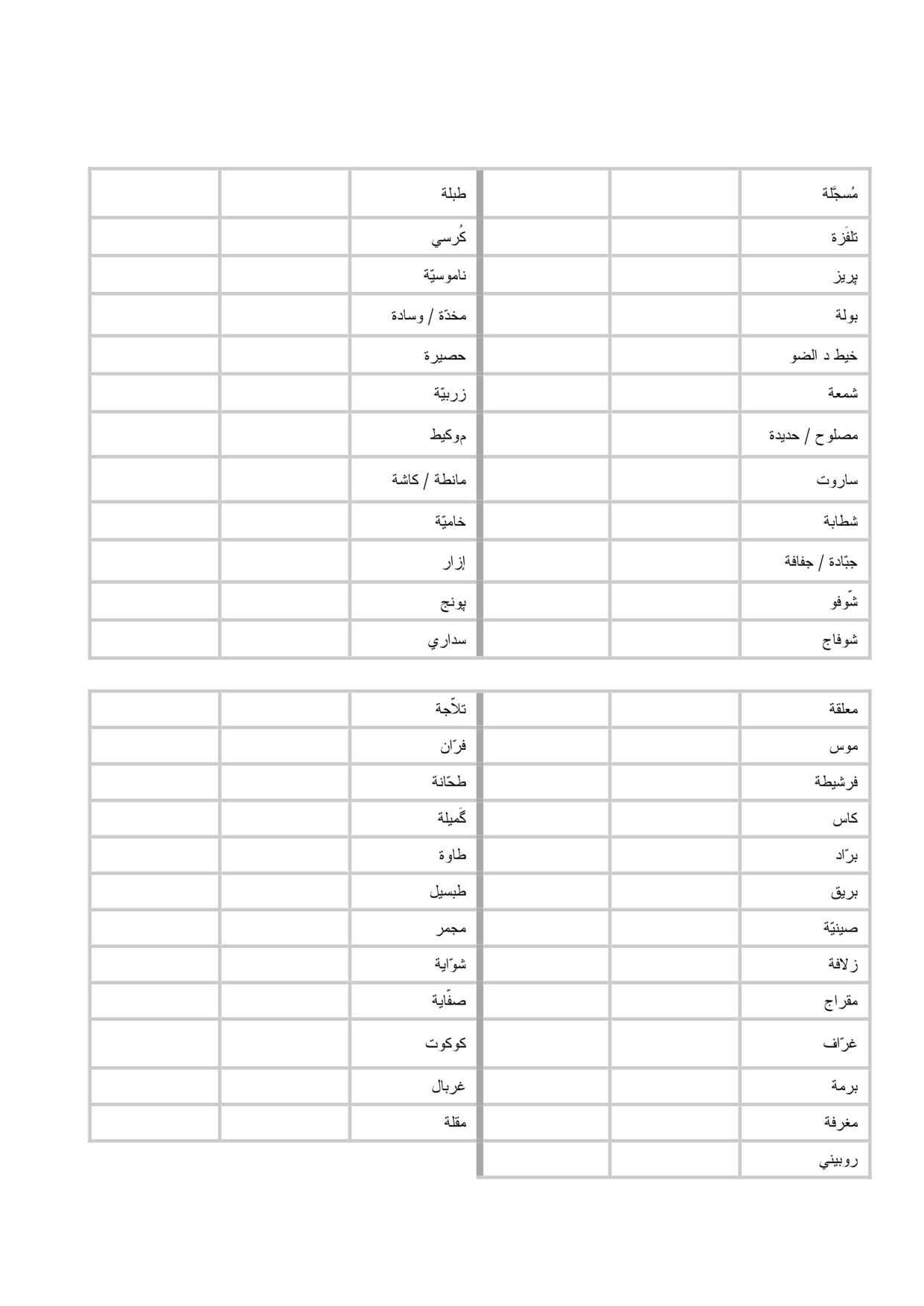
Furnishing a House
House Furniture
radio / tape
table
tbla
musjjala
recorder
chair
kursi
television
tlfaza
bed
namusiya
electric outlet
priz
mxdda /
pillow
light bulb
bola
usada
floor mat
нsira
electric cord
xit d d-dow
rug
zrbiya
candle
šmعa
msluн /
carpet
mukit
iron
нdida
manta /
blanket
key / switch
sarut
kaša
curtain
xamiya
broom
štaba
jbbada /
sheet
izar
squeegee
jfafa
Moroccan sofa
ponj
water heater
ššufu
couch
sdari
heater
šofaj
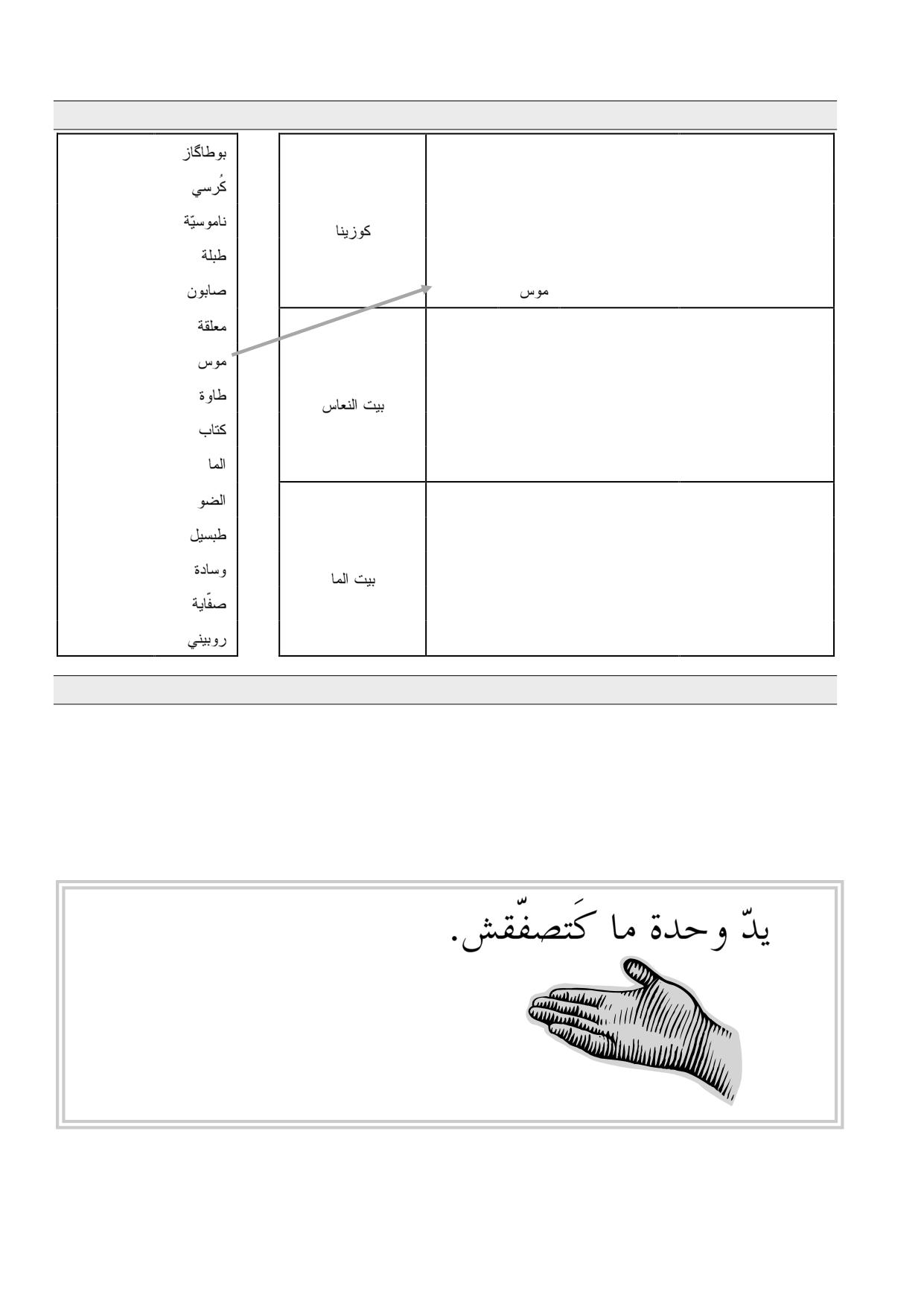
Kitchenware
refrigerator
tllaja
spoon
mعlqa
oven
frran
knife
mus
blender
tннana
fork
fršita
saucepan
gamila
glass
kas
cooking pot
tawa
teapot
brrad
plate
tbsil
coffee pot
briq
brazier
mjmr
tray
siniya
grill
šuwaya
bowl
zlafa
strainer
sffaya
kettle
mqraj
pressure
kokot
pitcher
ġrraf
cooker
sifter
ġrbal
couscous pot
brma
frying pan
mqla
ladle
mġrfa
faucet
robini
128 • Moroccan Arabic
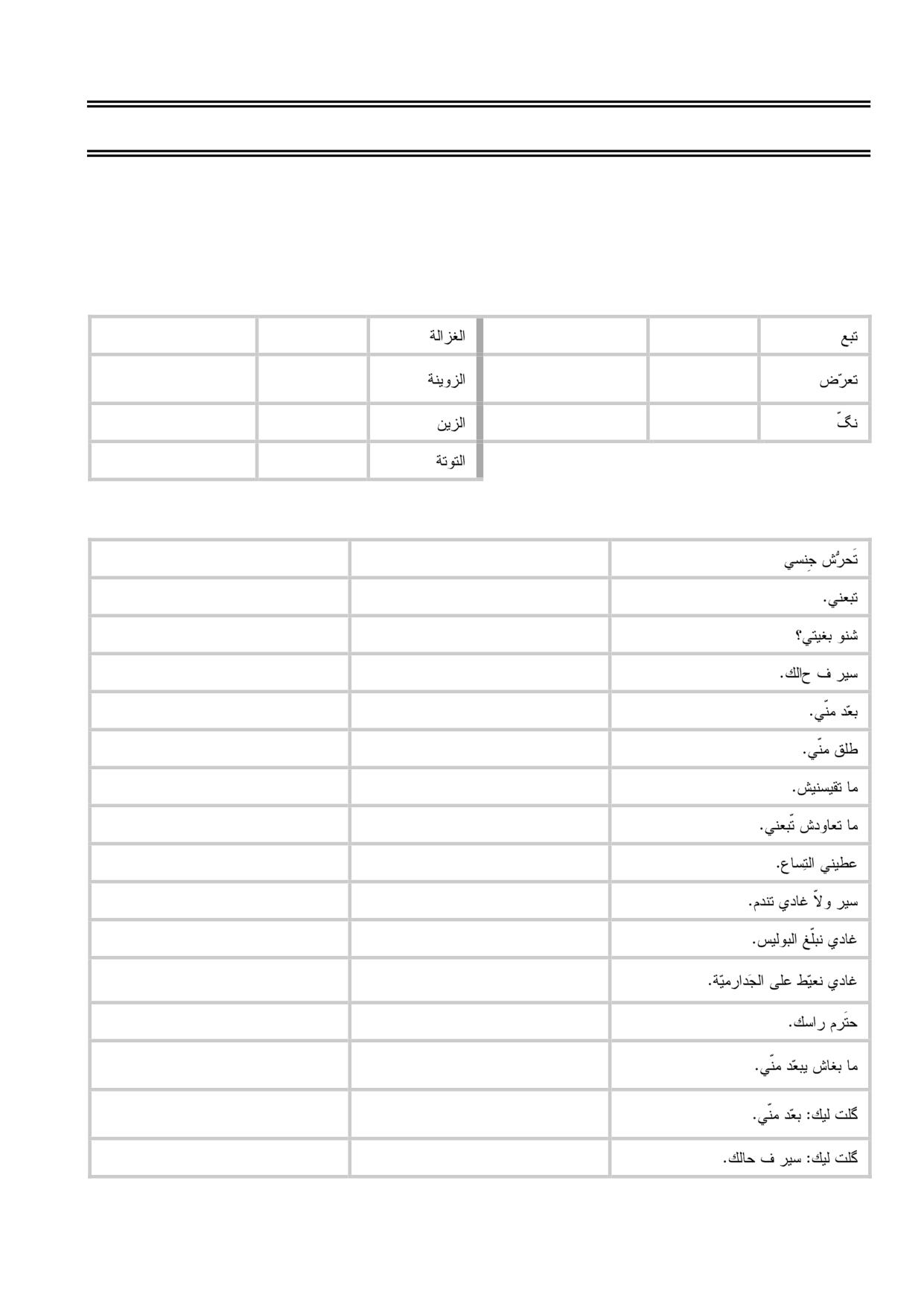
Exercise: Put the household items in the correct “room.”
butagaz
kursi
kuzina
namusiya
tbla
sabun
mus
mعlqa
mus
bit n-nعas
tawa
ktab
l-ma
d-du
tbsil
bit l-ma
usada
sffaya
robini
Exercise: Describe in Darija the house you want to rent.
Moroccan Wisdom:
ydd wнda ma-kat-sffq-š.
One hand can’t clap.
129
Safety and Security
Objective: By the end of the chapter, you will be able to:
• list some safety and security problems you may face during your service
• describe some strategies for dealing with these issues
• use Moroccan Arabic to implement these strategies
Sexual Harassment
Vocabulary
gazelle*
l-ġzala
to follow someone
tbع
to get in someone's
the beautiful*
z-zwina
tعrrd
way
the beauty*
z-zin
to harass
ngg
a strawberry (girl)*
t-tuta
*These words are used by men to harass women.
Expressions
sexual harassment
taнrruš jinsi
He followed me.
tbعni.
What do you want?
šnu bġiti?
Go away.
sir f нalk.
Get away (far) from me.
bععd mnni.
Let go of me.
tlq mnni.
Don‟t touch me.
ma-t-qisni-š.
Don‟t follow me again.
ma-t-عawd-š t-tbعni.
Give me some space. (go away)
عtini t-tisaع.
Go or you will regret it.
sir wlla ġadi t-ndm.
I will tell the police.
ġadi n-bllġ l-bulis.
ġadi n-عiyt عla
I will call the gendarmes.
j-jadarmiya.
Respect yourself.
нtarm rask.
He doesn‟t want to get away
ma-bġa-š y-bععd mnni.
(far) from me.
I told you: get away (far) from
glt lik: bععd mnni.
me.
I told you: go away.
glt lik: sir f нalk.
130 • Moroccan Arabic
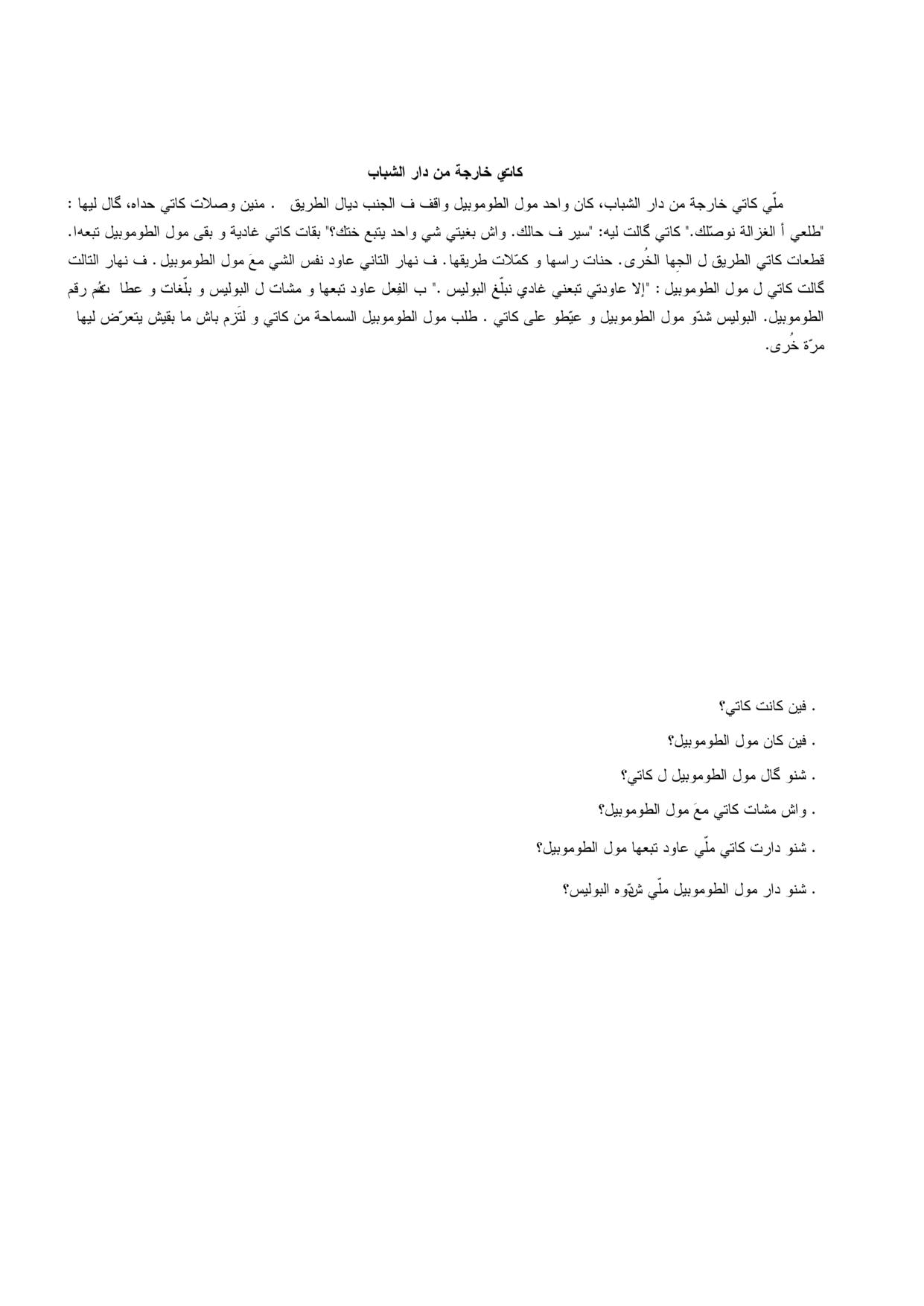
Text - Arabic
Text - Transcription
Cathy xarja mn dar š-šbab
mlli Cathy xarja mn dar š-šbab, kan waнd mul t-tumubil waqf f j-jnb
dyal t-triq. mnin wslat Cathy нdah, gal liha: "tlعi a l-ġzala n-wsslk."
Cathy galt lih: "sir f нalk. weš bġiti ši waнd y-tbع xtk?" bqat Cathy
ġadya u bqa mul t-tumubil tbعha. qtعat Cathy t-triq l j-jiha l-xura. нnat
rasha u kmmlat triqha. f nhar t-tani عawd nfs š-ši mعa mul t-tumubil. f
nhar t-talt galt Cathy l mul t-tumubil: "ila عawdti tbعni ġadi n-bllġ
l-bulis." b l-fiعl عawd tbعha u mšat l l-bulis u bllġat u عtathum rqm
t-tumubil. l-bulis šddu mul t-tumubil u عiytu عla Cathy. tlb mul
t-tumubil s-smaнa mn Cathy u ltazm baš ma-bqi-š y-tعrrd liha mrra xora.
Questions
1. fin kant Cathy?
1
2. fin kan mul t-tumubil?
2
3. šnu gal mul t-tumubil l Cathy?
3
4. weš mšat Cathy mعa mul t-tumubil?
4
5. šnu dart Cathy mlli عawd tbعha
5
mul t-tumubil?
6. šnu dar mul t-tumubil mlli šdduh
6
l-bulis?
Text - English Translation
Cathy coming out of the youth center
When Cathy was coming out of the youth center, there was a man in his car by the side of the
road. As she passed by him, he told her: “Get in gazelle, I will take you home.” Cathy said: “Go
away. Is it okay with you if someone harasses your sister?” Cathy kept walking and the man was
following her with his car. She crossed the road, ignoring him, and continued on her way. The next
day, the same thing happened with that man. The following day Cathy told the man: “If you follow
me again I will tell the police.” In fact, he did follow her again and so she went to the police station.
She told them what happened and gave them the license plate number. The police arrested the
man and called Cathy. The man apologized to Cathy and promised not to get in her way again.
131
At the Taxi Stand
Vocabulary
seat
blasa
windshield
j-jaja
tire
rwida
cracked
mšquqa
smooth
memsuнa
to be afraid
xaf
to happen
wqع
Expressions
Drive slowly please.
sug b š-šwiya عafak.
llahumma slama wala
Better safe than sorry.
ndama.
Dialogue
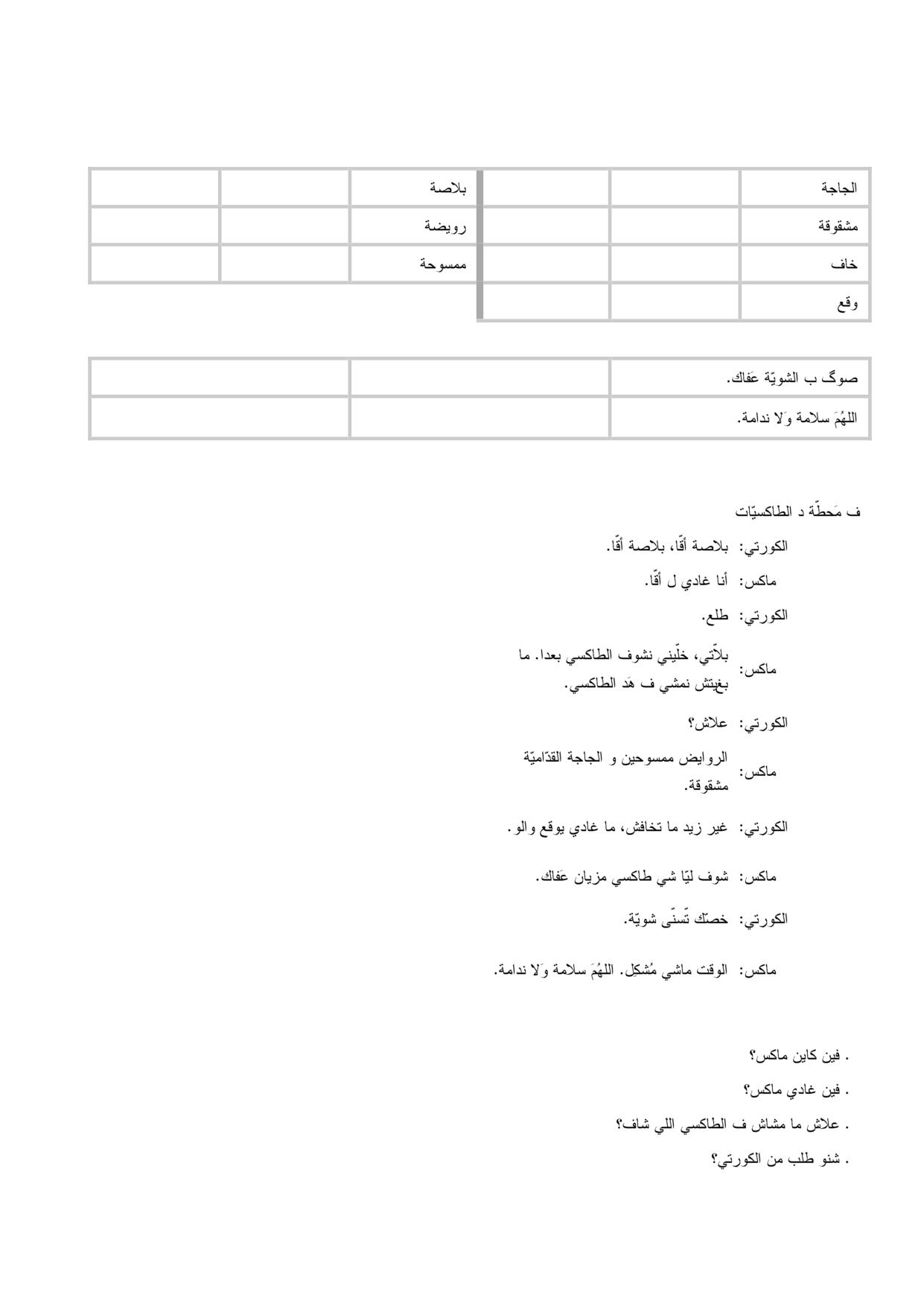
f maнtta d t-taxiyat
l-kurti: blasa Akka, blasa Akka.
Max: ana ġadi l Akka.
l-kurti: tlع.
Max: bllati, xllini n-šuf
t-taksi bعda. ma-bġit-š
n-mši f had t-taksi.
l-kurti: عlaš?
Max: r-rwayd mmsuнin u j-jaja
l-qddamiya mšquqa.
l-kurti: ġir zid ma-t-xaf-š, ma
ġadi y-wqع walu.
Max: šuf liya ši taxi mzyan
عafak.
l-kurti: xssk t-tsnna šwiya.
Max: l-wqt maši muškil.
llahumma slama wala
ndama.
Questions
1. fin kayn Max?
1
2. fin ġadi Max?
2
3. عlaš ma-mša-š f t-taxi l-li šaf?
3
4. šnu tlb mn l-kurti?
4
132 • Moroccan Arabic
English Translation
At the taxi stand
l-kurti:
A seat to Aqqa, a seat to Aqqa.
Max:
I am going to Aqqa.
l-kurti:
Get in.
Max:
Wait. Let me see the taxi first
I don‟t want to go in this taxi.
l-kurti:
Why?
Max:
The tires are smooth and the windshield is cracked.
l-kurti:
Come on, don‟t worry. Nothing is going to happen.
Max:
Find me a good taxi.
l-kurti:
You have to wait a little bit.
Max:
Time is not a problem. Better safe than sorry.
At Work
Vocabulary
to bring in
dxxl
to lock to
šdd mعa
(something)
to take out
xrrj
to steal
srq
a lock
qfl
to be stolen
tsrq
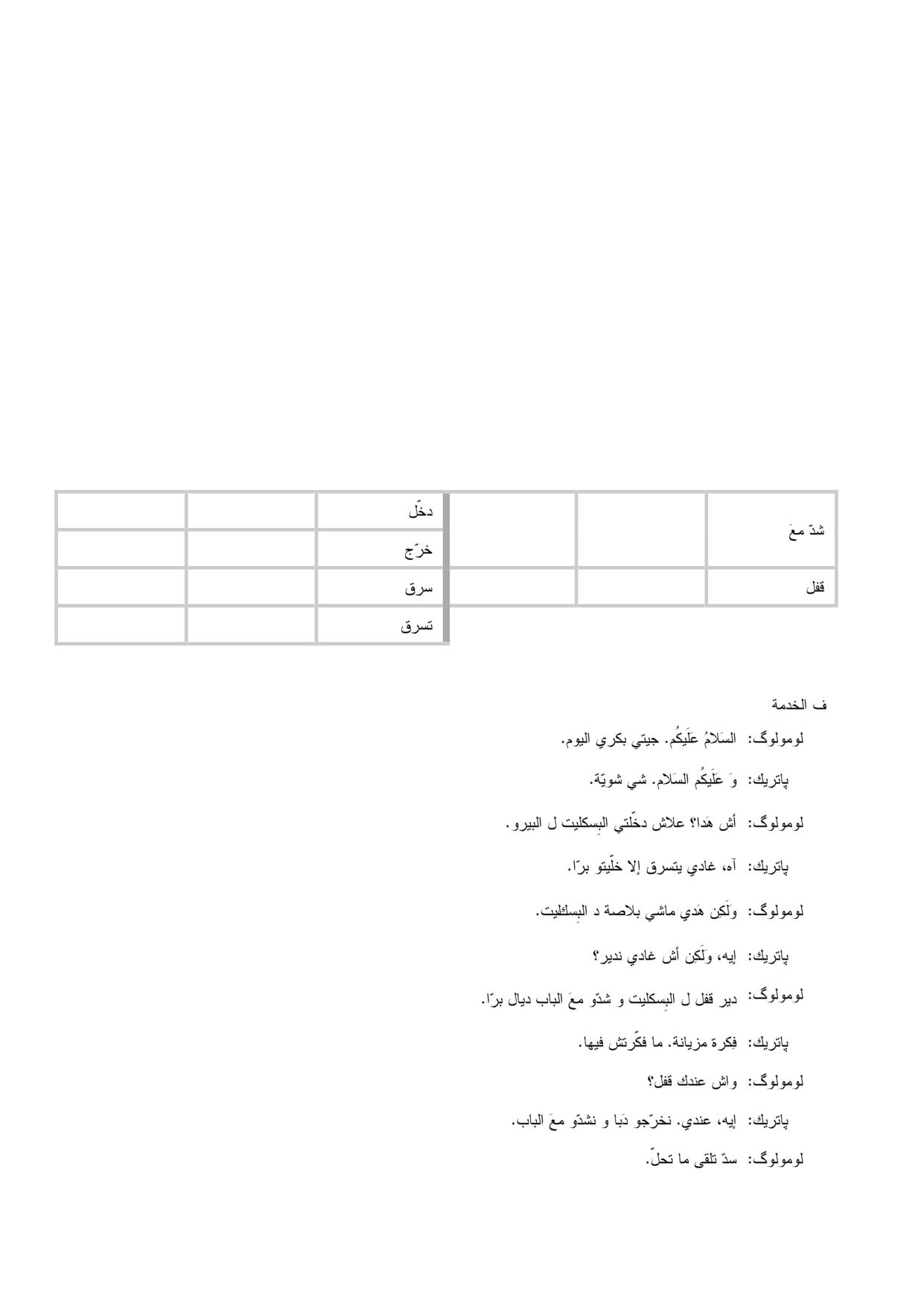
Dialogue
f l-xdma
lomolog: s-salamu عalaykum. jiti
bkri l-yum.
Patrick: wa عalaykum s-salam. ši
šwiya.
lomolog: aš hada? عlaš dxxlti
l-bisklit l l-biru.
Patrick: ah, ġadi y-tsrq ila
xllitu brra.
lomolog:
welakin hadi maši blasa d
l-bisklit.
Patrick: iyeh, welakin aš ġadi
n-dir?
lomolog: dir qfl l l-bisklit u
šddu mعa l-bab dyal brra.
Patrick: fikra mzyana. ma-fkkrt-š
fiha.
lomolog: weš عndk qfl?
Patrick: iyeh, عndi. n-xrrju daba
u n-šddu mعa l-bab.
lomolog: sdd t-lqa ma-t-нll.
133
Questions
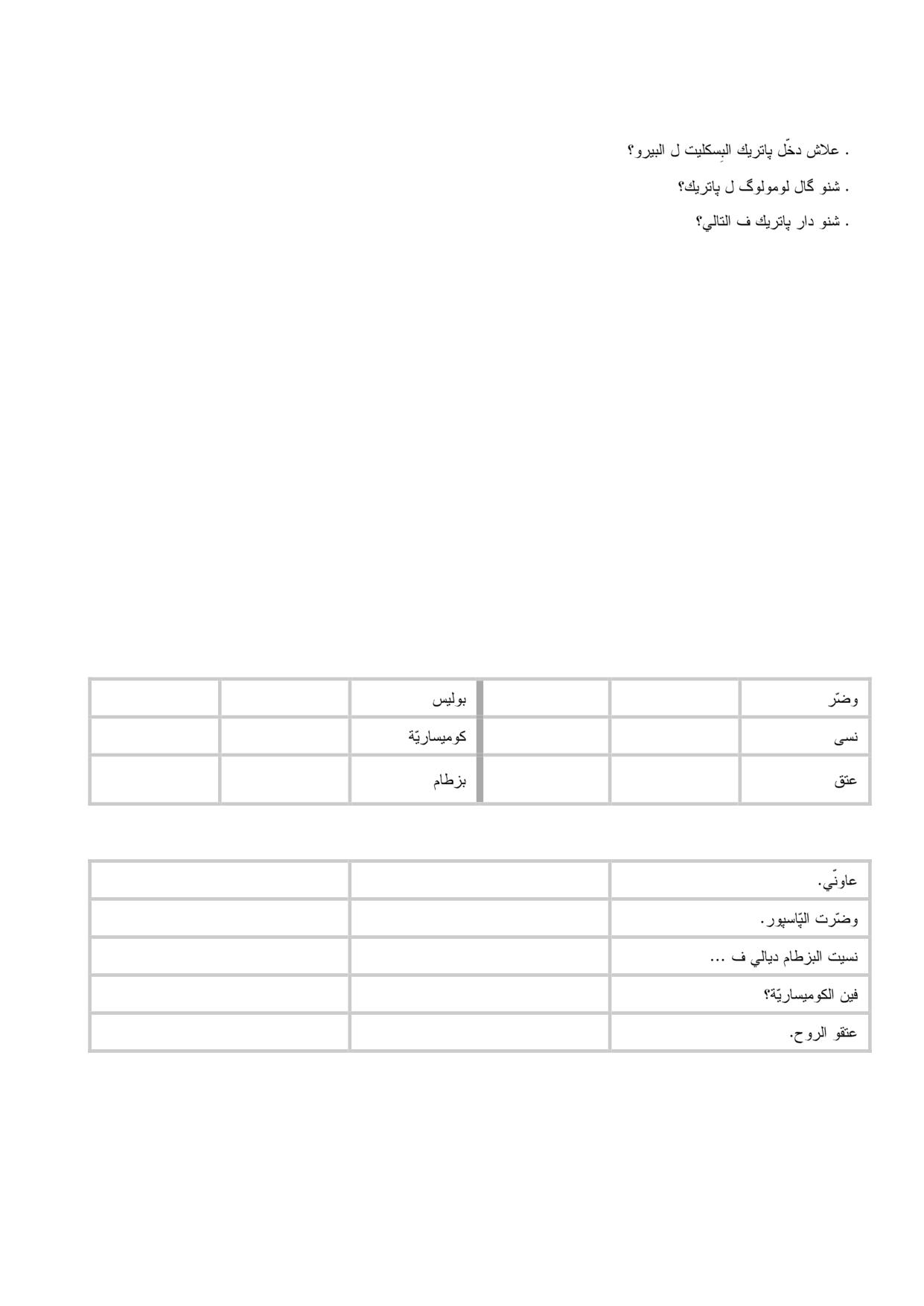
1. عlaš dxxl Patrick l-bisklit l
1
l-biru?
2. šnu gal lomolog l Patrick?
2
3. šnu dar Patrick f t-tali?
3
English Translation
At work
counterpart: Peace be upon you. You came in early today.
Patrick: Peace be upon you too. A little bit.
counterpart: What‟s this? Why did you bring your bicycle into the office?
Patrick: Oh. It will be stolen if I leave it outside.
counterpart: But this is not the place for bicycles.
Patrick: Yes, but what should I do?
counterpart: Use a lock with the bicycle, and lock it to the gate.
Patrick: Good idea. I didn‟t think about that.
counterpart: Do you have a lock?
Patrick: Yes, I have one. I‟ll take it outside now and lock it to the gate.
counterpart: Lock now what you will find later.
Forgetting a Wallet in a Taxi / Filing a Report
Vocabulary
police
bulis
to lose
wddr
police station
kumisariya
to forget
nsa
to save
wallet
bztam
عtq
(someone)
Expressions
Help me.
عawnni.
I lost my passport.
wddrt l-ppasppor.
I forgot my wallet in...
nsit l-bztam dyali f...
Where‟s the police station?
fin l-kumisariya?
Help me! (use only in extreme danger)
عtqu r-ruн.
134 • Moroccan Arabic
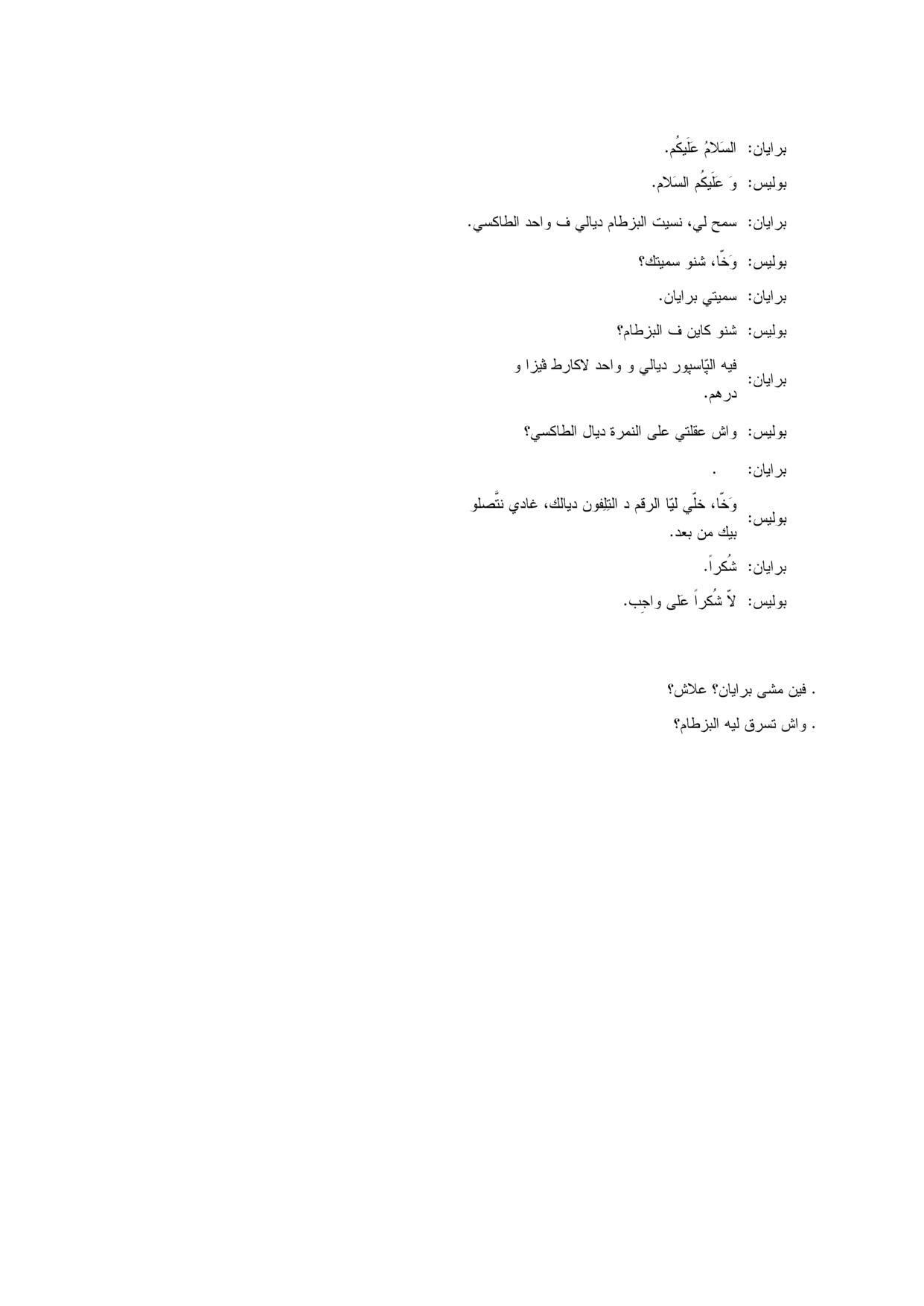
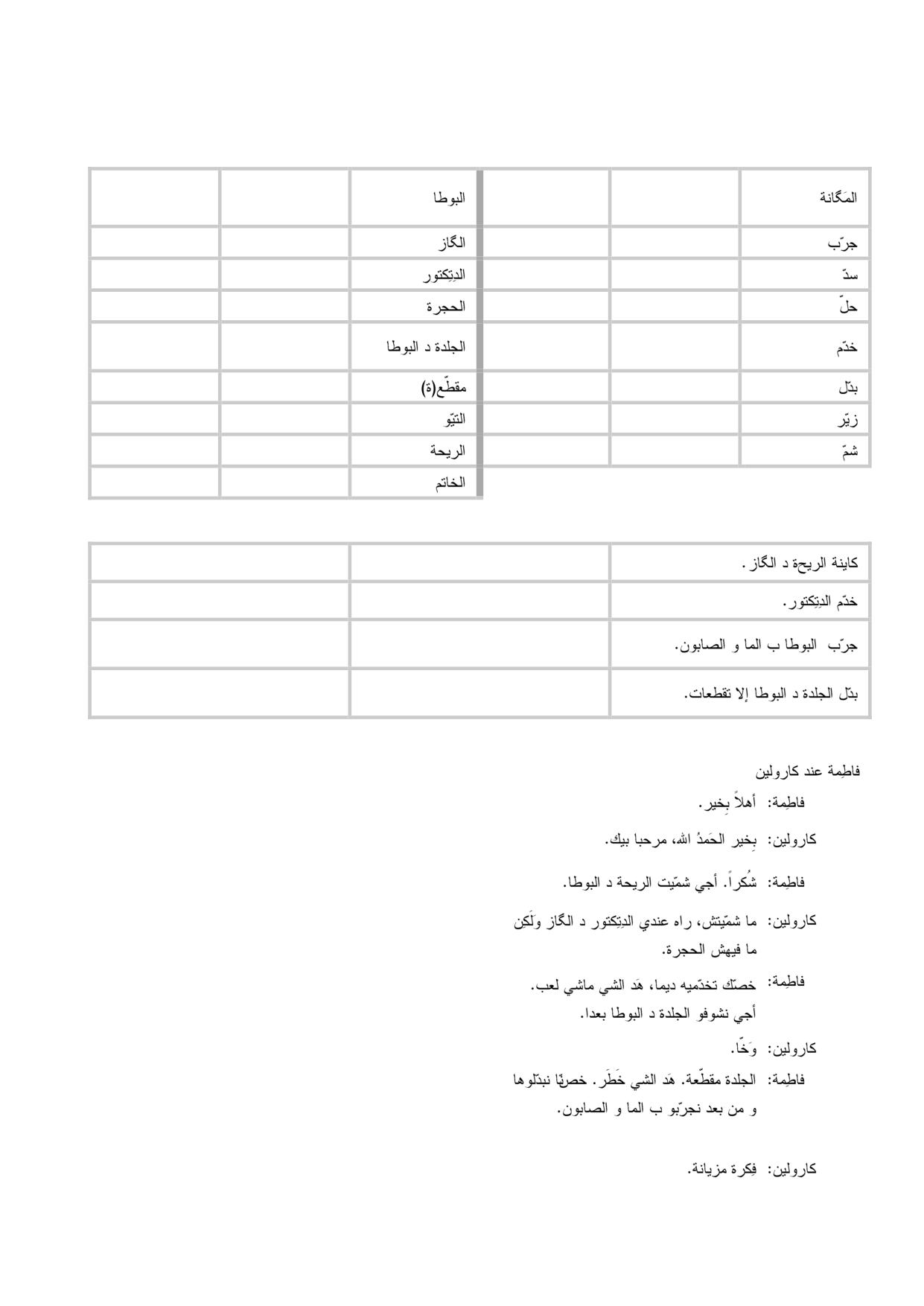
Dialogue
Brian: s-salamu عalaykum.
bulis: wa عalaykum s-salam.
Brian: smн li, nsit l-bztam
dyali f waнd t-taksi.
bulis: waxxa, šnu smitk?
Brian: smiti Brian
bulis: šnu kayn f l-bztam?
Brian: fih l-ppasppor dyali u
500
waнd lakart viza u 500
drhm.
bulis: weš عqlti عla n-nmra
dyal t-taksi?
Brian: 45.
45
bulis: waxxa, xlli liya r-rqm d
t-tilifun dyalk, ġadi
n-ttaslu bik mn bعd.
Brian: šukran.
bulis: lla šukran عala wajib.
Questions
1. fin mša Brian? عlaš?
1
2. weš tsrq lih l-bztam?
2
English Translation
Brian: Peace be upon you.
police: Peace be upon you too.
Brian: Excuse me, I forgot my wallet in a taxi.
police: Okay, what‟s your name?
Brian: My name is Brian ...
police: What was in the wallet?
Brian: My passport, a Visa card, and 500 dirham.
police: Do you remember the taxi‟s number?
Brian:
45.
police: Okay, leave me your phone number, we‟ll call you later.
Brian: Thanks.
police: It‟s my duty.
135
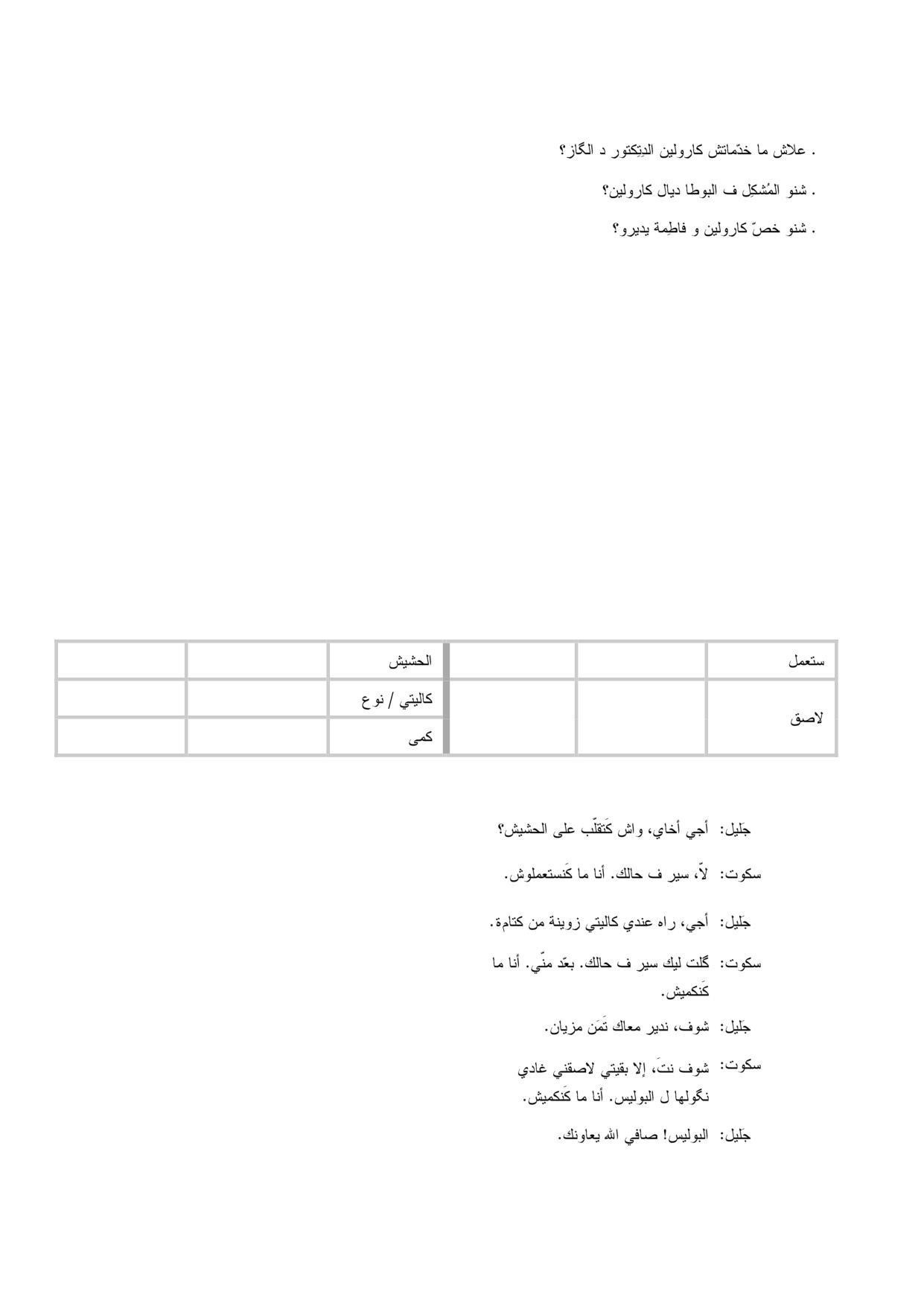
Butagas
Vocabulary
metal regulator
butane gas
l-buta
between gas
l-magana
tank
tank and hose
gas
l-gaz
to test
jrrb
CO detector
d-ditiktur
to close (tank)
sdd
battery
l-нjra
to open (tank)
нll
gasket
j-jlda d
to turn on /
xddm
(rubber ring)
l-buta
to make work
torn
mqttع(a)
to change
bddl
hose
t-tiyu
to tighten
ziyr
odor / smell
r-riнa
to smell
šmm
ring
l-xatm
Expressions
There is a gas smell.
kayna r-riнa d l-gaz.
Turn on the detector.
xddm d-ditiktur.
Test the butagas tank with
jrrb l-buta b l-ma u
water and soap.
s-sabun.
Change the rubber ring if it‟s
bddl j-jlda d l-buta
torn.
ila tqtعat.
Dialogue
Fatima عnd Caroline
Fatima: ahlan bixir.
Caroline: bixir l-нamdullah, mrнba
bik.
Fatima: šukran. aji šmmit r-riнa d
l-buta.
Caroline: ma-šmmit-š, rah عndi
d-ditiktur d l-gaz welakin
ma-fih-š l-нjra.
Fatima: xssk t-xddmih dima, had
š-ši maši lعb. aji n-šufu
j-jlda d l-buta bعda.
Caroline: waxxa.
Fatima: j-jlda mqttعa. had š-ši
xatar. xssna n-bddluha u
mn bعd n-jrrbu b l-ma u
s-sabun.
Caroline: fikra mzyana.
136 • Moroccan Arabic
Questions
1. عlaš ma-xddmat-š Caroline
1
d-ditiktur d l-gaz?
2. šnu l-muškil f l-buta dyal
2
Caroline?
3. šnu xss Caroline u Fatima y-diru?
3
English Translation
Fatima:
Hello, how are you?
Caroline:
Fine, thanks be to God. Welcome.
Fatima:
Thanks. Come here . . . I smell gas.
Caroline:
I don‟t smell it. I have a gas detector but it ran out of batteries.
Fatima:
You should always have it on. This is no game. Let‟s look at the
rubber gasket ring first.
Caroline:
Okay.
Fatima:
You see, the rubber ring is torn. This is dangerous. We have to
change it, then test it with water and soap.
Caroline:
Good idea.
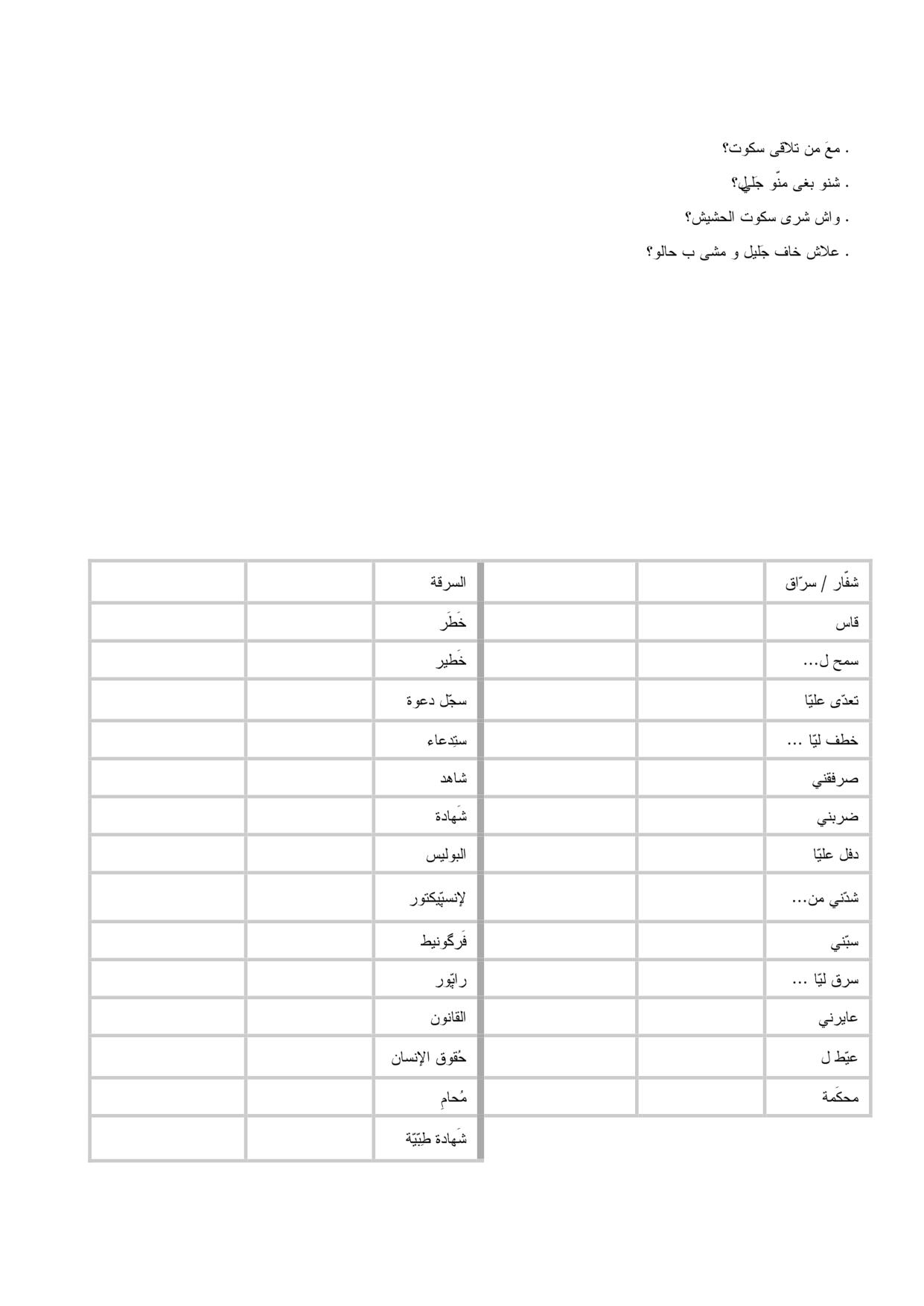
Hash
Vocabulary
hashish
l-нšiš
to use
stعml
quality
kaliti / nuع
sticking to /
bothering
lasq
to smoke
kma
someone
Dialogue
Jalil: aji axay, weš kat-qllb عla
l-нšiš?
Scott: lla, sir f нalk. ana
ma-kan-stعmlu-š.
Jalil: aji, rah عndi kaliti zwina
mn ktama.
Scott: glt lik sir f нalk. bععd
mnni. ana ma-kan-kmi-š.
Jalil: šuf, n-dir mعak taman
mzyan.
Scott:
šuf nta, ila bqiti lasqni
ġadi n-gulha l l-bulis.
ana ma-kan-kmi-š.
Jalil:
l-bulis! safi lla y-عawnk.
137
Questions
1. mعa mn tlaqa Scott?
1
2. šnu bġa mnnu Jalil?
2
3. weš šra Scott l-нšiš?
3
4. عlaš xaf Jalil u mša b нalu?
4
English Translation
Jalil:
Come here (brother), are you looking for hash?
Scott:
No, go away. I don‟t use it.
Jalil:
Come on, it‟s good stuff from Ktama.
Scott:
I said go away. I don‟t smoke.
Jalil:
Look, I‟ll give you a good price.
Scott:
You look, if you keep bothering me I‟ll call the police. I don‟t smoke.
Jalil:
Police! Okay, may God help you.
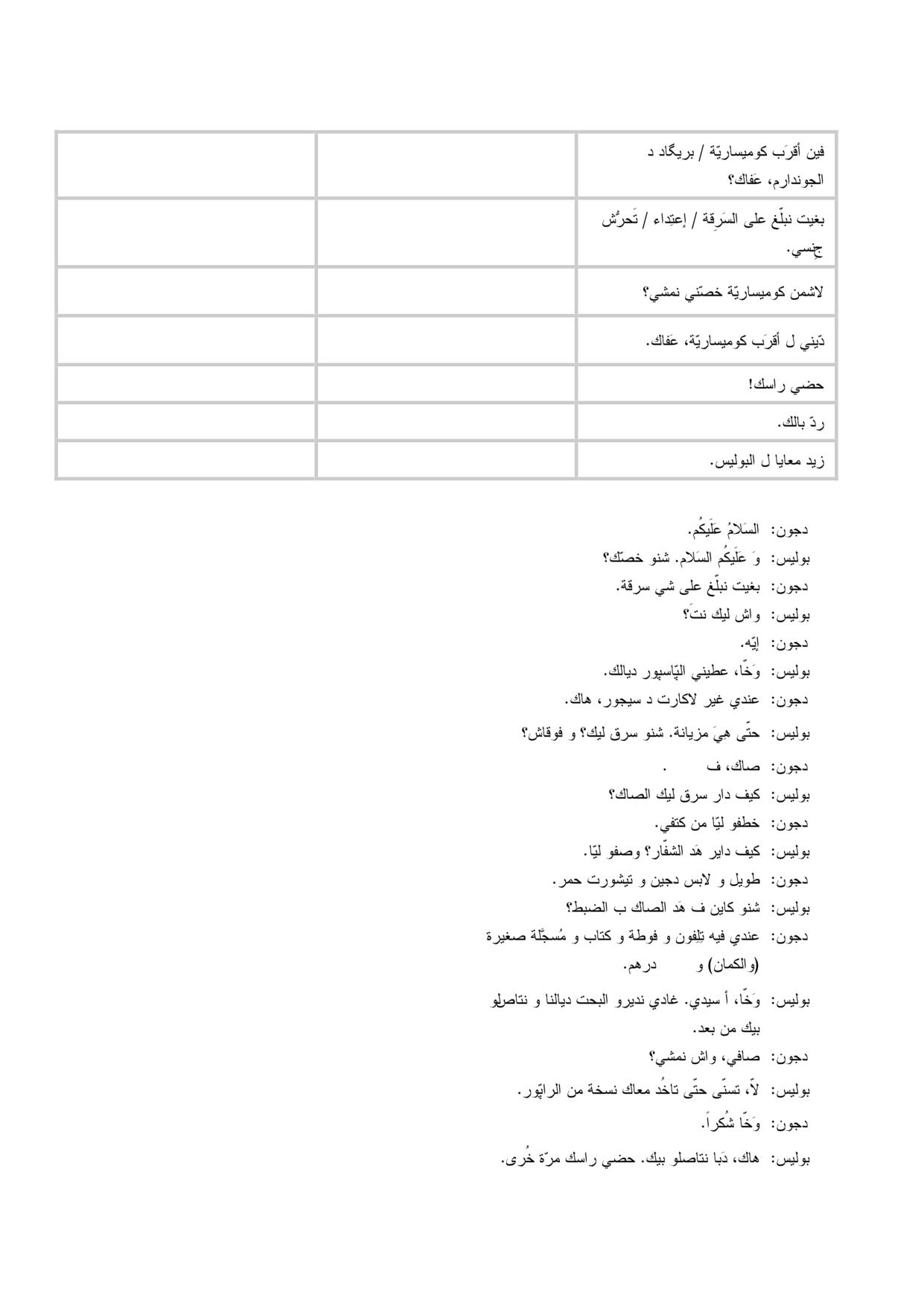
Theft
Vocabulary
šffar /
theft
s-srqa
thief
srraq
danger
xatar
to touch
qas
dangerous
xatir
to forgive
smн l...
make a statement /
sjjl dعwa
he attacked me
tعdda عliya
file a report
summons
stidعa
he snatched my...
xtf liya...
witness
šahd
he slapped me
srfqni
testimony
šahada
he hit me
drbni
police
l-bulis
he spit on me
dfl عliya
he grabbed me
police inspector
l-inspiktur
šddni mn...
from...
police car
fargunit
he cursed me
sbbni
report
rappur
he stole my...
srq liya...
law
l-qanun
he insulted me
عayrni
нuquq
human rights
to call (the police)
عiyt l
l-'insan
lawyer
muнami
court
mнkama
medical certificate /
šahada
report
tibbiya
138 • Moroccan Arabic
Expressions
fin 'aqrab kumisariya /
Where‟s the closest police /
brigad d j-jundarm,
gendarme station, please.
عafak?
I want to make a statement
bġit n-bllġ عla s-srqa
about a theft / an attack / sexual
/ iعtida' / taнrruš
harassment.
jinsi.
What police station should I go
lašmn kumisariya xssni
to?
n-mši?
Take me to the closest police
ddini l 'aqrab
station, please.
kumisariya, عafak.
Be careful!
нdi rask!
Pay attention.
rdd balk.
Come with me to the police.
zid mعaya l l-bulis.
Dialogue
John: s-salamu عalaykum.
bulis: wa عalaykum s-salam. šnu xssk?
John: bġit n-bllġ عla ši srqa.
bulis: weš lik nta?
John: iyeh.
bulis: waxxa, عtini l-ppaspor dyalk.
John: عndi ġir la-kart d sejur, hak.
bulis: нtta hiya mzyana. šnu srq lik? u
fuqaš?
John: sak, f 3:00.
3:00
bulis: kif dar srq lik s-sak?
John: xtfu liya mn ktfi.
bulis: kif dayr had š-šffar? wsfu liya.
John: twil u labs djin u t-šurt нmr.
bulis: šnu kayn f had s-sak b d-dbt?
John:
عndi fih tilifun u futa u ktab u
musjjala sġira (walkman) u 200
200
drhm.
bulis: waxxa, a sidi. ġadi n-diru l-bнt
dyalna u n-taslu bik mn bعd.
John: safi, weš n-mši?
bulis: lla, tsnna нtta t-axud mعak nsxa
mn r-rappur.
John: waxxa šukran.
bulis:
hak, daba n-taslu bik. нdi rask
mrra xura.
139
English Translation
John:
Peace be upon you.
police officer:
Peace be upon you too. Can I help you?
John:
I want to report a theft.
police officer:
Are you the victim?
John:
Yes.
police officer:
Okay, your passport, please.
John:
I have only my “carte de sejour.” Here you are.
police officer:
That‟s okay. What was stolen from you and
when?
John:
A bag at 3:00.
police officer:
How was it stolen?
John:
A man snatched it from my shoulder.
police officer:
Can you describe the thief?
John:
He‟s tall, wearing jeans and a red T-shirt.
police officer:
What exactly did you have in the bag?
John:
A cell phone, a towel, a book, a walkman, and
200 dirham.
police officer:
Okay, sir, we‟ll do our investigation and we‟ll get
in touch with you later.
John:
That‟s it? Can I leave?
police officer:
Wait a minute, you‟ve got to take a photocopy of
the report.
John:
Okay, thanks.
police officer:
Here you are. We‟ll get in touch with you. Be
careful in the future.
House Security / Doors and Windows
Vocabulary
sliding metal bolt
lock
qfl
z-zkrum
for locking doors
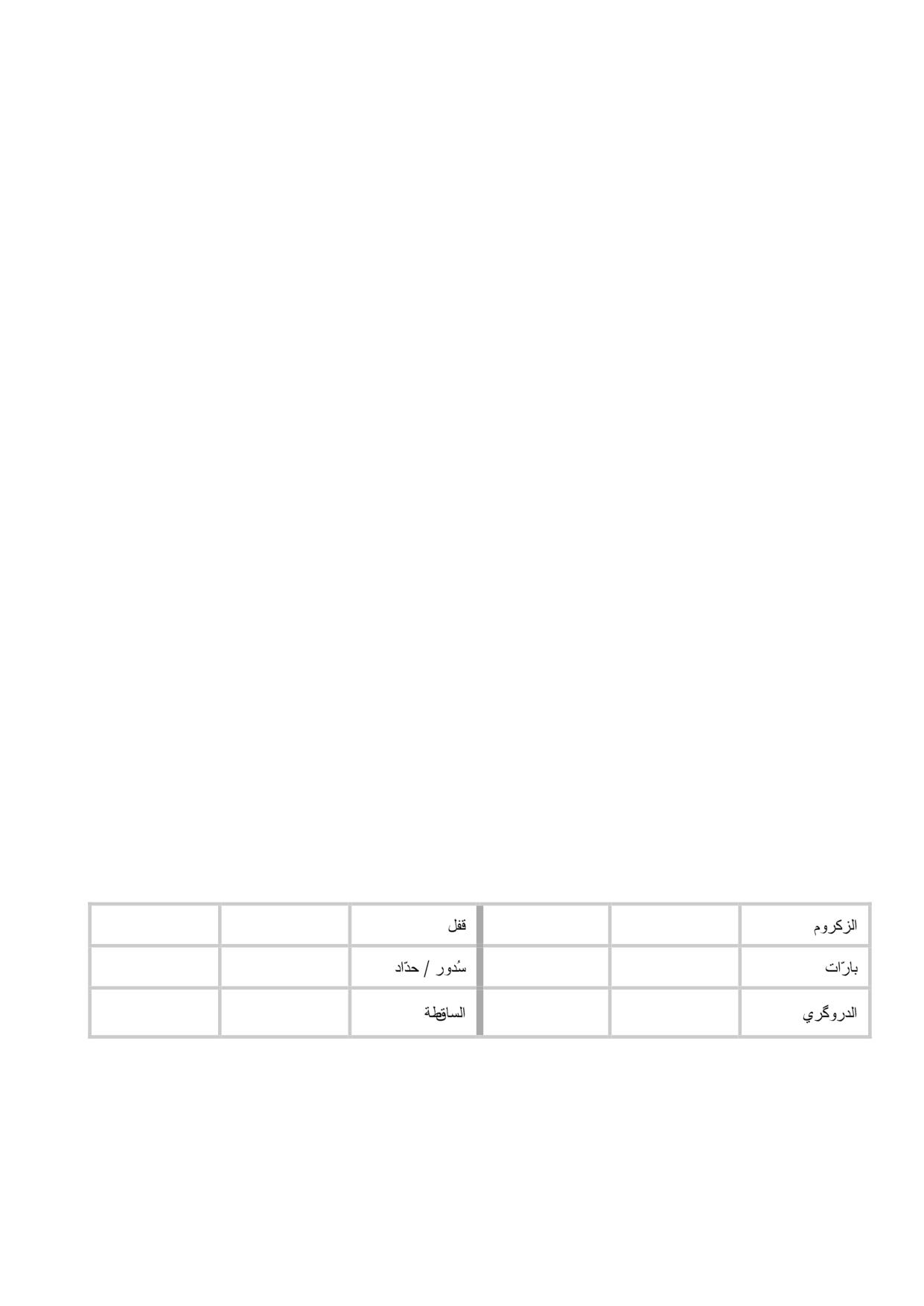
sudur /
welder
iron bars
barrat
нddad
hardware
latch / bolt
s-saqta
d-drogri
store
140 • Moroccan Arabic
Dialogue
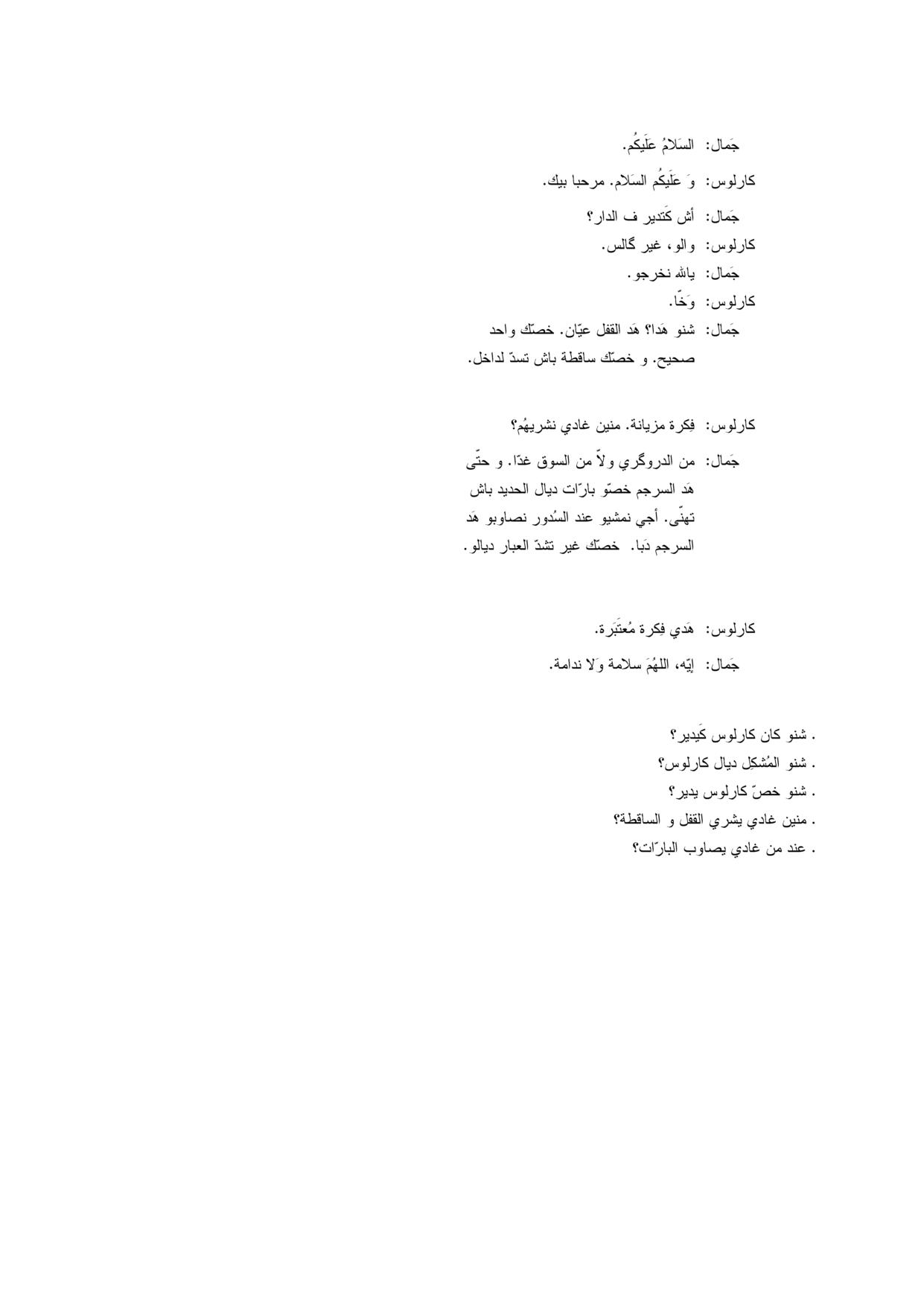
Jamal: s-salamu عalaykum.
Carlos: wa عalaykum s-salam.
mrнba bik.
Jamal: aš kat-dir f d-dar?
Carlos: walu, ġir gals.
Jamal: yallah n-xrju.
Carlos: waxxa.
Jamal: šnu hada? had l-qfl
عiyan. xssk waнd sнiн. u
xssk saqta baš t-sdd
ldaxl.
Carlos: fikra mzyana. mnin ġadi
n-šrihum?
Jamal: mn d-drugri wlla mn
s-suq ġdda. u нtta had
s-srjm xssu barrat dyal
l-нdid baš thnna. aji
n-mšiu عnd s-sudur
n-sawbu had s-srjm daba.
xssk ġir t-šdd l-عbar
dyalu.
Carlos: hadi fikra muعtabara.
Jamal: iyeh, llahumma slama
wala ndama.
Questions
1. šnu kan Carlos kay-dir?
1
2. šnu l-muškil dyal Carlos?
2
3. šnu xss Carlos ydir?
3
4. mnin ġadi y-šri l-qfl u s-saqta?
4
5. عnd mn ġadi y-sawb l-barrat?
5
English Translation
Jamal: Peace be upon you.
Carlos: And peace be upon you too. Welcome.
Jamal: What are you doing at home?
Carlos: Nothing, just sitting around.
Jamal: Let‟s go out.
Carlos: Okay.
Jamal: What is this? This lock is not strong. You need a strong one. You also need a
sliding metal bolt in order to lock the door from the inside.
Carlos: Good idea. Where can I get these from?
Jamal: From the hardware store or from souk tomorrow. Also this window needs iron bars
for you to feel safe. Let‟s go to the welder‟s to fix this window now. You need to
measure it.
Carlos: Excellent idea.
Jamal: It‟s better to be safe than sorry.
141
Political Harassment
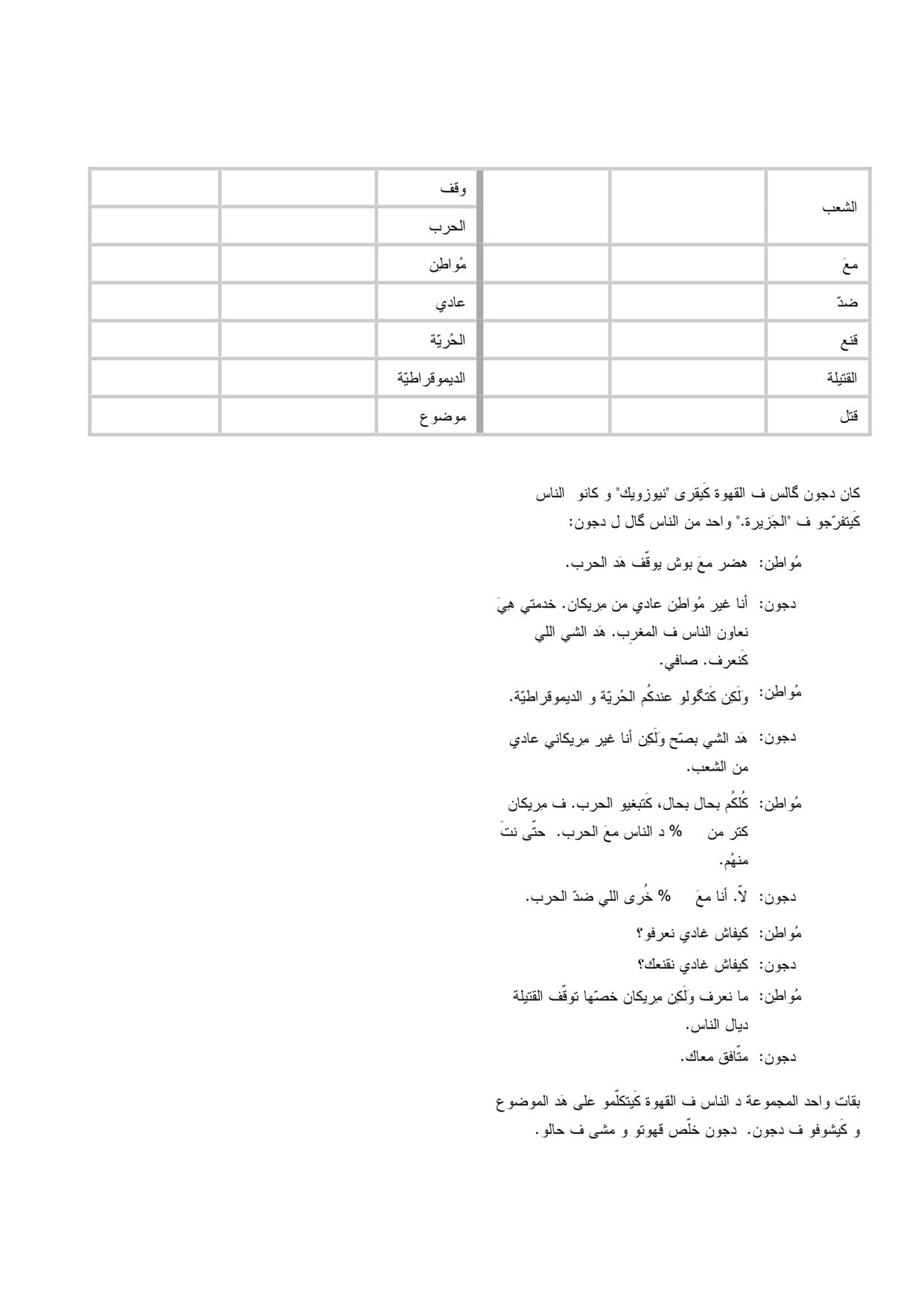
Vocabulary
to end
wqf
population,
š-šعb
people
war
l-нrb
citizen
muwatin
for
mعa
normal
عadi
against
dedd
freedom
l-нuriya
to convince
qnع
democracy
d-dimuqratiya
killing
l-qtila
subject
muduع
to kill
qtl
Dialogue
kan John gals f l-qhwa kay-qra
"Newsweek" u kanu n-nas kay-tfrrju f
"Al-Jazira." waнd mn n-nas gal l John:
muwatin: hdr mعa Bush y-wqqf had
l-нrb.
John: ana ġir muwatin عadi mn
mirikan. xdmti hiya n-عawn
n-nas f l-mġrib. had š-ši
l-li kan-عrf. safi.
muwatin: welakin kat-gulu عndkum
l-нuriya u d-dimuqratiya.
John: had š-ši bssн welakin ana
ġir mirikani عadi mn
š-šعb.
muwatin: kulkum bнal bнal, kat-bġiu
l-нrb. f mirikan ktr mn
50
50% d n-nas mعa l-нrb.
нtta nta mnhum.
John: lla. ana mعa 50% xora l-li
50
dedd l-нrb.
muwatin: kifaš ġadi n-عrfu?
John: kifaš ġadi n-qnعk?
muwatin: ma-n-عrf welakin mirikan
xssha t-wqqf l-qtila dyal
n-nas.
John: mttafq mعak.
bqat waнd l-mjmuعa d n-nas f l-qhwa
kay-tkllmu عla had l-muduع u kay-šufu
f John. John xlls qhwtu u mša f
нalu.
142 • Moroccan Arabic
Questions
1. fin kan John?
1
2. šnu kan kay-dir?
2
3. šnu kanu n-nas kay-diru?
3
4. šnu hiya l-xdma dyal John f
4
l-mġrib?
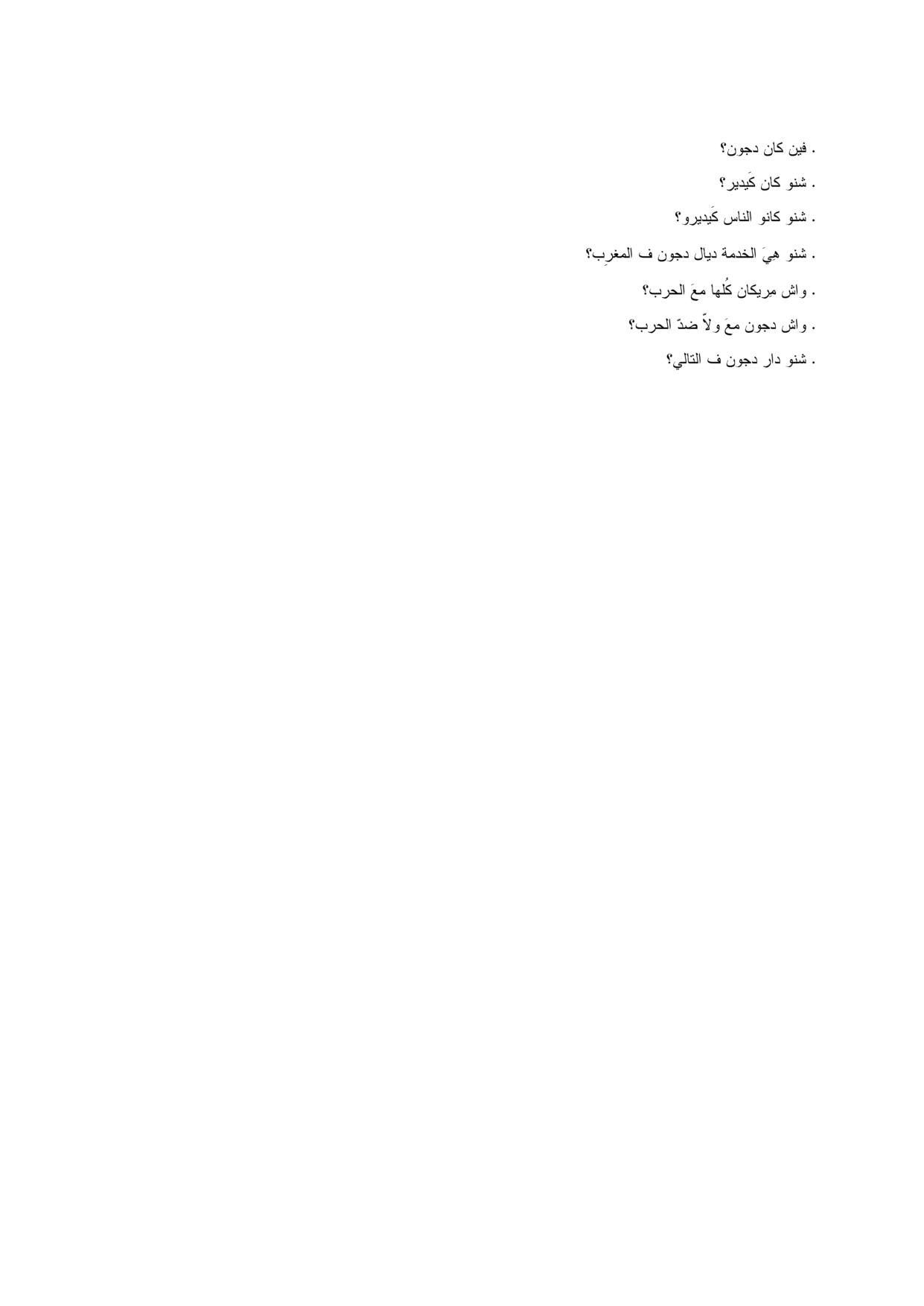
5. weš mirikan kulha mعa l-нrb?
5
6. weš John mعa wlla ddd l-нrb?
6
7. šnu dar John f t-tali?
7
English Translation
John was sitting in a café reading “Newsweek.” Some people there were watching “Al-Jazeera.” One
of the men at the café said to John:
Moroccan citizen: Talk to Bush about stopping this war.
John: I‟m just a normal citizen from America. My job is to help people in Morocco.
That‟s all I know.
Moroccan citizen: But in America you say you have freedom and democracy.
John: That‟s true, but I am just a normal American.
Moroccan citizen: You are all the same. You all like war. In America more than 50% of the people
are for the war. You are one of them.
John: No, I am with the other Americans against the war.
Moroccan citizen: How are we going to know?
John: How can I convince you?
Moroccan citizen: I don‟t know but America must stop killing people.
John: I agree.
A group of people in the café kept talking about the subject of the war. They were looking at John.
John paid for his coffee and left.
143
Appendices
Pronunciation of Moroccan Arabic
144
Supplementary Grammar Lessons
148
More Useful Expressions
157
Moroccan Holidays
159
Glossary of Verbs
163
144 • Moroccan Arabic
Pronunciation of Moroccan Arabic
Despite what you may think at first, it is indeed possible for you to learn how to pronounce the sounds
of Moroccan Arabic. Learning to pronounce Arabic sounds correctly entails two things: first, becoming
aware of how to make the different sounds and, second, practicing with a native speaker. This chapter
will help you with the first task.
Understanding How Sounds Are Made
Before we move directly into how to pronounce Arabic sounds, let‘s first understand how sounds are
made in general. Then we can use this knowledge in order to work on Arabic sounds.
Fricatives and Stops
Make the /s/ sound. Notice how air is being forced through the space between your tongue and the
gum ridge in your mouth. When a sound is produced like this, by forcing air between some small
opening, that sound is called a fricative. Make the /f/ sound. This sound is also a fricative, because in
order to make it we must force air between our teeth and our bottom lip. Some sounds in English that
are fricatives are: /s/, /z/, /sh/, /th/, /f/, /v/, and others.
Now make the /t/ sound. Here, we are not forcing air through a small opening at a constant pressure,
but rather we completely block the air flow for a moment, and then release the air stream in one big
burst. A sound that is produced by blocking the air flow, and then releasing it, is called a stop. Make
the /k/ sound. This is another ―stop‖ because again, you will notice how we build up a lot of pressure
with air, and then release it. Some stops in English are: /t/, /k/, /g/, /b/, /p/, and others.
Voiced and Voiceless Sounds
We can also categorize consonant sounds according to whether we use our voice box or not. Make the
/s/ sound. While making the sound, hold your hand over your throat. Now make the /z/ sound, still
holding your hand to your throat. You‘ll notice that with /s/, we don‘t use our voice box, but with /z/,
our voice box vibrates. Sounds like /s/ are called voiceless, since we don‘t use our voice box. Sounds
like /z/ are called voiced, since our voice box vibrates. Make the sound /t/. Is it voiceless or voiced?
Now make the sound /d/. Voiceless or voiced?
Let‘s look now at some of the difficult Arabic sounds, using what we know about sounds in general.
Pronunciation of Non-English Consonants
The Sound “q“ ( )
The q sound is similar to the k sound. Both are voiceless ―stops‖ that are made by releasing air
forcefully after completely blocking the air flow momentarily. The only difference is where in the
throat the speaker blocks the air flow. The q sound will be made further back in the throat than the k
sound. Try the following exercise.
First, take a minute to become more familiar with your throat muscles. Open your mouth and say aah,
as if you were at the doctor‘s office. Your tongue should be flat in your mouth. Without raising your
tongue, pull it back so that the base of your tongue closes off air by pulling back against the throat. At
this point, you should not be able to breathe through your mouth, although it is wide open. Practice
doing this first without making a sound. After performing this exercise several times, make a sound by
releasing the air forcefully. The result will be the sound q.
The Sound “x“ ( )
The sound x is a voiceless fricative formed around the same place as the sound q. It is found in many
European languages: the Russian x, the Scottish pronunciation of loch, and the German ch as
The /t/ sound is voiceless and the /d/ sound is voiced. Both are ―stops.‖
145
pronounced after a back vowel as in Bach. Some people use this sound to say yech! To pronounce x,
make the sound q and pay attention to where the back of your tongue hits the back of the roof of your
mouth and blocks your windpipe. Instead of closing off the windpipe with the back of your tongue
completely, block it part way, and you will produce this sound.
The Sound “ġ“ ( )
The sound ġ is the same sound as the sound x, except it is ―voiced.‖ In other words, if you can make
the sound x, all you need to do is vibrate your voice box at the same time, and you will produce ġ.
Think of the correspondence between the sounds k (kite) and g (game): k is voiceless and g is voiced.
Pronounce k and g several times, paying attention to how your voice changes when you say g. Now say
x several times, and then ―voice‖ it. The result is ġ.
Alternatively, you may think of ġ as similar to the sound you make when gargling. Gargle for a minute
and pay attention to the muscles you use. The sound ġ is pronounced using these same muscles in
similar fashion.
The Emphatic Sounds “s“ (
), “d“ (
), and “t“ (
)
The sound s is the emphatic counterpart of the sound s. Pronounce the sound s aloud, and note the
position of your tongue. It should be toward the front of the mouth and high, close to the roof. Now,
starting at the back of your teeth, move your tongue back along the roof of your mouth. You will find a
bony ridge just behind the teeth, before the upward curve of the roof. Put your tongue against this
ridge. The rest of your tongue will drop lower inside your mouth. The emphatic or velarized
consonants in Arabic are pronounced by placing the tip of your tongue in this spot and dropping the
rest of the tongue as low as you can. Thus, the sounds s, d, and t are all made with the tongue in this
position.
All the emphatic sounds are lower in pitch than their non-emphatic counterparts. They are
pronounced with greater muscular tension in the mouth and throat and with a raising of the back and
root of the tongue toward the roof of the mouth. You can notice this contraction of the throat easily by
prolonging the ‗l‘ in ―full.‖
One important note about the emphatic sounds: they deepen the sound of surrounding vowels. Pay
attention to the sound of all vowels near these emphatic sounds, because the quality of the vowels gives
the best indication of the presence of emphatic consonants. One important example is عtini, ―give
me‖ in Moroccan Arabic. Most trainees will hear the word and think it is pronounced عtayni, with the
middle vowel sound ay instead of i. This is because the emphatic sound t affects the way the i
sounds, making it sound (to the English speaker‘s ear) like an ay. It is, in fact, an i however.
The Sound “н“ ( )
The sound н is a voiceless fricative pronounced deep in the throat. It has no equivalent in English. In
order to practice this sound, first take a few minutes to become better acquainted with some of your
throat muscles that you use often, but not to speak English. The following exercises are designed to
make you aware of what these muscles can already do, so that you can use them to speak Arabic.
Practice them for a few minutes every day, as often as you can.
1. With your mouth closed, block off your windpipe at your throat. Put your hand on your throat
at the Adam‘s apple and constrict the muscles on the inside. You should be able to feel the
muscles contracting. Alternately tighten and relax them for a few minutes.
2. Repeat this with your mouth open. Try to breathe out through your mouth-if you can, you are
not closing off the windpipe entirely.
3. Constrict those same muscles so that air can just barely squeeze through your throat. Imitate
someone fogging a pair of glasses to clean them. The sound of the air coming through your
constricted throat muscles is н. By now, you should be aware of what your throat muscles are
doing.
146 • Moroccan Arabic
4. Bend your head down so that your chin rests on the top of your chest, and repeat exercise 3.
This position should make it easier for you to feel what you are doing.
Pronouncing н takes practice, first to pronounce the letter alone, and then to pronounce it surrounded
by other letters in a word. You must learn to pronounce it properly to be understood, and at first, this
will take some concentration on your part. However, the more you practice now, the sooner you will be
able to say it easily.
The Sound “ع“ ( )
We now come to one of the most distinctive sounds in Arabic: ع. When pronounced correctly, ع has its
own unique beauty and can be a very expressive sound. It is not as difficult to pronounce as one may
first think, but you need to exercise your throat muscles, the same ones that you use to pronounce н.
You should continually be doing the exercises you learned above for н, in which you constricted your
throat muscles as if you were blocking off the air passage from the inside. You can feel this by putting
your hand on your throat. Say н, and feel the muscles contract. Now pronounce the same sound and
―voice‖ it. That is, say the say sound while vibrating your voice box, changing the breathy sound of н
into the deep, throaty sound of ع. The sounds н and ع are only different because н is voiceless and ع is
voiced.
Some trainees think that ع sounds like a vowel, but it is not a vowel. Because we constrict our throat
muscles and force air through the passageway, the sound ع is a fricative. Vowels do not force air
through a partially blocked passageway, and thus cannot be fricatives.
The Arabic “r“ ( )
The sound r in Arabic is not the same as the English ―r.‖ It is not difficult, like some of the other sounds
above may seem at first. But because it is new, we include here a short description of it. The sound is a
flap, like the Spanish or Italian ―r.‖ You already know how to make this sound: it is the sound
American English speakers make saying gotta as in gotta go. Say gotta several times in a row very
quickly and pay attention to what your tongue is doing. You should feel it flapping against the roof of
your mouth behind your teeth. Now pronounce the sound alone. Another good exercise is to practice
making a whirring sound: rrrrrrrrrrrrrrr. Do these exercises daily until you have mastered this
sound.
Pronunciation of Shedda
In Arabic, a ―shedda‖ is a pronounced stress upon a letter in a word. In transcription, this stress is
indicated by a doubling of a consonant (see page 3). When there is shedda, it indicates that the
consonant is to be held twice as long as a normal consonant. That is, it should be pronounced for twice
the length of time. This is easy with fluid sounds like z or r. With sounds like b or d, however, you
must begin to say them and pause in the middle of pronouncing them for a second. This may take
some practice at first.
In English, this doubling of a consonant sound never occurs in the middle of words, but is very
common from the end of one word to the beginning of another. Compare the difference between the
single ‗d‘ in ―lay down‖ and the double ‗dd‘ in ―laid down.‖ Noticing the difference between the single
‗d‘ and double ‗dd‘ in this example will give you some idea of how a shedda affects pronunciation.
It cannot be stressed enough that shedda affects not only the pronunciation of a word, but
also its meaning, especially for verbs. Recognizing when shedda is used and learning to
pronounce it correctly yourself is an important task in your study of Moroccan Arabic.
147
The Definite Article
In English, the ―definite article‖ is the word ―the.‖ It is different from the ―indefinite articles,‖ which
are ―a‖ and ―an.‖ In English, the definite article speaks about something specific: I washed the dog
today (you know which dog I‘m speaking about). The indefinite articles talk about something non-
specific: I saw a dog today (you don‘t know the dog I‘m speaking about).
In Arabic, the definite article is not always used exactly as in English. When written in Arabic script, it
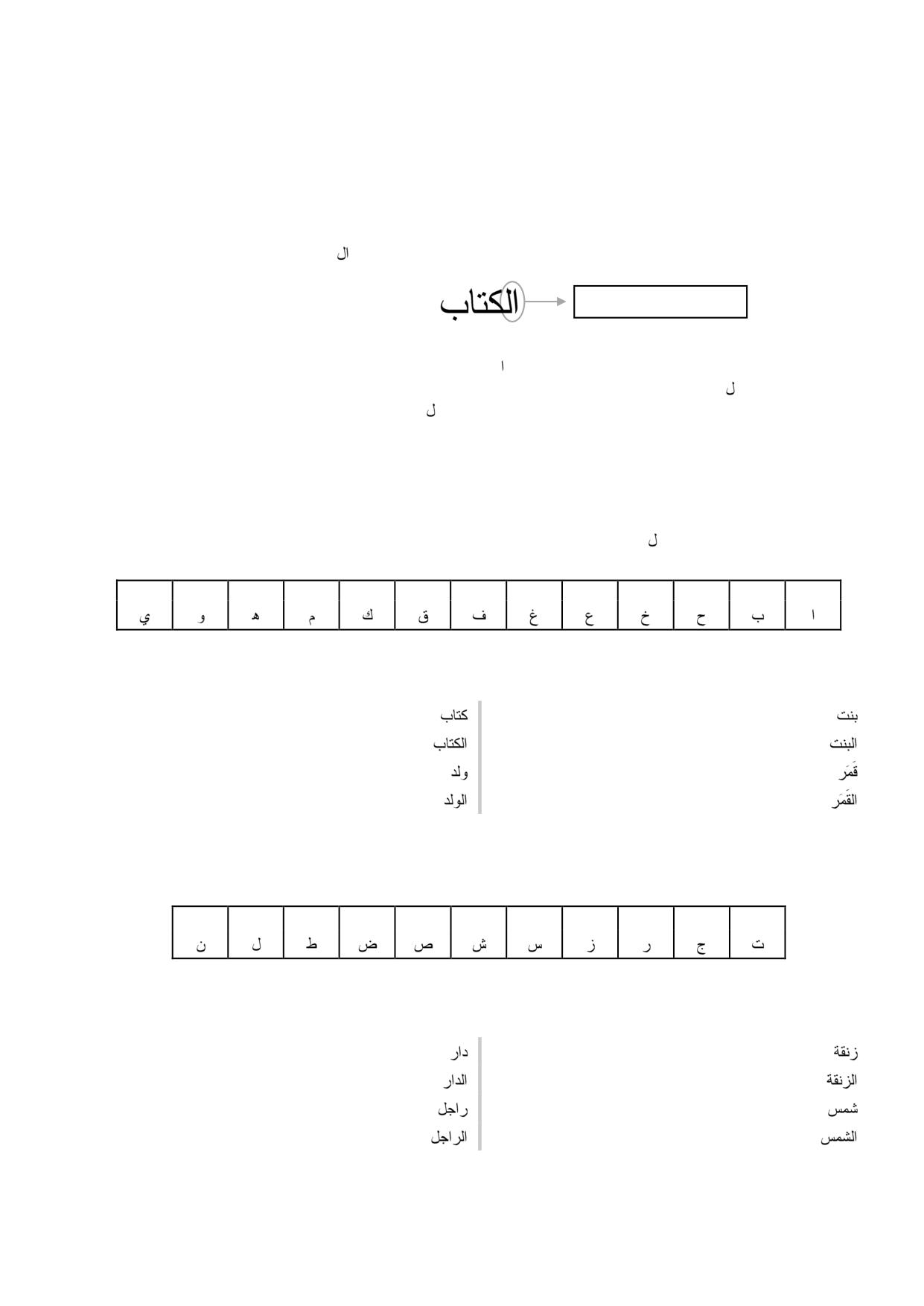
is composed of two letters, al (
), attached to the beginning of a noun or an adjective. Here is the
Arabic script for ―the book‖:
the definite article
These two letters are always written in Arabic script for a definite article, but they are not always
pronounced. In Moroccan Arabic, the first letter, a ( ), is never pronounced. Two possibilities exist,
therefore, for pronouncing the definite article. Sometimes, the second letter, l ( ), is pronounced.
Other times, instead of pronouncing the l ( ), the first letter of the word is doubled with a ―shedda.‖
Whether the definite article is pronounced with ―l‖ or by doubling the first letter with shedda is
determined by which letter is the first letter of the word. Let‘s look at these two different
possibilities.
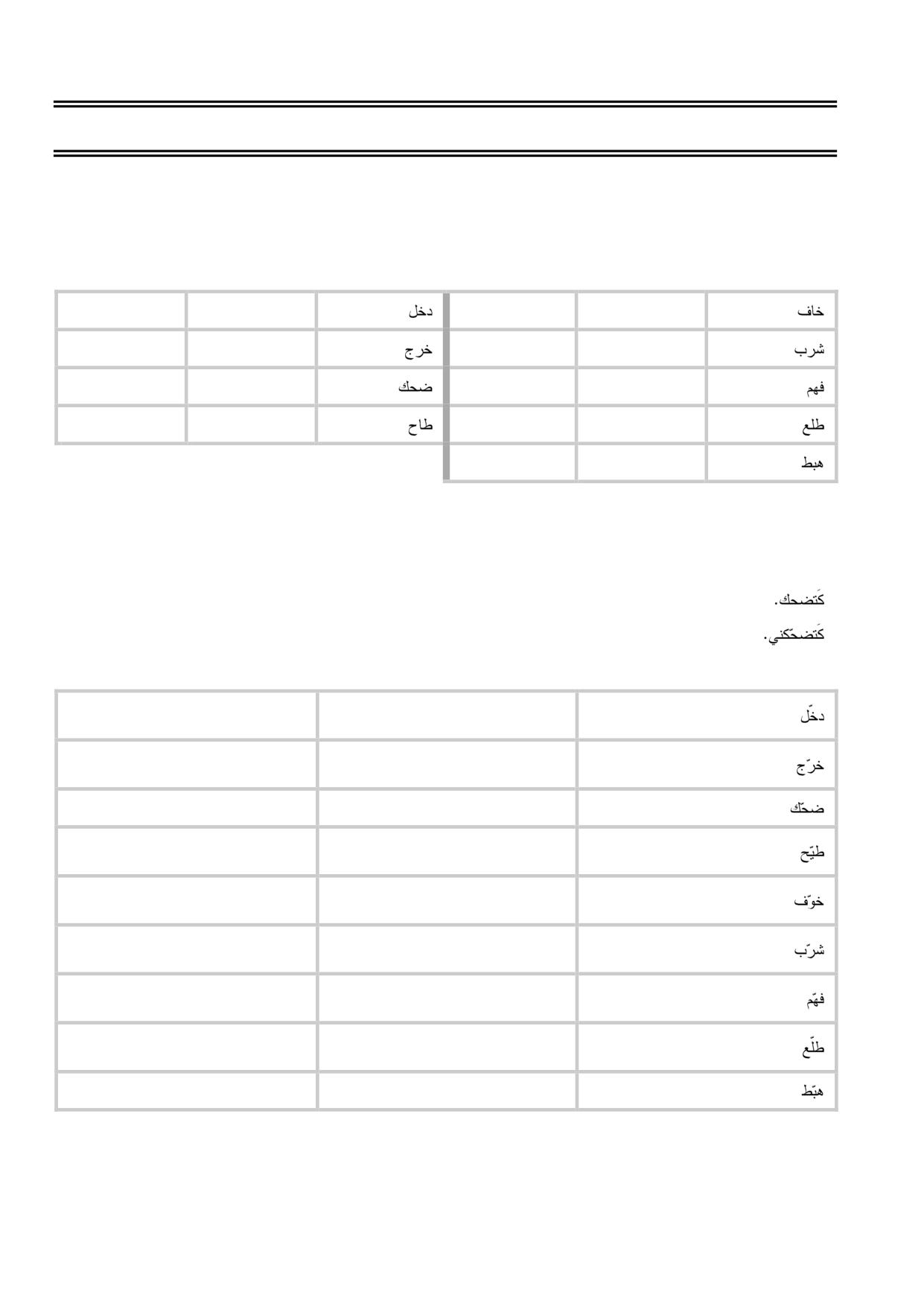
The Moon Letters
In the first possibility, the Arabic definite article is pronounced with an l ( ) at the beginning of a word.
All words that begin with the following letters follow this rule:
i/y
u/w
h
m
k
q
f
ġ
ع
x
н
b
a
These letters are called moon letters, because the Arabic word for moon, qamar, begins with one of
the letters in the group. Notice in the following examples that the definite article is pronounced by
adding an l to the word:
a book
ktab
a girl
bnt
the book
l-ktab
the girl
l-bnt
a boy
wld
a moon
qamar
the boy
l-wld
the moon
l-qamar
The Sun Letters
In the second possibility, the Arabic definite article is pronounced by doubling the first letter of a word
with a ―shedda.‖ All words that begin with the following letters follow this rule:
n
l
t
d
s
š
s
z
r
j
t
These letters are known as sun letters, because the Arabic word for sun, šms, begins with one of the
letters in the group. Notice in the following examples that the definite article is pronounced by
doubling the first letter of the word by using ―shedda.‖
a house
dar
a street
znqa
the house
d-dar
the street
z-znqa
a man
rajl
a sun
šms
the man
r-rajl
the sun
š-šms
148 • Moroccan Arabic
Supplementary Grammar Lessons
These are lessons you can work on by yourself or with your tutor once you arrive at your site. It is
unlikely you will be able to complete them during stage, unless you already have some experience with
Arabic.
Making Intransitive Verbs into Transitive Verbs
Intransitive verbs are verbs that do not require a direct object such as:
to come in
dxl
to be afraid
xaf
to go out
xrj
to drink
šrb
to laugh
dнk
to understand
fhm
to fall
taн
to go up
tlع
to go down
hbt
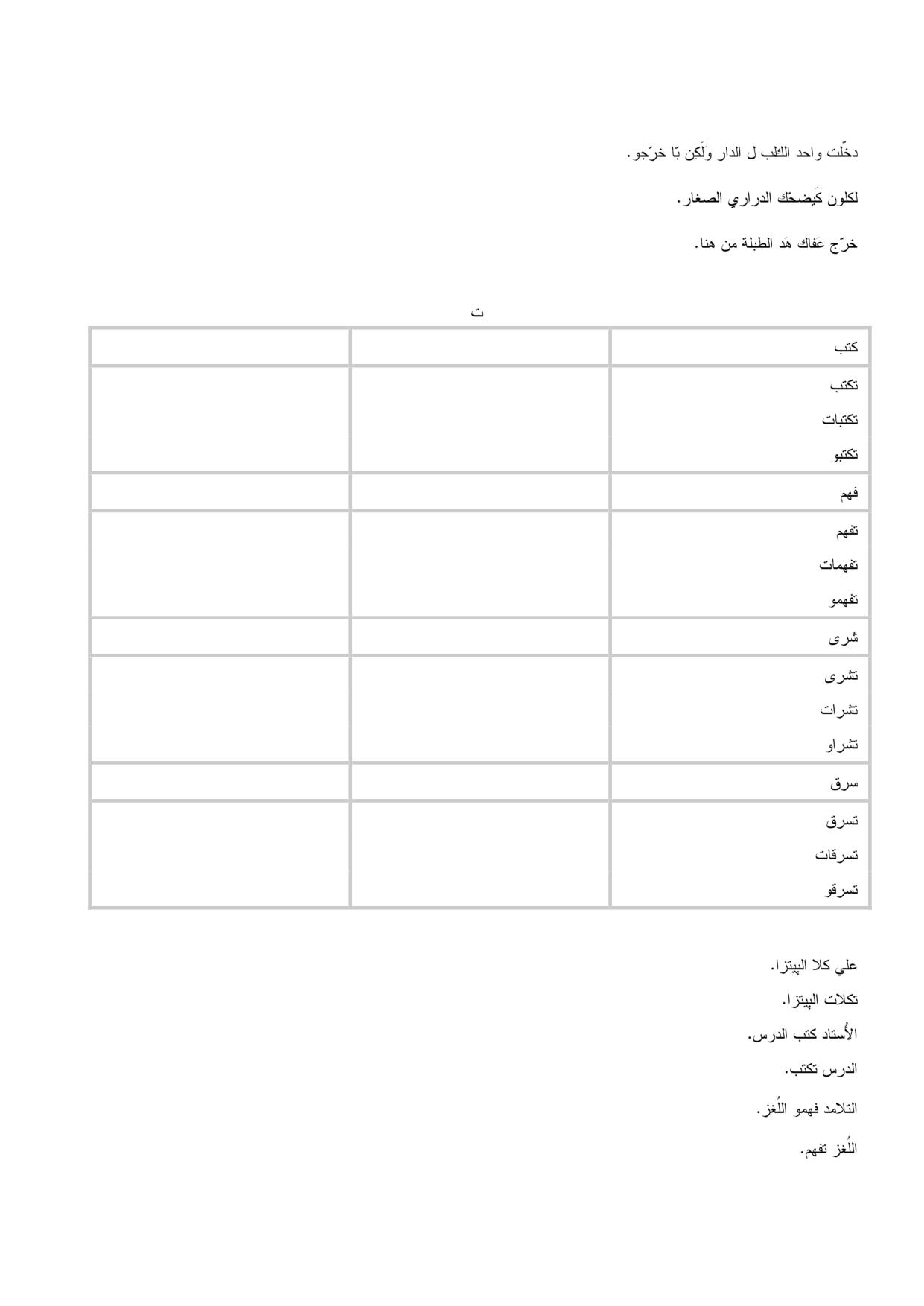
All these verbs are trilateral (i.e. they are made up of three letters) and they can be made transitive by
doubling their middle consonant (i.e. putting a shedda on it). The new transitive verb normally has the
meaning ―to make someone do something.‖ Look at how the meaning changes when the intransitive
verb dнk ―to laugh‖ is changed into a transitive verb:
You are laughing / you laugh.
kat-dнk.
You make me laugh.
kat-dннkni.
Here is a list of verbs commonly used in their transitive form:
to make (someone or
dxxl
something) enter / to bring in
to make (someone or
xrrj
something) exit / to take out
to make (so/sth) laugh
dннk
to drop / to throw down (i.e. to
tiyн
make something fall)
to frighten (i.e. to make
xuwf
someone afraid)
to water (i.e. to make something
šrrb
“drink”)
to make (someone) understand
fhhm
/ to explain
to make go up / to promote / to
tllع
take up
to bring down / to demote
hbbt
149
Some examples:
I brought in a dog to the house
dxxlt waнd l-klb l d-dar
but my father took it out.
welakin bba xrrju.
The clown makes small kids
l-klun kay-dннk d-drari
laugh.
s-sġar.
Take this table out of here,
xrrj عafak had t-tbla mn
please.
hna.
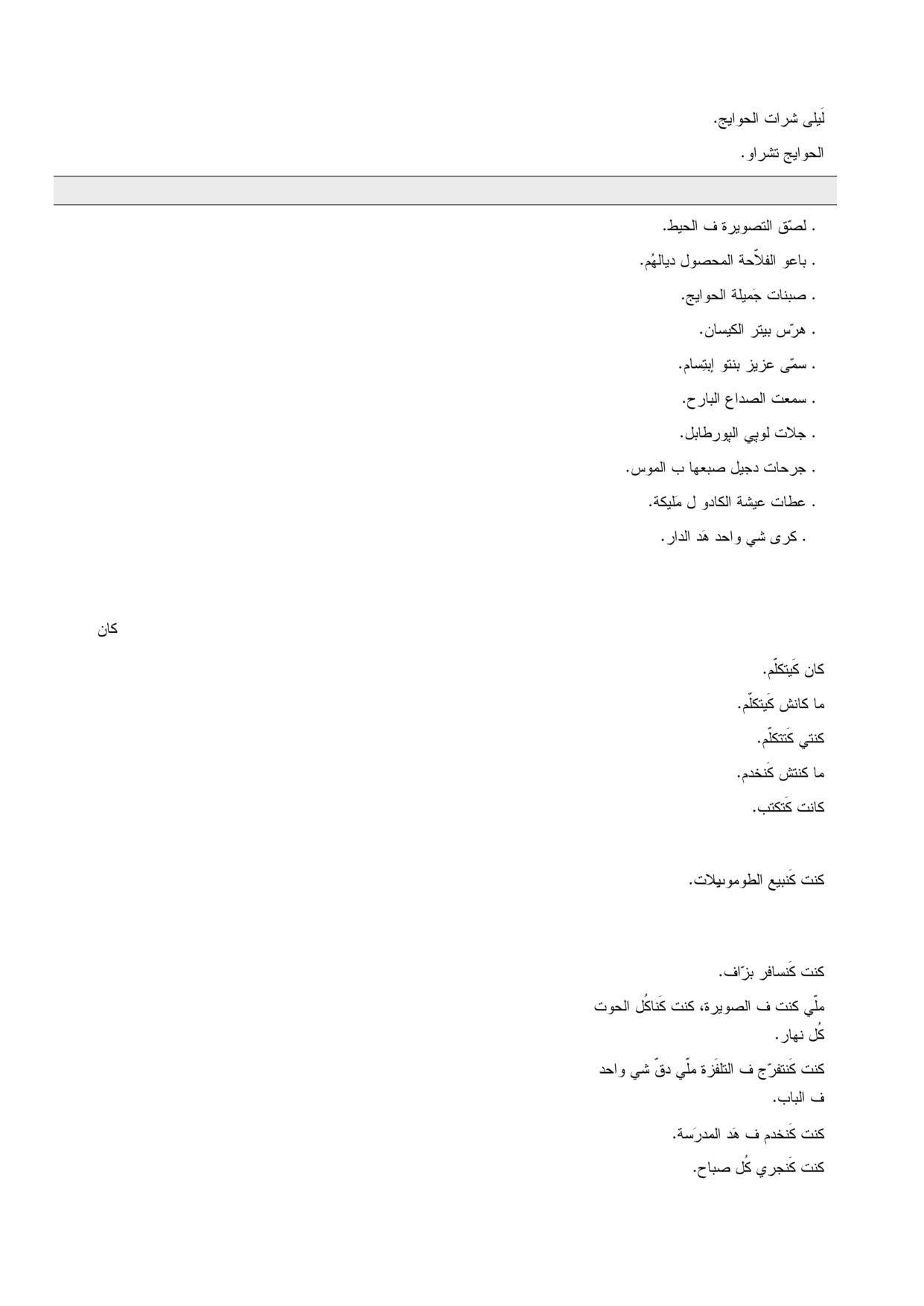
Passive Verbs
Transitive verbs can be made passive by adding t (
) to them, as shown below:
to write
ktb
to be written (masc.)
tktb
to be written (fem.)
tktbat
to be written (plur.)
tktbu
to understand
fhm
to be understood (masc.)
tfhm
to be understood (fem.)
tfhmat
to be understood (plur.)
tfhmu
to buy
šra
to be bought (masc.)
tšra
to be bought (fem.)
tšrat
to be bought (plur.)
tšrau
to steal
srq
to be stolen (masc.)
tsrq
to be stolen (fem.)
tsrqat
to be stolen (plur.)
tsrqu
Some examples:
Ali ate pizza.
عli kla l-pitza.
The pizza was eaten.
tklat l-pitza.
The teacher wrote the lesson.
l-ustad ktb d-drs.
The lesson was written.
d-drs tktb.
The students understood the
t-tlamd fhmu l-luġz.
riddle.
The riddle was understood.
l-luġz tfhm.
150 • Moroccan Arabic
Laila bought some clothes.
layla šrat l-нwayj.
Some clothes were bought.
l-нwayj tšrau.
Exercise: Put the sentences below in the passive form.
1. lssq t-tswira f l-нit.
1
2. baعu l-fllaнa l-mнsul dyalhum.
2
3. sbnat Jamila l-нwayj.
3
4. hrrs Peter l-kisan.
4
5. smma Aziz bntu Ibtisam.
5
6. smعt s-sda عl-barн.
6
7. jlat Lupe l-purtabl.
7
8. jrнat Jill sbعha b l-mus.
8
9. عtat Aicha l-kadu l Malika.
9
10. kra ši waнd had d-dar.
10
The Past Progressive
The Moroccan Arabic equivalent for the English past progressive (was doing, were doing) is the past of
kan (
) ―to be‖ followed by the present tense. For example:
He was talking.
kan kay-tkllm.
He wasn‟t talking.
ma-kan-š kay-tkllm.
You were talking.
knti kat-tkllm.
I wasn‟t working
ma-knt-š kan-xdm.
She was writing.
kant kat-ktb.
This construction can also be translated as ―used to.‖ For example:
I used to sell cars.
knt kan-biع t-tumubilat.
Whether a given occurrence of this construction is to be translated as past progressive or ―used to‖
depends upon the context.
I used to travel a lot.
knt kan-safr bzzaf.
mlli knt f s-swira, knt
When I was in Essaouira, I used
kan-akul l-нut kul
to eat fish every day.
nhar.
knt kan-tfrrj f
I was watching TV when
t-tlfaza mlli dqq ši
someone knocked at the door.
waнd f l-bab.
knt kan-xdm f had
I used to work in this school.
l-mdrasa.
I used to run every morning.
knt kan-jri kul sbaн.
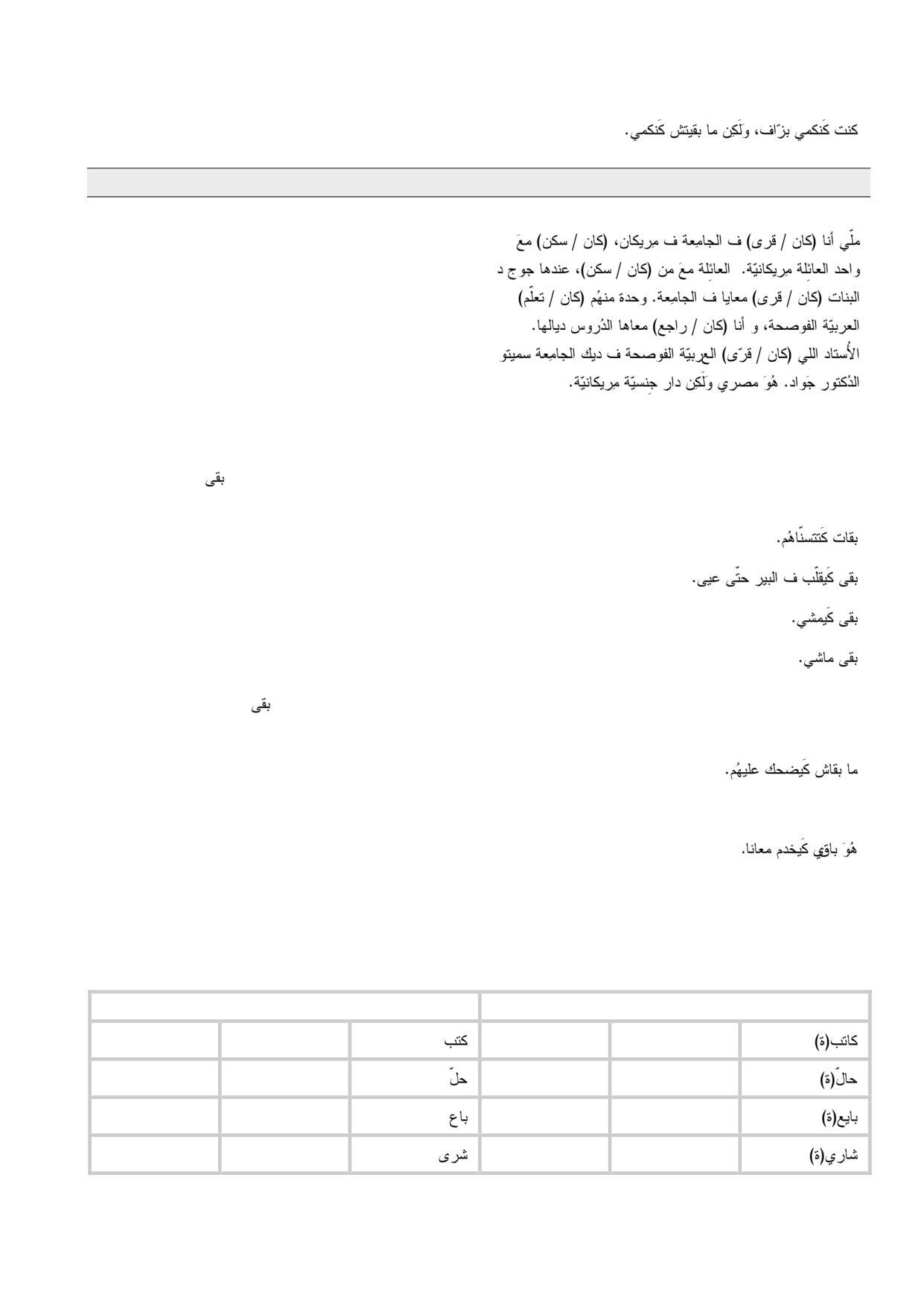
151
knt kan-kmi bzzaf,
I used to smoke a lot but I quit
welakin ma-bqit-š
smoking (don‟t smoke anymore).
kan-kmi.
Exercise: Put the verbs in parentheses in the correct form.
mlli ana (kan / qra) f j-jamiعa f
mirikan, (kan / skn) mعa waнd
l-عa'ila mirikaniya. l-عa'ila mعa
mn (kan / skn), عndha juj d l-bnat
(kan / qra) mعaya f j-jamiعa. wнda
mnhum (kan / tعllm) l-عrbiya
l-fusнa, u ana (kan / rajع) mعaha
d-durus dyalha. l-ustad l-li (kan /
qrra) l-عrbiya l-fusнa f dik
j-jamiعa smitu d-duktur Jawad. huwa
msri welakin dar jinsiya mirikaniya.
The Verb “to remain”
The verb bqa (
) ―to remain‖ is followed by the present tense or by the active participle (see section
below) when it corresponds to the English ―kept doing something.‖ Some examples:
She kept waiting for them.
bqat kat-tsnnahum.
He kept on searching in the well bqa kay-qllb f l-bir
until he got tired.
нtta عya.
He kept going (habitually).
bqa kay-mši.
He kept going (continued on his
bqa maši.
way, on one occasion).
When negated, bqa (
) in verb phrases is equivalent to ―no longer, not anymore,‖ with either past or
present meaning. For example:
He didn‟t (doesn‟t) laugh at them
ma-bqa-š kay-dнk عlihum.
anymore.
The active participle baqi preceding the present tense is equivalent to the English ―still.‖
He‟s still working with us.
huwa baqi kay-xdm mعana.
Verb Participles
Verb participles are adjectives derived from verbs. They agree in gender and number, like all
adjectives, but not in person (I, you, he) or tense (past, present). Transitive verbs have two participles,
an active and a passive participle. Intransitive verbs have only an active participle.
The Active Participle
Verb Stem
Active Participle
to write
ktb
having written
katb(a)
to open
нll
having opened
нall(a)
to sell
baع
having sold
bayع(a)
to buy
šra
having bought
šari(a)
152 • Moroccan Arabic
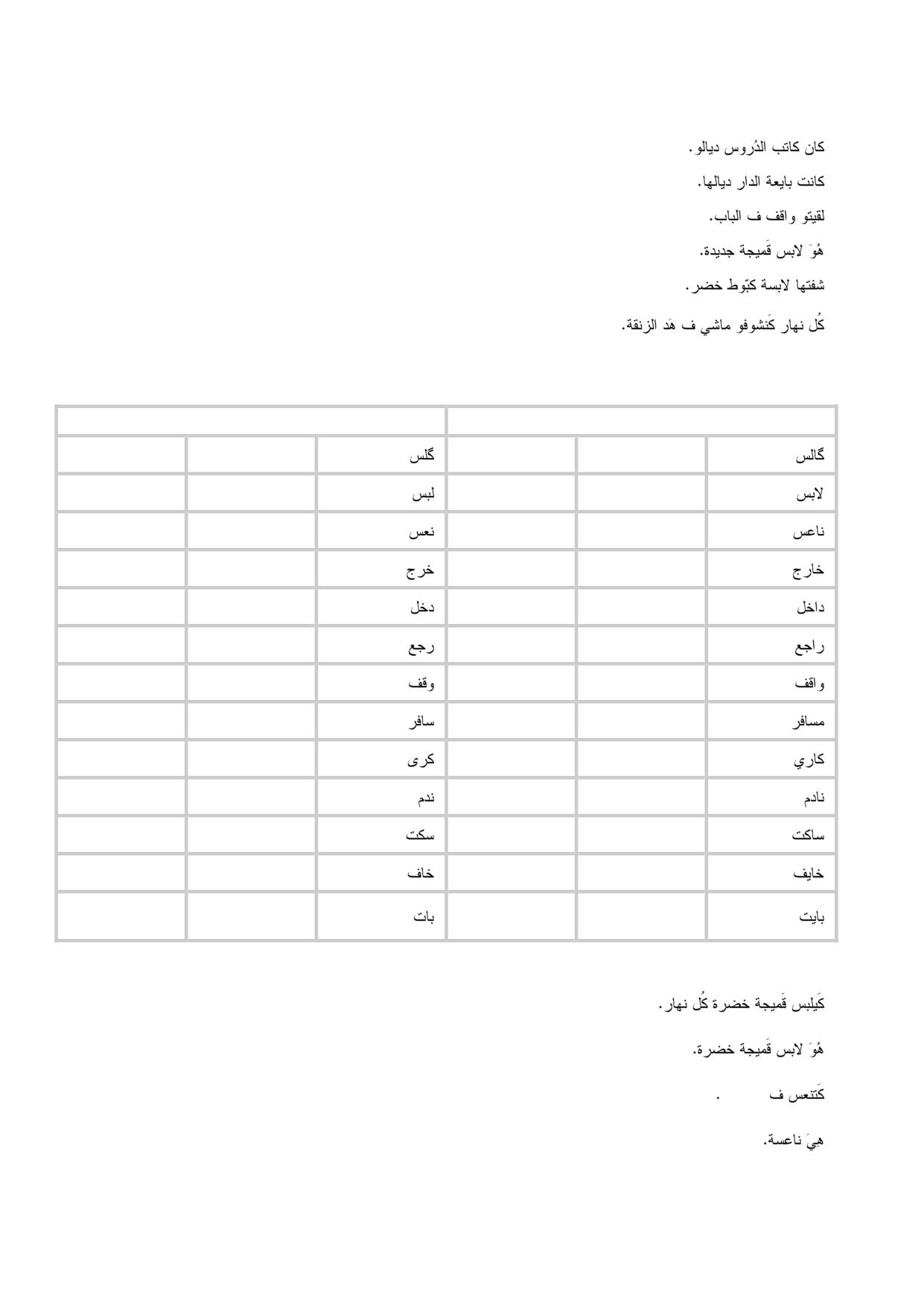
Some examples:
He had written he lessons.
kan katb d-durus dyalu.
She had sold her house.
kant bayعa d-dar dyalha.
I found him standing at the door. lqitu waqf f l-bab.
He is wearing a new shirt today. huwa labs qamija jdida.
I saw her wearing a green coat. šftha labsa kbbut xdr.
Everyday I see him walking on kul nhar kan-šufu maši f
this street.
had z-znqa.
For a small group of verbs, the active participle must be used in order to express a current (i.e.
progressive) activity. For these verbs, the present tense expresses only a habitual activity
Verb Stem
Active Participle
to sit / stay
gls
sitting
gals
to wear
lbs
wearing
labs
to sleep
nعs
sleeping
naعs
to leave / exit
xrj
leaving
xarj
to enter
dxl
entering
daxl
to return
rjع
returning
rajع
to stand
wqf
standing
waqf
to travel
safr
traveling
msafr
to rent
kra
renting
kari
to regret
ndm
regretting
nadm
to be quiet
skt
being quiet
sakt
to be afraid
xaf
being afraid
xayf
to spend the
spending the
bat
bayt
night
night
Some examples:
He wears a green shirt every
kay-lbs qamija xdra kul
day. (habitual → present tense)
nhar.
He is wearing a green shirt.
huwa labs qamija xdra.
(now→ participle)
She goes to sleep at 10:00.
kat-nعs f 10:00.
10:00
(habitual → present tense)
She is sleeping.
hiya naعsa.
(now→ participle)
153
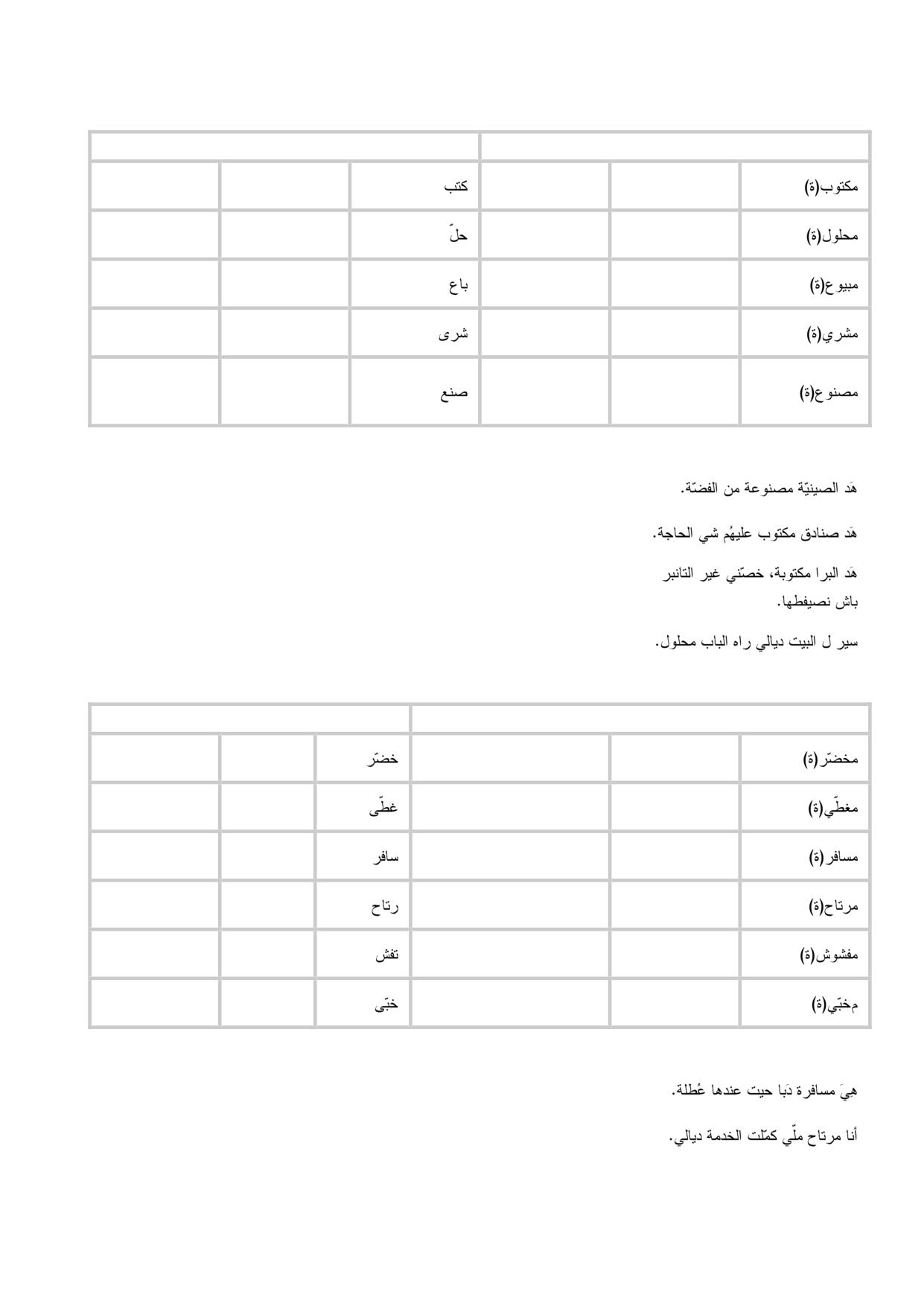
Passive Participle
Verb Stem
Passive Participle
(having been)
to write
ktb
mktub(a)
written
(having been)
to open
нll
mнlul(a)
opened
(having been)
to sell
baع
mbiuع(a)
sold
(having been)
to buy
šra
mšri(a)
bought
(having been)
to make
snع
made /
msnuع(a)
(manufacture)
manufactured
Some examples:
had s-siniya msnuعa mn
This tray is made of silver.
l-fdda.
These boxes have something
had snadq mktub عlihum ši
written on them.
l-нaja.
This letter is written; I need only had l-bra mktuba, xssni
a stamp to send it.
ġir t-tanbr baš n-siftha.
Go to my room, the door is
sir l l-bit dyali rah
open.
l-bab mнlul.
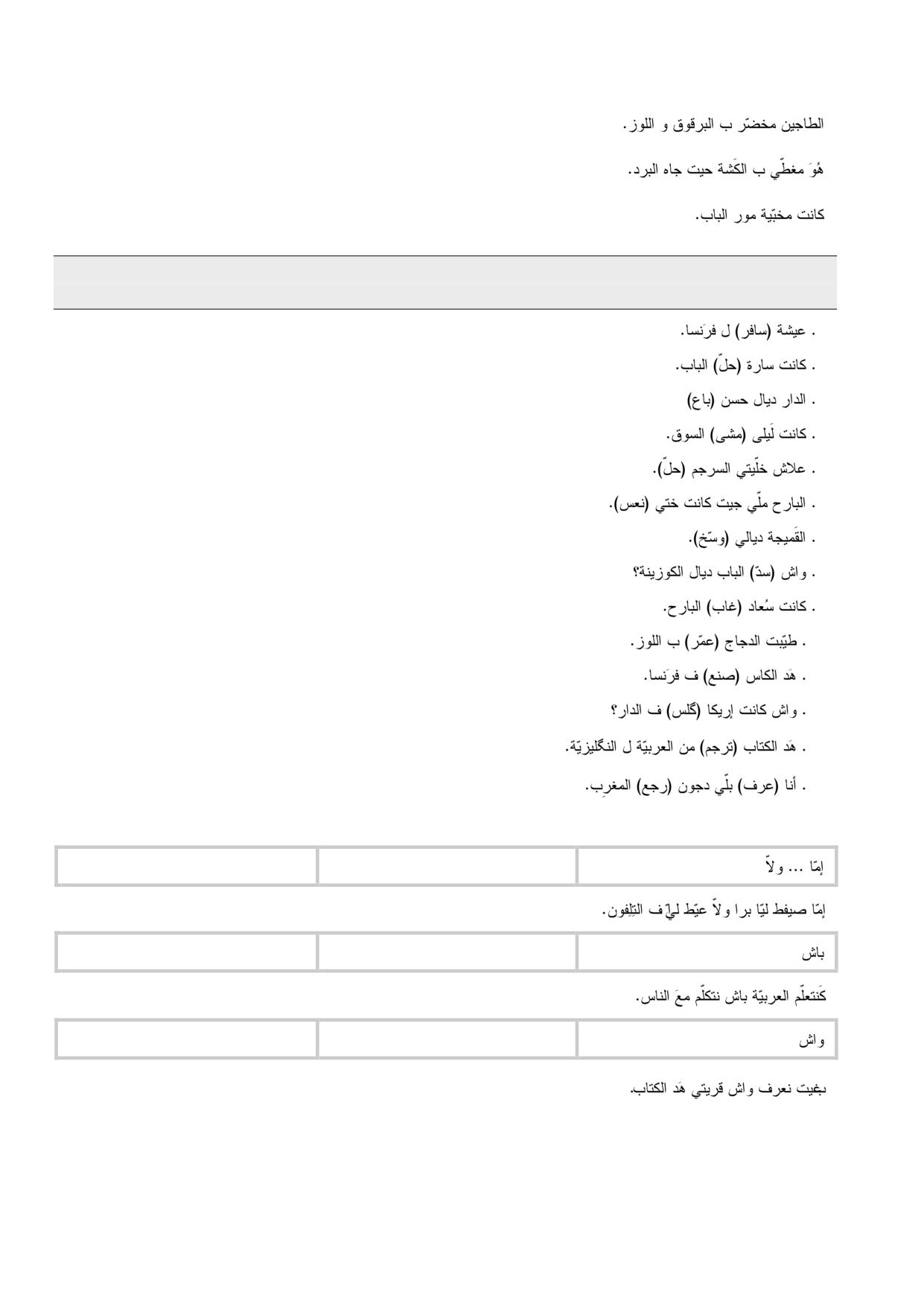
Intransitive Verbs with Only One Participle
Verb Stem
Participle
having garnished
to garnish
xddr
mxddr(a)
having been garnished
having covered
to cover
ġtta
mġtti(a)
having been covered
having traveled
to travel
safr
msafr(a)
having been traveled
having rested
to rest
rtaн
mrtaн(a)
having been rested
having gone flat
to go flat
tfš
mfšuš(a)
having been gone flat
having hidden
to hide
xbba
mxbbi(a)
having been hidden
Some examples:
She is traveling now because
hiya msafra daba нit
she is on vacation.
عndha عutla.
I‟m relaxed since I finished my
ana mrtaн mlli kmmlt
work.
l-xdma dyali.
154 • Moroccan Arabic
The tajine is garnished with
t-tajin mxddr b l-brquq
prunes and almonds.
u l-luz.
He is covered with a blanket
huwa mġtti b l-kaša нit
because he is cold.
jah l-brd.
She was hidden behind the
kant mxbbya mur l-bab.
door.
Exercise: In the sentences below, supply the proper form of the participle of the verb
written in parentheses.
1. Aicha (safr) l fransa.
1
2. kant Sara (нll) l-bab.
2
3. d-dar dyal нsn (baع)
3
4. kant Layla (mša) s-suq.
4
5. عlaš xlliti s-srjm (нll).
5
6. l-barн mlli jit kant xti (nعs).
6
7. l-qamija dyali (wssx).
7
8. weš (sdd) l-bab dyal l-kuzina?
8
9. kant Suعad (ġab) l-barн.
9
10. tiybt d-djaj (عmmr) b l-luz.
10
11. had l-kas (snع) f fransa.
11
12. weš kant Erika (gls) f d-dar?
12
13. had l-ktab (trjm) mn l-عrbiya l
13
n-ngliziya.
14. ana (عrf) blli djun (rjع)
14
l-mġrib.
Conjunctions
either ... or
imma ... wlla
imma sift liya bra wlla
Either send a letter or call me.
عiyt liya f t-tilifun.
in order to
baš
I am learning Arabic in order to
kan-tعllm l-عrbiya baš
talk to people.
n-tkllm mعa n-nas.
if
weš
I want to know if you read this
bġit n-عrf weš qriti had
book.
l-ktab.
155
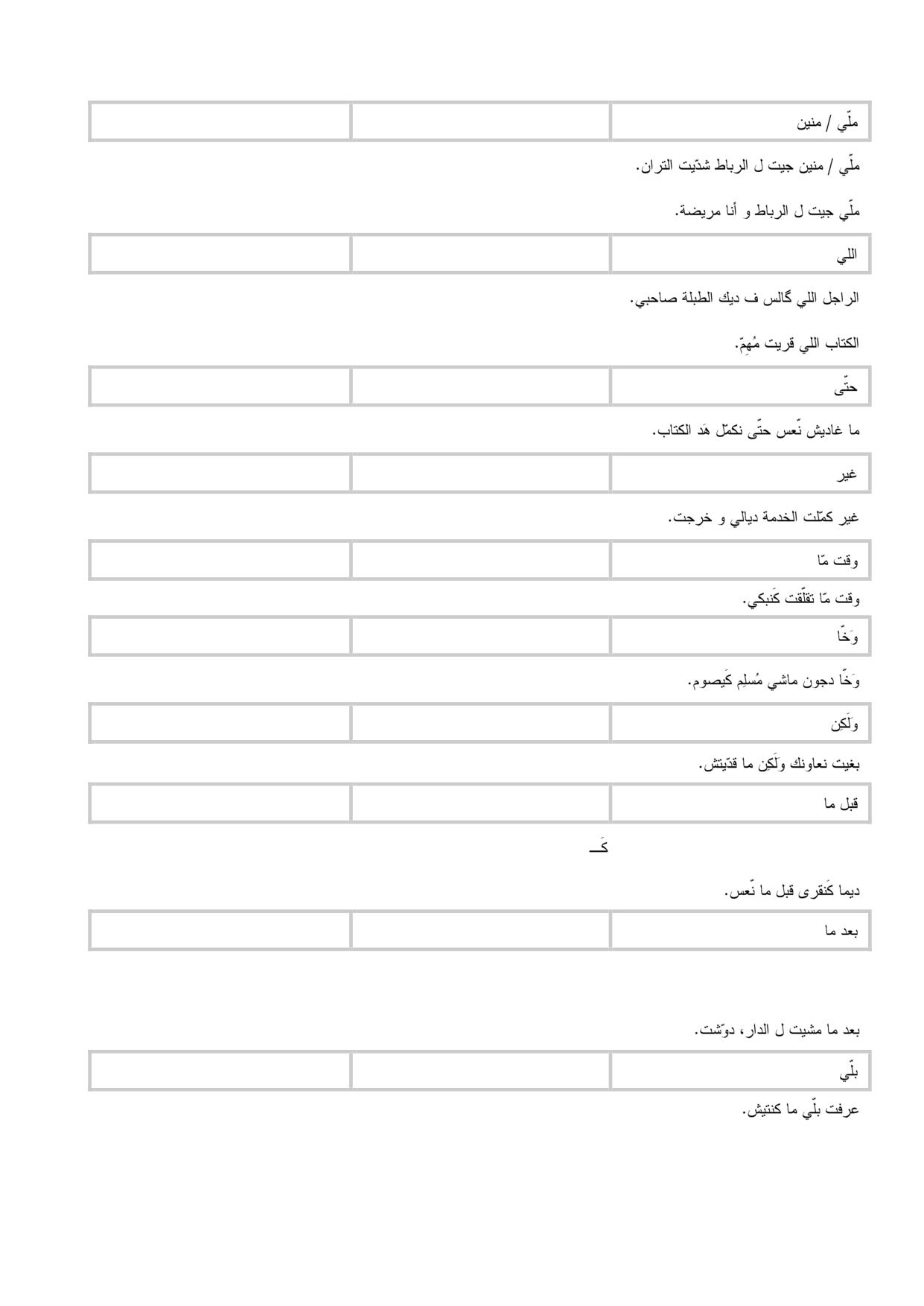
when / since
mlli / mnin
When I came to Rabat I took the mlli / mnin jit l r-rbat
train.
šddit t-tran.
I have been sick since I came to
mlli jit l r-rbat u ana
Rabat.
mrida.
who / whom / which / that
l-li
The man who is sitting at that
r-rajl l-li gals f dik
table is my friend.
t-tbla saнbi.
The book that I read is
l-ktab l-li qrit muhimm.
important.
until
нtta
I won‟t sleep until I finish this
ma-ġadi-š n-nعs нtta
book.
n-kmml had l-ktab.
as soon as
ġir
As soon as I finished my work I ġir kmmlt l-xdma dyali u
went out.
xrjt.
whenever
wqt mma
Whenever I am upset I cry.
wqt mma tqllqt kan-bki.
although / even though
waxxa
Although John is not a Muslim
waxxa John maši muslim
he fasts.
kay-sum.
but
welakin
bġit n-عawnk welakin
I want to help you but I can‟t.
ma-qddit-š.
before
qbl ma
This conjunction requires the present tense without the prefix ka (
), even if the past is referred to.
dima kan-qra qbl ma
I always read before I sleep.
n-nعs.
after
bعd ma
In sentences having this conjunction, the verb of the subsequent phrase has to be in the same tense as
the first one.
bعd ma mšit l d-dar,
After I went home, I showered.
duwšt.
that
blli
I knew that you weren‟t there.
عrft blli ma-knti-š.
156 • Moroccan Arabic
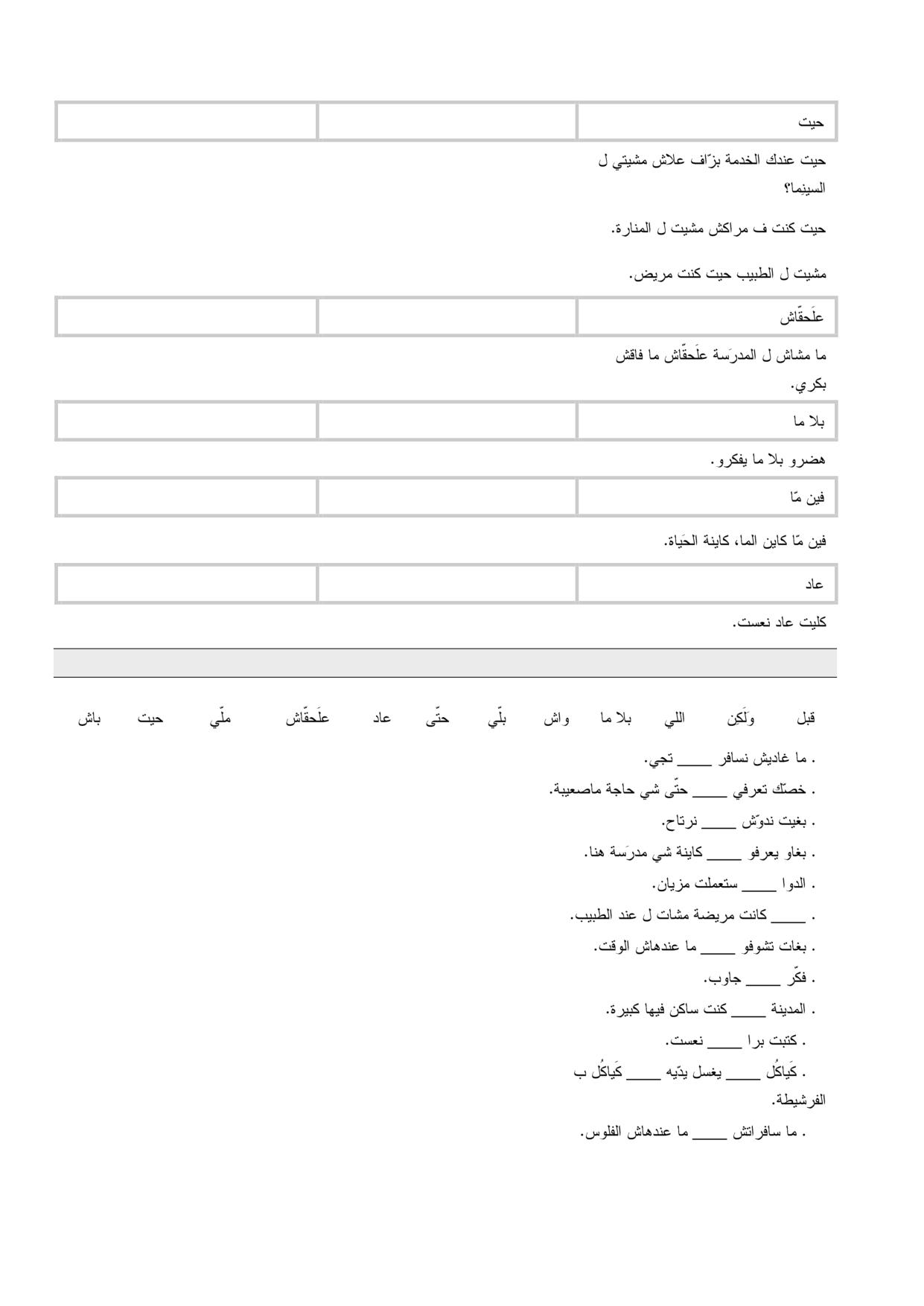
since / when / because
нit
Since you had a lot of work, why нit عndk l-xdma bzzaf
did you go to the cinema?
عlaš mšiti l s-sinima?
When I was in Marrakech I went нit knt f Marrakech mšit
to the Menara.
l l-Menara.
I went to the doctor because I
mšit l t-tbib нit knt
was sick.
mrid.
because
عlaнqqaš
He didn‟t go to school because ma-mša-š l l-mdrasa
he didn‟t wake up early.
عlaнqqaš ma-faq-š bkri.
without
bla ma
They talked without thinking.
hdru bla ma y-fkru.
wherever
fin mma
Wherever there is water there is fin mma kayn l-ma, kayna
life.
l-нayat.
then
عad
I ate then slept.
klit عad nعst.
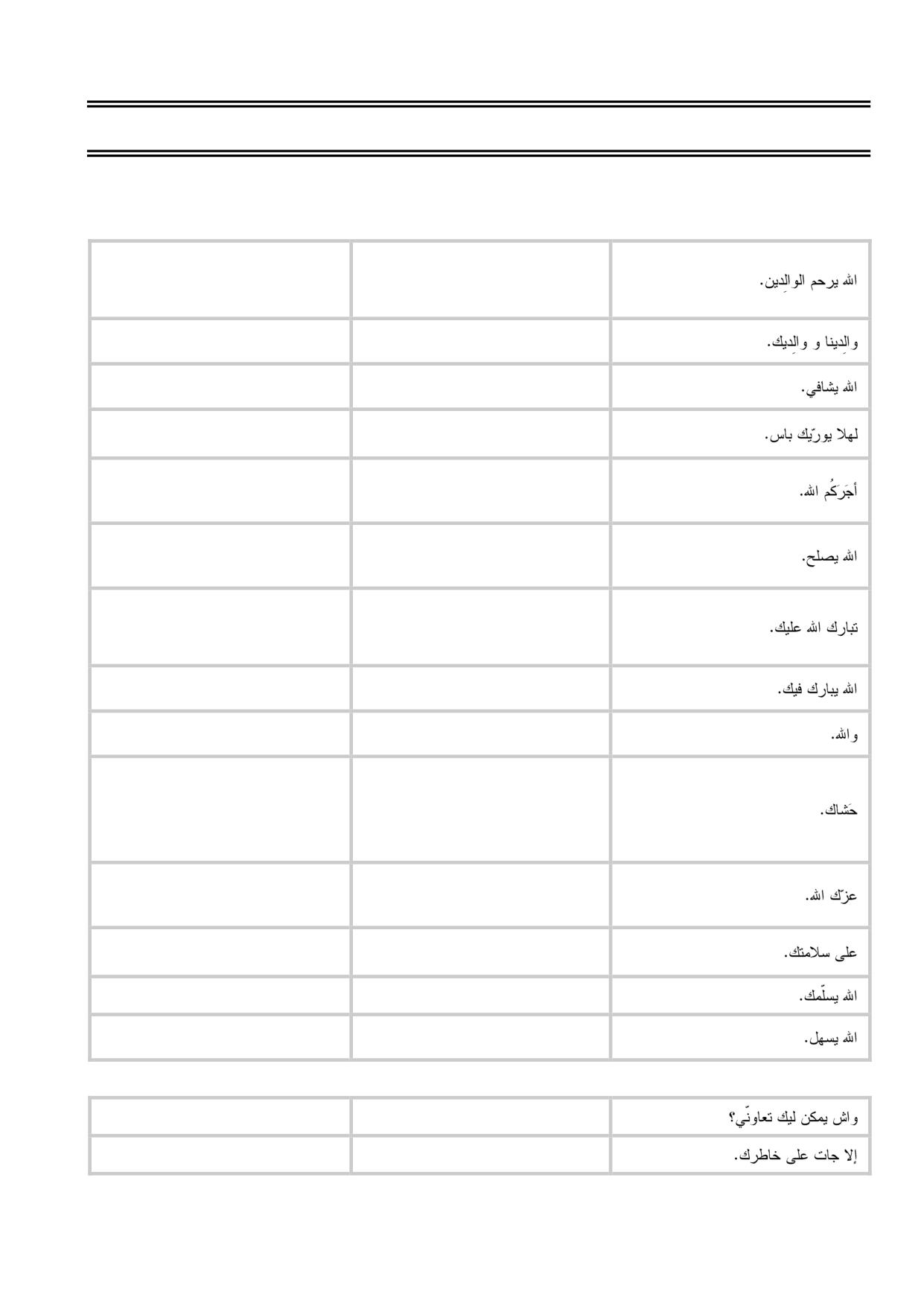
Exercise: Fill in the blanks with the appropriate conjunction from the list.
baš
нit
mlli
عlaнqqaš عad нtta blli weš bla ma l-li welakin qbl
1. ma-ġadi-š n-safr
____
t-ji.
1
2. xssk t-عrfi
____
нtta ši нaja masعiba.
2
3. bġit n-duwš
____
n-rtaн.
3
4. bġau y-عrfu
____
kayna ši mdrasa hna.
4
5. d-dwa
____
stعmlt mzyan.
5
6.
____
kant mrida mšat l عnd t-tbib.
6
7. bġat t-šufu
____
ma-عndha-š l-wqt.
7
8. fkkr
____
jawb.
8
9. l-mdina
____
knt sakn fiha kbira.
9
10. ktbt bra
____
nعst.
10
11. kay-akul
____
y-ġsl yddih
____
11
kay-akul b l-fršita.
12. ma-safrat-š
____
ma-عndha-š l-flus.
12
157
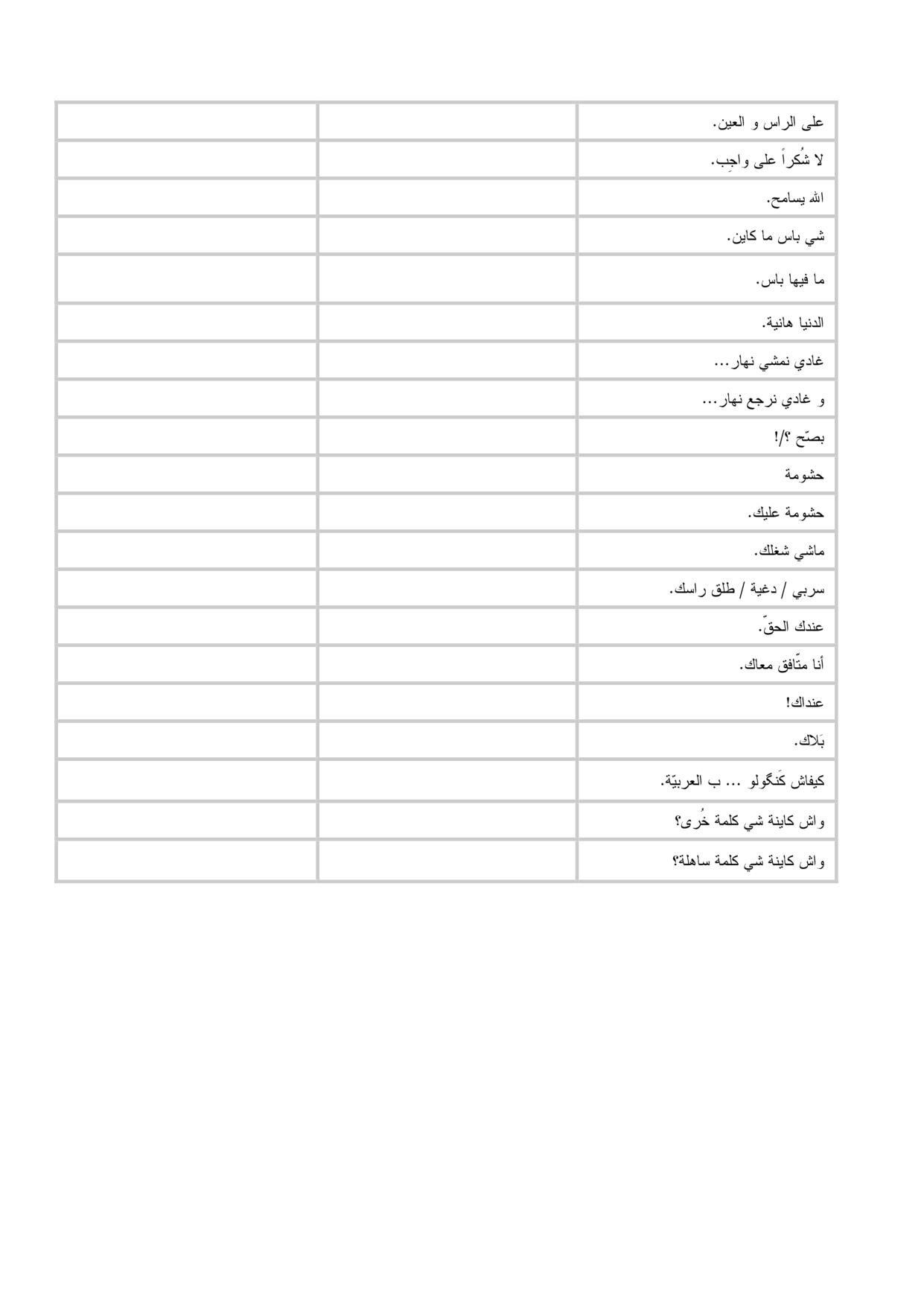
More Useful Expressions
You were given some useful expressions on pages 19 to 21. Here are more expressions, including many
―God phrases.‖
God Phrases
May God bless your parents.
(used often when asking for a service /
lla y-rнm l-walidin.
information or to express gratitude to
someone)
Our parents and yours. (a
walidina u walidik.
response to the above)
May God cure you. (used to show
lla y-šafi.
sympathy toward a sick person)
May God not show you any
lhla y-wrrik bas.
harm. (a response to the above)
May God magnify the good
deeds. (used to offer condolences for
ajarakum llah.
someone‟s death)
May God make your child a
good person. (used to complement a
lla y-slн.
parent on his/her child)
May God grant you grace. (used
when saying goodbye to a friend or
tbark llah عlik.
congratulating him/her on a job well
done)
May God grant you grace.
lla y-bark fik.
(response to the above)
I swear to God. (expresses that
ullah.
what you said was true)
Used to express “excuse me” when
someone does something for you, such
as: hands you socks or shoes, pours
нašak.
water over your hands to wash them,
etc. It is also used when the speaker
mentions words like “donkey” or “trash.”
May God grant you pride and
honor. (used as a response to the
عzzk llah.
above)
Used on the arrival of somebody
عla slamtk.
after a trip.
Response to the above.
lla y-sllmk.
May God make your life easier.
lla y-shl.
(said to beggars)
Other Expressions
Would you please help me?
weš ymkn lik t-عawnni?
If you don‟t mind.
ila jat عla xatrk.
158 • Moroccan Arabic
It is my pleasure.
عla r-ras u l-عin.
You‟re welcome.
la šukran عla wajib.
God forgives.
lla y-samн.
It is all right. (no harm done)
ši bas ma kayn.
There is no harm. (response to
ma fiha bas.
apology)
That‟s fine.
d-dnya hanya.
I‟m going on ...
ġadi n-mši nhar...
and I‟ll be back on ...
u ġadi n-rjع nhar...
Really ?/!
bssн ?/!
It‟s shameful.
нšuma
Shame on you.
нšuma عlik.
It‟s none of your business.
maši šġlk.
Hurry up.
srbi / dġya / tlq rask.
You are right.
عndk l-нqq.
I agree with you.
ana mttafq mعak.
Watch out!
عndak!
Move aside.
balak.
kifaš kan-gulu ... b
How do we say ... in Arabic?
l-عrbiya.
Is there another word?
weš kayna ši klma xura?
weš kayna ši klma
Is there an easy word?
sahla?
159
Moroccan Holidays
Holidays in Morocco are extremely important and festive occasions. Women and girls have henna
parties and come out of their houses to celebrate. Visitors are entertained and gifts are exchanged
among friends. Particular religious rites are performed. Special sweets and foods are washed down by
glass after glass of mint tea as everyone gets caught up in the socializing and celebrating.
Religious Holidays
There are both religious and civil holidays in Morocco. The Gregorian calendar, based on solar
computation, is used for civil purposes. This is the calendar Westerners generally use.
The Islamic calendar, based on lunar computation, divides the year into twelve months which
reoccur in varying relationship to the Gregorian year and complete their cycle every thirty years of 355
days. These thirty-year cycles consist of nineteen years of 354 days and eleven years of 355 days. Thus,
the Islamic calendar gains 10 to 11 days a year on the Gregorian year.
This calendar is called the Hegiran calendar because its starting point was the hegira, when
Mohamed fled from Mecca in 622 of the Gregorian calendar. This calendar is used for religious
purposes in Morocco.
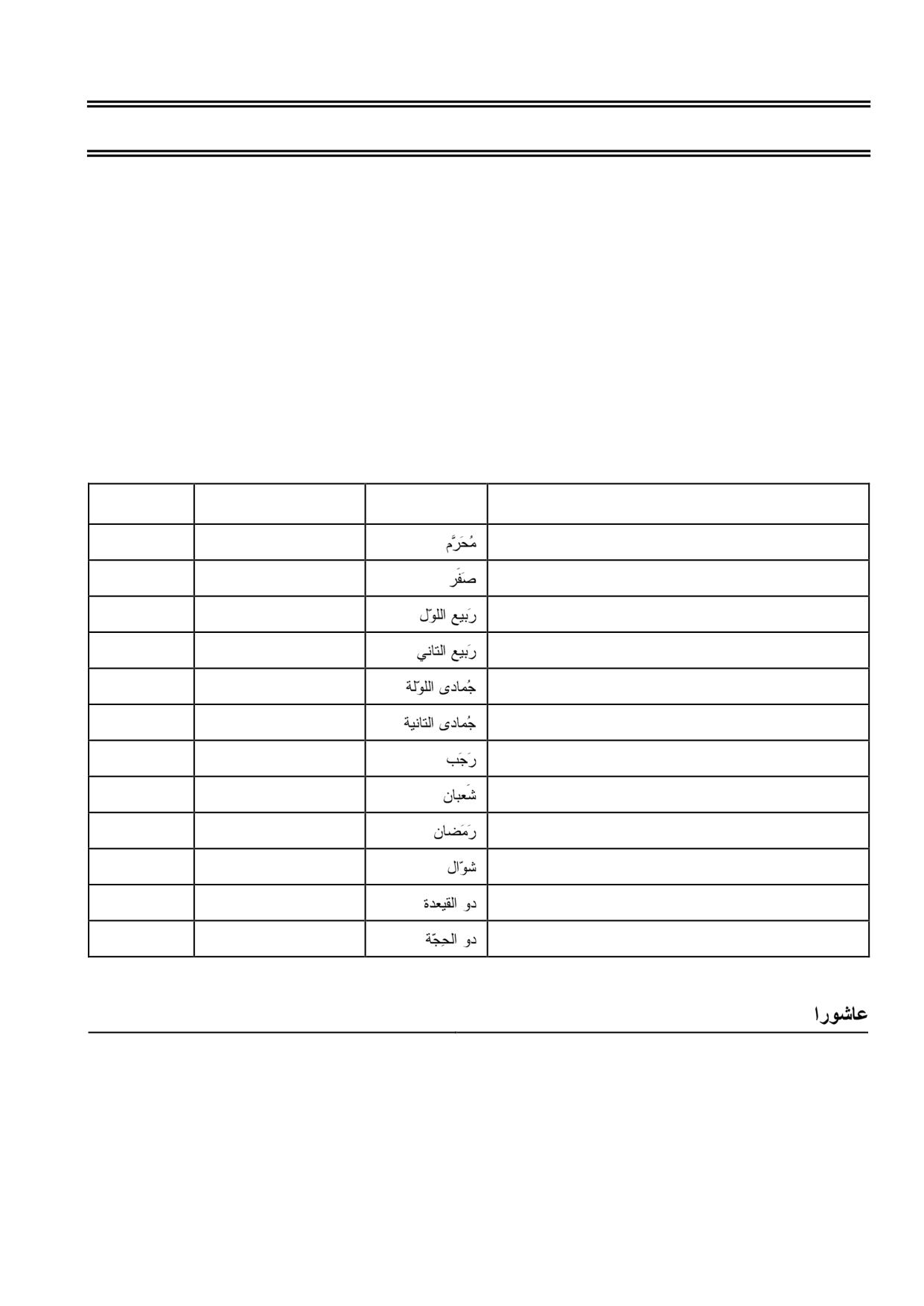
Transcription
Month
Arabic
Festivals
Name
1st
muнarram
10th of the month: عašura
2nd
safar
3rd
rabiع l-luwl
12th of the month: l diع-mulud
4th
rabiع t-tani
5th
jumada l-luwla
6th
jumada t-tanya
7th
rajab
8th
šaعban
15th of the month: šعbana
9th
ramadan
10th
šuwal
1st of the month: l-عid s-sġir
11th
du l-qiعda
12th
du l-нijja
10th of the month: l-عid l-kbir
Here are descriptions of the major festivals:
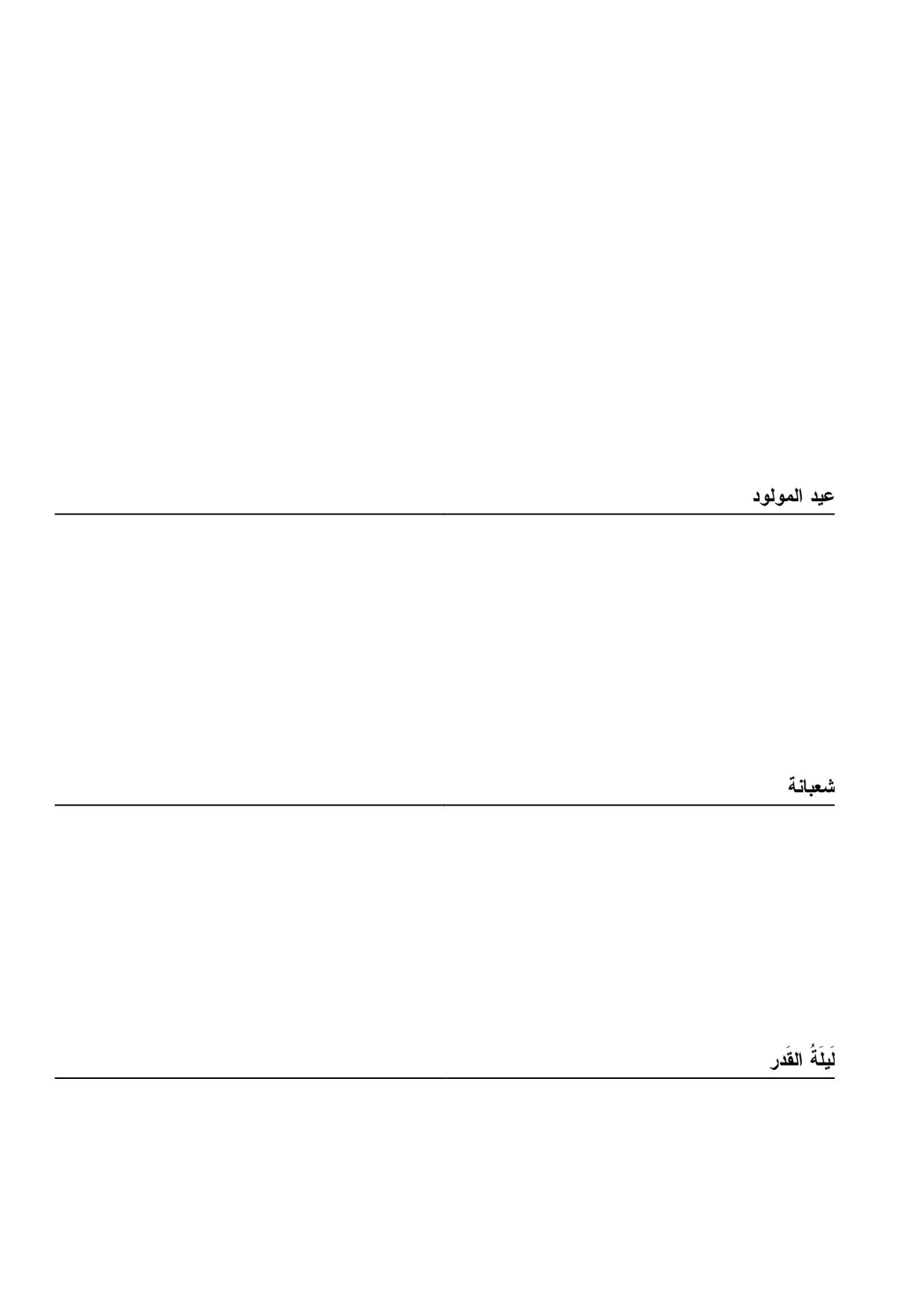
عašura
muнarram, the first month of the Islamic year, is in Morocco called šhr عašura, the month of the
arušaع. It has derived this name from the feast on the tenth day of the month. This day, called nhar
عašura is the Islamic New Year‘s Day. It is said that Allah created Adam and Eve, heaven and hell, and
life and death on the 10th.
The month of arušaع is rich in magical qualities. The ninth and particularly the tenth day are
blessed days, and on the latter, many sacred or wonderful events are said to have taken place in the
160 • Moroccan Arabic
past. In Morocco, baraka is also generally ascribed to those days. Magic, good, or evil is extensively
practiced on the arušaع day and on the preceding night which is said to favor witches. People gather
and many wear masks and costumes and speak in disguised voices on the night before the arušaع. It is
believed that magic practiced at this time of year will produce an effect which lasts for the whole year.
Good food has a place in the rejoicing of arušaع, in accordance with the traditional saying of the
Prophet, ―Who give the plenty to his household on the arušaع day, God will bestow plenty upon him
throughout the remainder of the year.‖ Cow, bullock, goat, sheep, dried dates, and eggs are fixed
according to local custom. Visits to the graves of relatives and alms-giving are common at this time.
Of great interest are the fire and water rites practiced at arušaع, to which purificatory and other
beneficial effects are ascribed. On arušaع eve, ―the bonfire night‖ fires are built throughout the town
and the people sing and dance around them. The chief object of the rite is to purify men and animals or
to protect them from evil influences, since there is ―baraka‖ (blessings) from those fires.
Similar effects are attributed to the water rites which even more frequently are practiced on the
following morning. It is a general belief that there is baraka in all water on this morning. To take a bath
on the morning of the arušaع day is a very wide-spread custom, and in many cases it was expressly
said that it must be done before sunrise. Children are traditionally involved in this festival. They
dress-up, play small drums, and are given gifts during this holiday.
عid l-mulud
In Morocco, the third month of the Islamic year is called šhr l-mulud, the month of the mulud.
These names are given because of the feast celebrating the birth of the Prophet which commences on
the twelfth day of the month and lasts for several days. The mulud is a particularly blessed month and
all children born during it are considered fortunate.
The Prophet‘s Birthday has more significance in Morocco because Morocco is a Kingdom rather
than a republic, and King Mohamed VI is a descendant of the Prophet. The anniversary is brilliantly
celebrated at the Imperial Palace in Rabat and in the evening in Sale a great procession of candles takes
place.
In Meknes the Aissaoua brotherhood has its own unique celebration worth seeing. Followers of the
holy man, l-hadi Ben Aissa throng to Meknes and play music, dance, celebrate and make what is called
―the small pilgrimage‖ to nearby saints‘ tombs.
šعbana
The eighth month of the Moroccan year is called šعban. On the fifteenth day a festival known as
šعbana takes place. According to legend, this is the day that Allah ―registers all the actions of mankind
which they are to perform during the year and all the children of men who are to be born and die in the
year.‖
Traditionally, barren women gather in homes in the neighborhood and cook a couscous meal with
special spices. This meal is eaten by the women and children at home or in the mosque. The barren
women in the group hope this will help them to give birth during the upcoming year.
šعbana is also the month before the month of fasting, Ramadan. People think of the difficult
month ahead and have a feast. Craftsmen guilds often have parties on this night involving music and
feasting.
laylatu l-qadr
Ramadan is the ninth month of the Islamic year. The most important feature of Ramadan is the
complete abstinence from food, drink and sexual activity from daybreak to sunset. Every Muslim who
has reached the age of puberty must fast. Pregnant women, menstruating women, travelers, and those
who are ill are exempt from fasting, but should make it up at a later date.
161
According Islam, there is one night in Ramadan which is more important than any other, namely,
laylatu l-qadr, ―the night of power.‖ The Koran is said to have been sent down to the Prophet on
that night. This night is one of the last ten nights of Ramadan, but its exact date has not been
discovered by anyone but the Prophet himself. Tradition fixes it to be one of the odd nights-the 21st,
23rd, 25th, 27th, or 29th-and in Morocco it is celebrated on the 27th day.
On the night of the 27th, the men go to the mosque to pray. From sundown to daybreak, the imam
(the prayer leader) reads the Koran. The complete Koran is read before the sun rises. It is believed by
some that the sky will open up during this night and wishes will ascend directly to Allah and be
granted. During the night, special meals of couscous are prepared and brought to the mosques. Those
unable to go to the mosque eat specially prepared meals at home. Each family gives part of the meal to
the poor.
l-عid s-sġir
Immediately following Ramadan is l-عid s-sġir, or ―the little feast.‖ Everyone stays up very late
hoping to hear the announcement that the new moon has been sighted and Ramadan and fasting are
over. When it has officially been sighted, a three-day festival ensues in which alms-giving plays a major
role. The alms usually consist of food items like wheat or barley, and each family does the best it can.
The chief religious rite of the feast is a prayer service at the mosque.
l-عid l-kbir
On the tenth day of the month du l-нijja, the last month of the year, the Islamic world
celebrates its yearly sacrificial feast. In Morocco it is known as l-عid l-kbir or ―the great feast.‖
This is the central feast in Islam, comparable to and derived from the feast of the atonement,
Abraham‘s substitute sacrifice, for the remission of sins. Hence, the animal sacrificed must be mature
and without blemish.
Every family must have its own sheep just as Americans need turkeys for the proper celebration of
Thanksgiving. Those who cannot afford a sheep buy a lamb or another less expensive animal. In
Morocco, the animal cannot be slain until the King has killed his sheep. Then in each household, the
head of the family kills the sheep (sometimes a butcher is asked to come to the house and perform the
ritual). The sheep is eaten in an orderly fashion determined by local custom. For example, on the first
day, the liver, heart, stomach, and lungs are eaten. On the second day, normally the head and feet are
eaten. However, the head and feet can be eaten on the first day if that is the local custom. There are
purification and sanctification customs and rites that prepare the people for the holy feast and its
principal feature, the sacrifice. People must purify and sanctify themselves in order to benefit from the
holy feast and its sacrifice. Personal cleanliness should be observed. Men and boys visit the barber and
often make a trip to the hammam as well.
Henna is used not merely as a cosmetic, but as a means of protection against evil influences.
Women paint their hands with it and, in many cases, also their feet. Among some ethnic groups, henna
is also applied to domestic animals.
Alms-giving and prayer are two other purification rites practiced during the great feast. Gifts are
exchanged between family members and a portion of the meal is given to the poor. The day begins with
prayer. The chief praying ceremony takes place in the morning at the mosque.
Moussems
Many Moroccan communities commemorate local saints, or ―marabous,‖ in a yearly festival or
―moussem.‖ Most moussems are held near the tomb of the marabou and involve music, dancing and
fantasia. For a very famous marabou‘s moussem, people will come from very far away. Some very
famous moussems celebrate Moulay Bouchaib (near El Jadida), Moulay Brahim (near Marrakech),
Moulay Yaعqub (Fes), and Moulay Idriss (Moulay Idriss). Many towns have their own moussems
known only to those in the region.
162 • Moroccan Arabic
National Holidays
In addition to the religious holidays, some important civil holidays commemorating significant
events in Morocco‘s recent history are celebrated. The most important of these are Independence Day,
the Throne feast, Green March Day, and King Mohamed‘s birthday.
The Festival of the Throne, or عid l-عrš, is the biggest of the civil holidays. This festival
commemorates the coming to power of the King on July 30, 1999. Celebrations including parades with
nationalistic anthems, usually occur in the cities with local government officials, like the governor,
making appearances. Traditionally during this holiday, country people come to visit their city relatives,
who are expected to feed and house them for the duration of the festival. There is often a special
emphasis on improving the appearance of the town prior to this holiday. City employees clean streets
and paint walls, and townspeople are sometimes required by government officials to paint their doors,
whitewash their houses, and display flags.
Green March Day is also celebrated by large parades in most of Morocco. This day commemorates
one of the greatest achievements of King Hassan II: the mobilization of 350,000 Moroccans for the
march into the Sahara territory. On November 6, 1975, the first Moroccan marchers, under the
leadership of the then Prime Minister Ahmed Osman, set out from Tarfaya and entered the Spanish
territory. During the celebration, those who went on the actual march once again dress up in green and
re-enact the march.
Independence Day, or l diع-istiqlal, commemorates the November 18, 1956 return of
Mohamed V from his French-imposed exile in Madagascar. This day gives rise to receptions at the
Imperial Palace and parades and celebrations all over Morocco.
The last of these major national holidays celebrates the King‘s Birthday, August 21, 1962. There are
many organized celebrations in Rabat and broadcasts on the radio praising the King.
Regional Festivals
There are also many regional festivals which are centered around a particular product in which a
region specializes. The product is displayed and sold; music and other activities take place in an
atmosphere similar to a country fair.
Some famous regional festivals are the Cherry Festival in Sefrou, the Date Festival in Erfoud, the
Rose Festival in El-Kelaa M‘Gouna (near Ouarzazate), the Marrakech Folklore and Music Festival, and
the Immouzer Honey Festival (near Agadir).
One of the most interesting festivals in Morocco is the re-enactment of an ancient market in the
High Atlas mountains. At one time, these very isolated High Atlas tribes would gather yearly at a
specific point near Imilchil where many mountain paths met for the yearly ―market.‖ Provisions for
many months were bought and sold and at one time one of the reasons for coming was to acquire a
bride. Men would meet a girl for the first time and pay her dowry then take her home. Some say this
practice still exists and others say it is just a re-enactment for tourists, but in any case, it is a large
market where many Berbers still buy many of the coming year‘s provisions.
Religious, civil, and regional festivals are an excellent chance to get out and see interesting things,
meet people on an informal basis, and have fun. Dates of these celebrations can be obtained from the
national tourist office branches in many cities, but people in your community will usually provide you
with the information about your region.
It should be noted that the same festival may be celebrated somewhat differently in various sections
of the country. For example, in Errachidia Province, a far greater emphasis is put on Green March Day
than in other sections of Morocco because that province provided the first contingent for the march.
Be sure to check out the expectations of your community for a particular holiday, particularly in
terms of visitation, entertaining, gift-giving, and participation, so you can get as involved as possible
and enjoy the holidays.
163
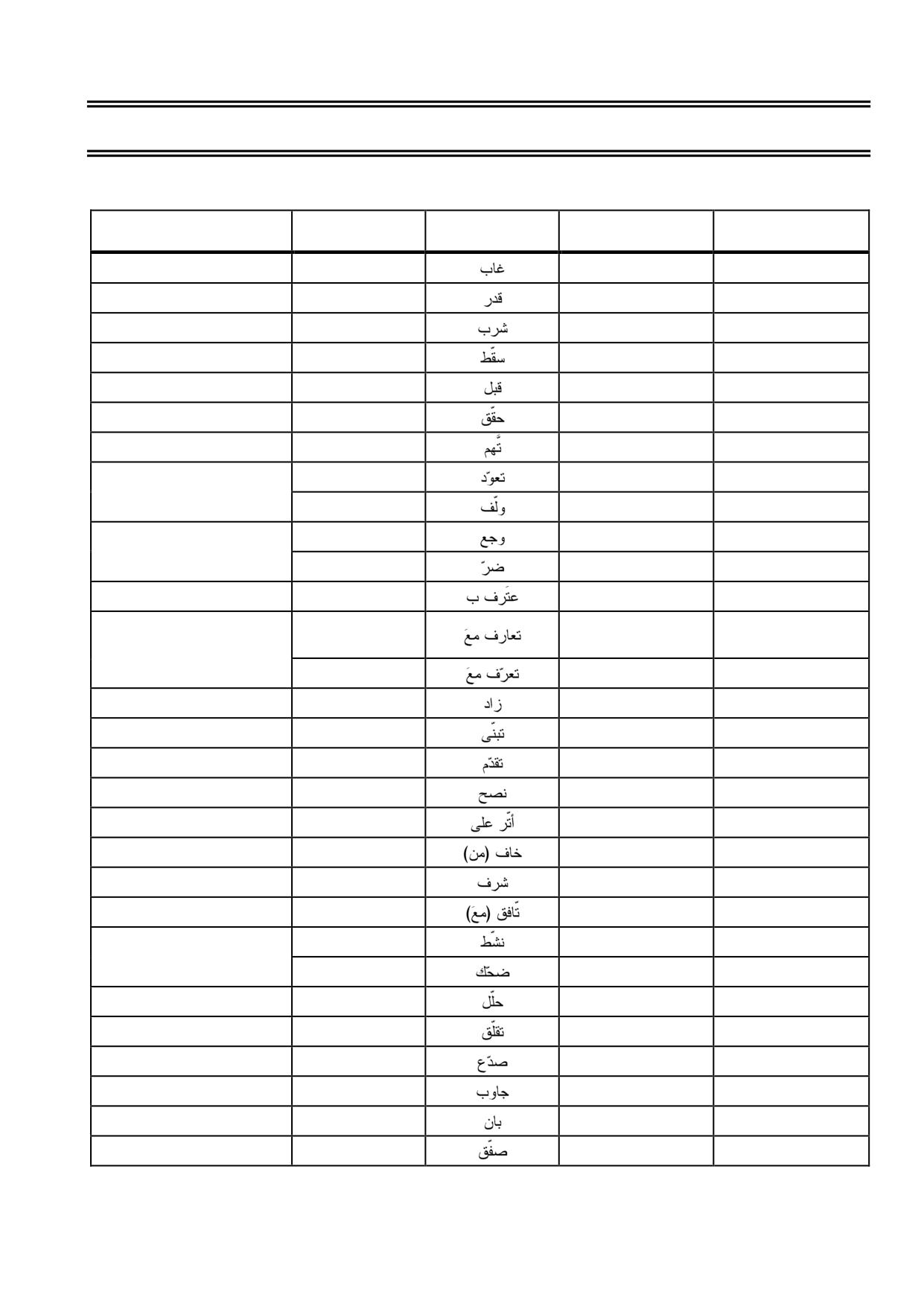
Glossary of Verbs
This glossary provides both the present tense and past tense conjugations for the subject ―I,‖ making it
possible for you to determine how to conjugate irregular verbs.
First Person
First Person
English
Transcription
Arabic
Present Tense
Past Tense
absent, to be
ġab
kan-ġib
ġbt
able, to be
qdr
kan-qdr
qdrt
absorb
šrb
kan-šrb
šrbt
abort (a fetus)
sqqt
kan-sqqt
sqqtt
accept
qbl
kan-qbl
qblt
accomplish
нqqeq
kan-нqqeq
нqqeqt
accuse
ttahm
kan-ttahm
ttahmt
accustom
tعuwd
kan-tعuwd
tعuwdt
wllf
kan-wllf
wllft
ache
wjع
kan-wjع
wjعt
drr
kan-drr
drrit
acknowledge
عtarf b
kan-عtarf
عtarft
acquaint with, become
tعarf mعa
kan-tعarf
tعarft
acquainted with, sth/sb
tعrrf mعa
kan-tعrrf
tعrrft
add
zad
kan-zid
zdt
adopt (a child, an idea)
tbnna
kan-tbnna
tbnnit
advance
tqddm
kan-tqddm
tqddmt
advise
nsн
kan-nsн
nsнt
affect
attr عla
kan-attr
attrt
afraid (of), to be
xaf (mn)
kan-xaf
xft
age (get old)
šrf
kan-šrf
šrft
agree (with)
ttafq (mعa)
kan-ttafq
ttafqt
amuse
nššt
kan-nššt
nšštt
dннk
kan-dннk
dннkt
analyze
нllel
kan-нllel
нllelt
angry, to be
tqllq
kan-tqllq
tqllqt
annoy
sddع
kan-sddع
sddعt
answer
jawb
kan-jawb
jawbt
appear
ban
kan-ban
bnt
applaud
sffq
kan-sffq
sffqt
164 • Moroccan Arabic
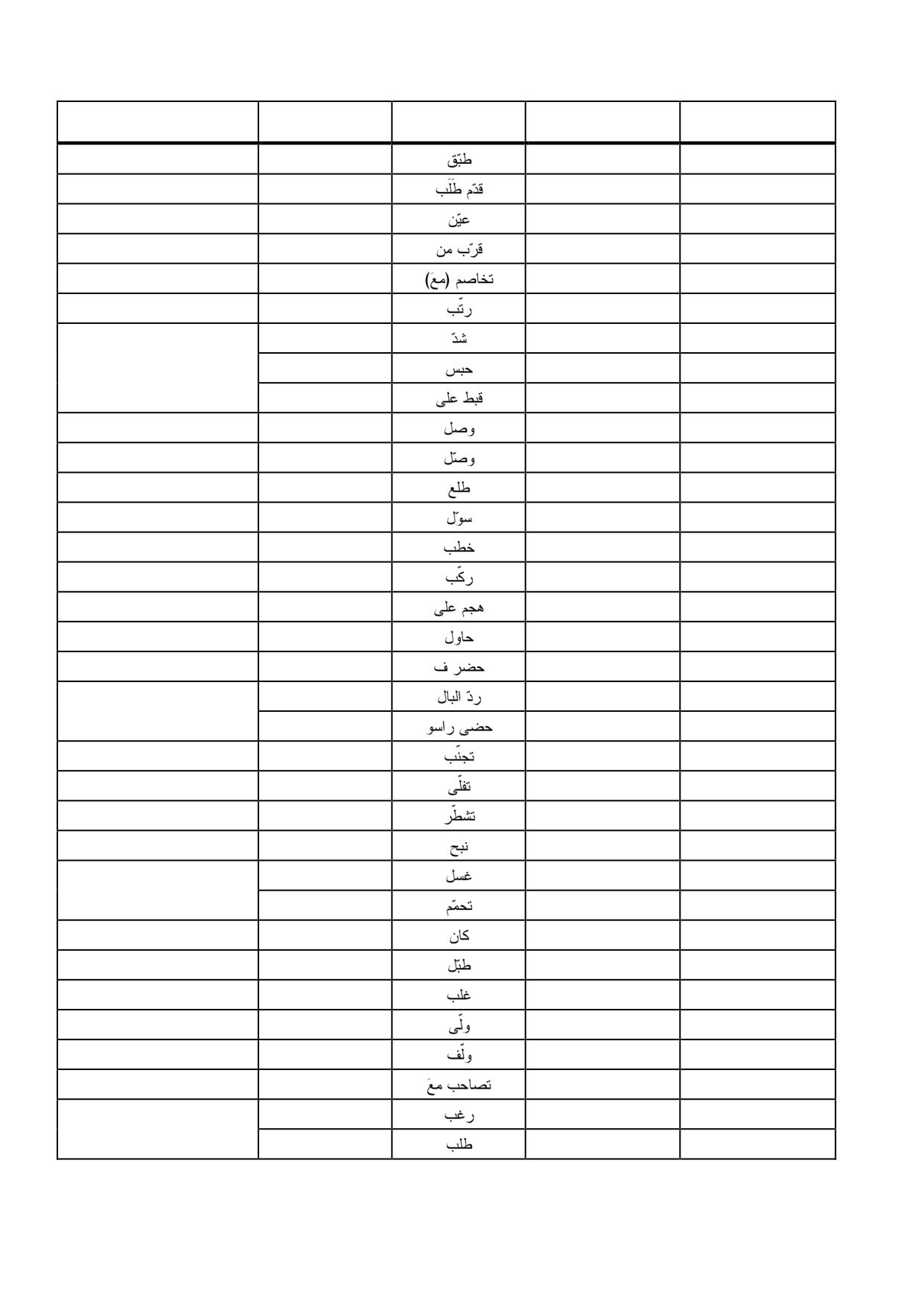
First Person
First Person
English
Transcription
Arabic
Present Tense
Past Tense
apply (a rule, an idea)
tbbq
kan-tbbq
tbbqt
apply for (a job)
qddm talab
kan-qddm
qddmt
appoint
عiyn
kan-عiyn
عiynt
approach
qrrb mn
kan-qrrb
qrrbt
argue (with)
txasm (mعa)
kan-txasm
txasmt
arrange
rttb
kan-rttb
rttbt
arrest sb
šdd
kan-šdd
šddit
нbs
kan-нbs
нbst
qbt عla
kan-qbt
qbtt
arrive
wsl
kan-wsl
wslt
arrive, to make
wssl
kan-wssl
wsslt
ascend
tlع
kan-tlع
tlعt
ask
suwl
kan-suwl
suwlt
ask (in marriage)
xtb
kan-xtb
xtbt
assemble (parts)
rkkb
kan-rkkb
rkkbt
attack
hjm عla
kan-hjm
hjmt
attempt
нawl
kan-нawl
нawlt
attend
нdr f
kan-нdr
нdrt
attention, pay
rdd l-bal
kan-rdd l-bal
rddit l-bal
нda rasu
kan-нdi rasi
нdit rasi
avoid
tjnnb
kan-tjnnb
tjnnbt
banter
tflla
kan-tflla
tfllit
bargain
tšttr
kan-tšttr
tšttrt
bark
nbн
kan-nbн
nbнt
bathe
ġsl
kan-ġsl
ġslt
tнmmem
kan-tнmmem
tнmmemt
be
kan
kan-kun
knt
beat (drum)
tbbl
kan-tbbl
tbblt
beat sb (in a game)
ġlb
kan-ġlb
ġlbt
become
wlla
kan-wlli
wllit
become accustomed
wllf
kan-wllf
wllft
befriend
tsaнb mعa
kan-tsaнb
tsaнbt
beg
rġb
kan-rġb
rġbt
tlb
kan-tlb
tlbt
165
First Person
First Person
English
Transcription
Arabic
Present Tense
Past Tense
begin
bda
kan-bda
bdit
belch/burp
tgrrع
kan-tgrrع
tgrrعt
believe sb
tiyq
kan-tiyq
tiyqt
believe (in)
amn (b)
kan-amn
amnt
benefit (from)
stafd (mn)
kan-stafd
stafdt
betray
xan
kan-xun
xnt
bigger, to make
kbbr
kan-kbbr
kbbrt
birth, to give
wld
kan-wld
wldt
bite
عdd
kan-عdd
عddit
blow up (with air)
nfx
kan-nfx
nfxt
blow up (explode)
frgع
kan-frgع
frgعt
boil
ġlla
kan-ġlli
ġllit
born, to be
tzad
kan-tzad
tzadt
borrow
tsllf
kan-tsllf
tsllft
bow
нdr
kan-нdr
нdrt
break
hrrs
kan-hrrs
hrrst
broken, to be
thrrs
kan-thrrs
thrrst
break down (machine)
txssr
kan-txssr
txssrt
breathe
tnffs
kan-tnffs
tnffst
bring
jab
kan-jib
jbt
brush (hair)
mšt
kan-mšt
mštt
build
bna
kan-bni
bnit
burn
нrq
kan-нrq
нrqt
burnt, to be
tнrq
kan-tнrq
tнrqt
burst (pipe)
tfrgع
kan-tfrgع
tfrgعt
bury
dfn
kan-dfn
dfnt
buy
šra
kan-šri
šrit
call
عiyt l/عla
kan-عiyt
عiytt
drb t
call on the phone
kan-drb
drbt
tilifun
عiyt l
kan-عiyt
عiytt
calm, to be (to not
thnna
kan-thnna
thnnit
worry)
can
qdr
kan-qdr
qdrt
camp
xiym
kan-xiym
xiymt
166 • Moroccan Arabic
First Person
First Person
English
Transcription
Arabic
Present Tense
Past Tense
capture
qbt
kan-qbt
qbtt
care of, to take
thla f
kan-thla
thlat
carry
hzz
kan-hzz
hzzit
carve (wood)
nqš
kan-nqš
nqšt
cash
srrf
kan-srrf
srrft
catch
šdd
kan-šdd
šddit
qbt
kan-qbt
qbtt
catch up (with)
xlt عla
kan-xlt
xltt
lнq عla
kan-lнq
lнqt
cause
sbbeb
kan-sbbeb
sbbebt
tsbbeb f
kan-tsbbeb
tsbbebt
celebrate
нtafl b
kan-нtafl
нtaflt
censor (prices, film)
raqb
kan-raqb
raqbt
change
bddl
kan-bddl
bddlt
change (money)
srrf
kan-srrf
srrft
change (weather)
tbddl
kan-tbddl
tbddlt
charge of, to be in
tkllf b
kan-tkllf
tkllft
cheat
ġšš
kan-ġšš
ġššit
cheat (exam)
nql
kan-nql
nqlt
cheat out of
šmt
kan-šmt
šmtt
chew
mdġ
kan-mdġ
mdġt
choose
xtar
kan-xtar
xtarit
churn
mxd
kan-mxd
mxdt
clap
sffq
kan-sffq
sffqt
clarify
šrн
kan-šrн
šrнt
wddн
kan-wddн
wddнt
clean
nqqa
kan-nqqi
nqqit
clean (pipes)
srrн
kan-srrн
srrнt
climb
tlع
kan-tlع
tlعt
clog
xnq
kan-xnq
xnqt
close
sdd
kan-sdd
sddit
close eyes
ġmmd
kan-ġmmd
ġmmdt
cold, to make
brrd
kan-brrd
brrdt
collapse
rab
kan-rib
rbt
167
First Person
First Person
English
Transcription
Arabic
Present Tense
Past Tense
collect
jmع
kan-jmع
jmعt
come
ja
kan-ji
jit
comment
عllq
kan-عllq
عllqt
compare
qarn bin
kan-qarn
qarnt
complain about
tškka mn
kan-tškka
tškkit
complain to
tškka عla
kan-tškka
tškkit
complete
kmml
kan-kmml
kmmlt
concentrate
rkkz
kan-rkkz
rkkzt
concern
hmm
kay-hmm
hmm
concerned with, to be
httm b
kan-httm
httmt
confess
عtarf
kan-عtarf
عtarft
confuse
нiyr
kan-нiyr
нiyrt
confused, to be
нar
kan-нir
нrt
congratulate
hnna
kan-hnni
hnnit
conjugate
srrf
kan-srrf
srrft
connect
rbt
kan-rbt
rbtt
consult (with)
tšawr (mعa)
kan-tšawr
tšawrt
contact
tasl b
kan-tasl
taslt
content with, to be (give
rda عla
kan-rdi
rdit
your blessing to)
continue in sth
stamr f
kan-stamr
stamrt
continue studies
tabع
kan-tabع
tabعt
contribute
sahm
kan-sahm
sahmt
control
tнkkm f
kan-tнkkm
tнkkmt
raqb
kan-raqb
raqbt
cook
tiyb
kan-tiyb
tiybt
cooperate (with)
tعawn (mعa)
kan-tعawn
tعawnt
cope
sllk
kan-sllk
sllkt
copy (by hand)
nql
kan-nql
nqlt
copy (photocopy)
nsx
kan-nsx
nsxt
correct
sннeн
kan-sннeн
sннeнt
cost
swa
kan-swa
swit
cough
kнн
kan-kнн
kннit
kнb
kan-kнb
kнbt
count
нsb
kan-нsb
нsbt
168 • Moroccan Arabic
First Person
First Person
English
Transcription
Arabic
Present Tense
Past Tense
cram into
xša
kan-xši
xšit
crazy, to be
нmq
kan-нmq
нmqt
crazy, to make
нmmq
kan-нmmq
нmmqt
create
xlq
kan-xlq
xlqt
cross (road)
qtع
kan-qtع
qtعt
cross-breed
lqqm
kan-lqqm
lqqmt
cry
bka
kan-bki
bkit
cry, to make
bkka
kan-bkki
bkkit
cure
dawa
kan-dawi
dawit
cured, to be
bra
kan-bra
brit
cut
qtع
kan-qtع
qtعt
cut (hair)
нssn
kan-нssn
нssnt
cut/injure (skin)
jrн
kan-jrн
jrнt
cut/injured, to be
tjrн
kan-tjrн
tjrнt
cut( a pattern from cloth)
fssl
kan-fssl
fsslt
damage
xssr
kan-xssr
xssrt
dampen
fzzg
kan-fzzg
fzzgt
damp, to get
fzg
kan-fzg
fzgt
dance
štн
kan-štн
štнt
deafen
smmk
kan-smmk
smmkt
deal with sb
tعaml mعa
kan-tعaml
tعamlt
decide
qrrer
kan-qrrer
qrrert
declare
عln
kan-عln
عlnt
decrease
nqs
kan-nqs
nqst
dedicate
hda
kan-hdi
hdit
defeat
ġlb
kan-ġlb
ġlbt
defend
dafع عla
kan-dafع
dafعt
define
нdded
kan-нdded
нddedt
defy
tнdda
kan-tнdda
tнddit
delay
عttl
kan-عttl
عttlt
deprive
нrm
kan-нrm
нrmt
descend
hbt
kan-hbt
hbtt
nzl
kan-nzl
nzlt
describe
wsf
kan-wsf
wsft
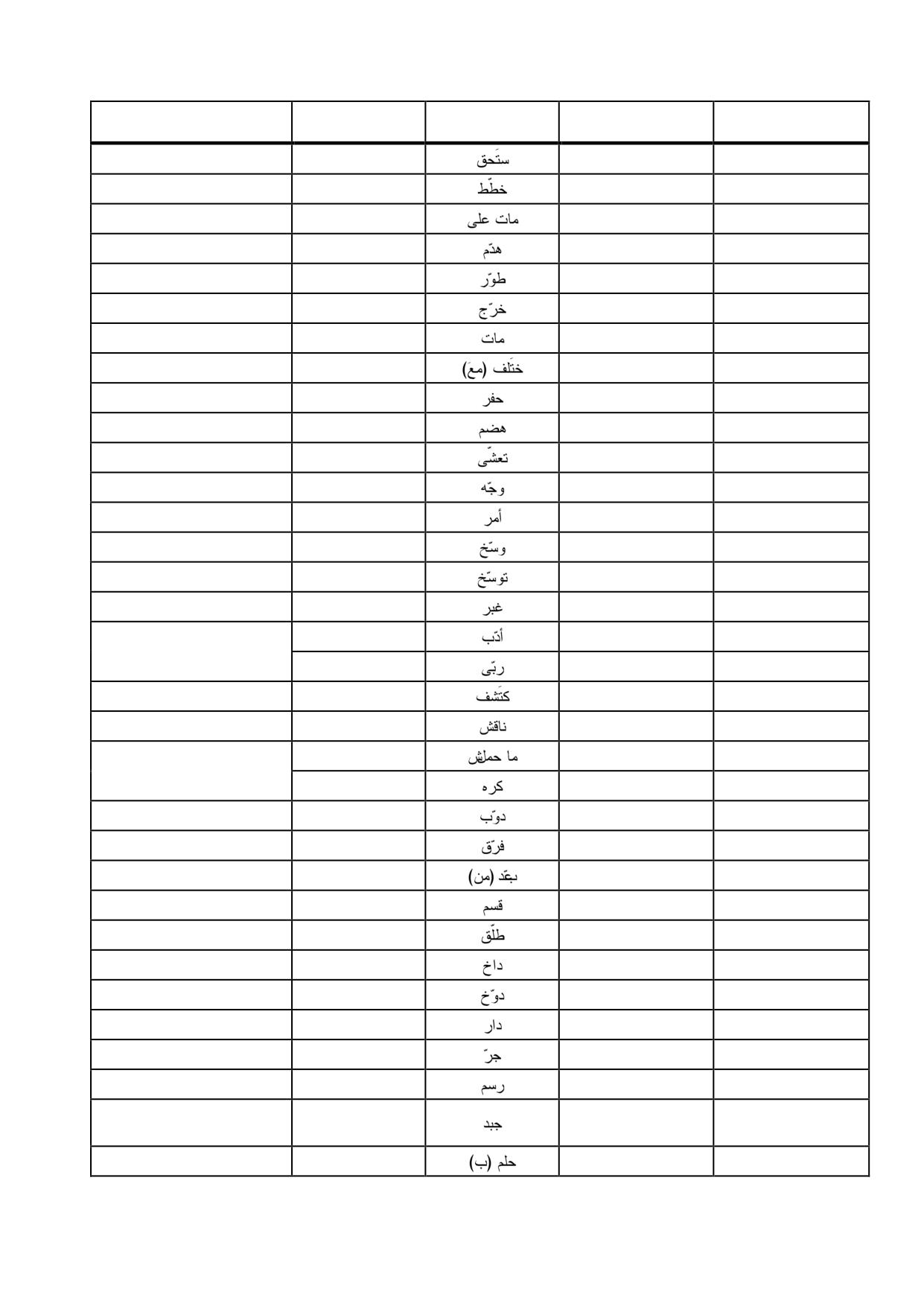
169
First Person
First Person
English
Transcription
Arabic
Present Tense
Past Tense
deserve
staнq
kan-staнq
staнqt
design
xttet
kan-xttet
xttett
desire strongly
mat عla
kan-mut
mtt
destroy
hddm
kan-hddm
hddmt
develop
tuwr
kan-tuwr
tuwrt
develop (film)
xrrj
kan-xrrj
xrrjt
die
mat
kan-mut
mtt
differ (from)
xtalf (mعa)
kan-xtalf
xtalft
dig
нfr
kan-нfr
нfrt
digest
hdm
kan-hdm
hdmt
dinner, to have
tعšša
kan-tعšša
tعššit
direct
wjjh
kan-wjjh
wjjht
direct (as an order)
amr
kan-amr
amrt
dirty, to make
wssx
kan-wssx
wssxt
dirty, to get
tussx
kan-tussx
tussxt
disappear
ġbr
kan-ġbr
ġbrt
discipline
addb
kan-addb
addbt
rbba
kan-rbbi
rbbit
discover
ktašf
kan-ktašf
ktašft
discuss (a topic)
naqš
kan-naqš
naqšt
dislike
ma-нml-š
ma-kan-нml-š
ma-нmlt-š
krh
kan-krh
krht
dissolve sth
duwb
kan-duwb
duwbt
distribute
frrq
kan-frrq
frrqt
distance oneself (from)
bععd (mn)
kan-bععd
bععdt
divide
qsm
kan-qsm
qsmt
divorce
tllq
kan-tllq
tllqt
dizzy, to get
dax
kan-dux
dxt
dizzy, to make
duwx
kan-duwx
duwxt
do
dar
kan-dir
drt
drag
jrr
kan-jrr
jrrit
draw
rsm
kan-rsm
rsmt
draw up (water from a
jbd
kan-jbd
jbdt
well)
dream (about)
нlm (b)
kan-нlm
нlmt
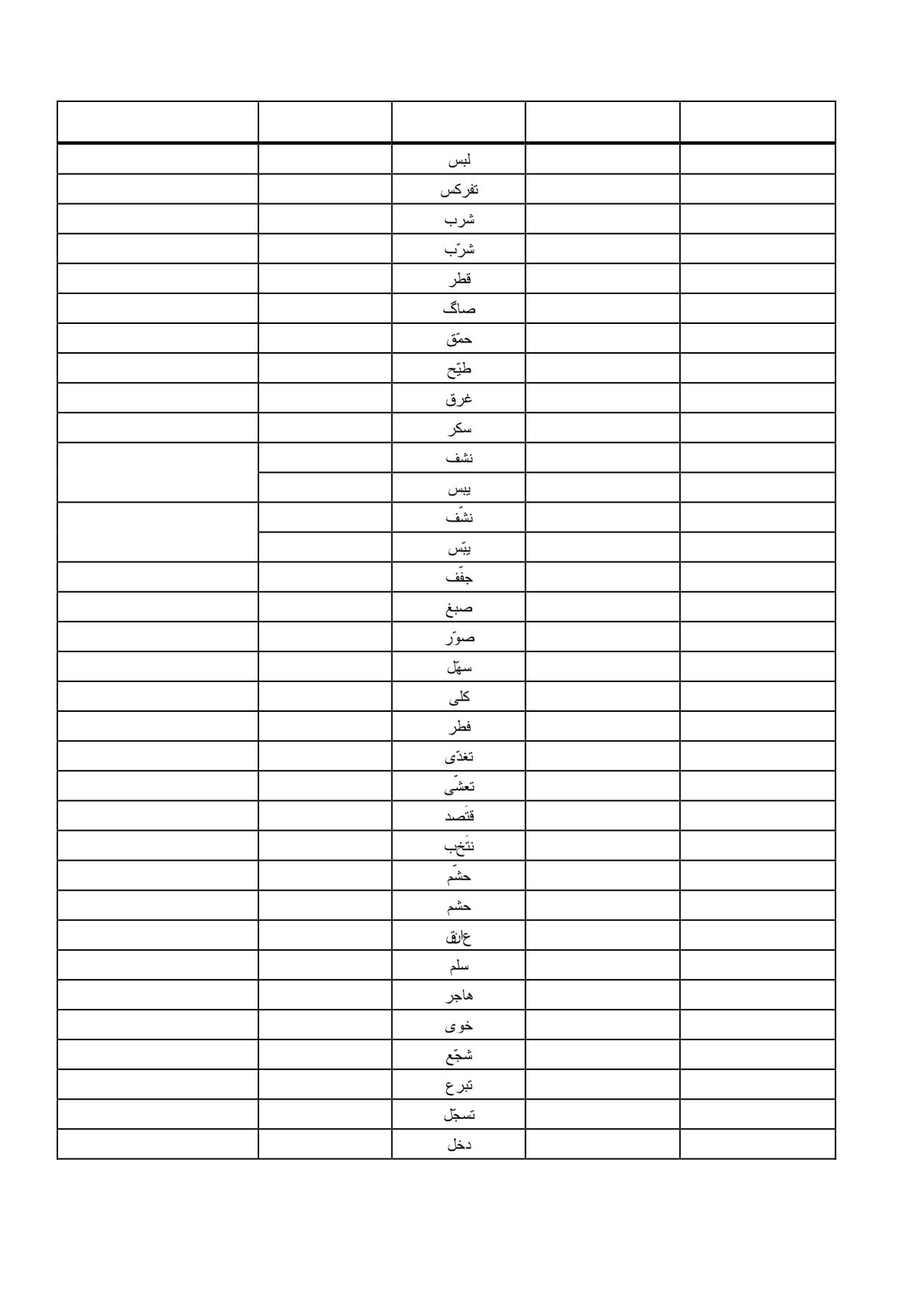
170 • Moroccan Arabic
First Person
First Person
English
Transcription
Arabic
Present Tense
Past Tense
dress
lbs
kan-lbs
lbst
dress up (slang)
tfrks
kan-tfrks
tfrkst
drink
šrb
kan-šrb
šrbt
drink, to make
šrrb
kan-šrrb
šrrbt
drip
qtr
kan-qtr
qtrt
drive
sag
kan-sug
sgt
drive crazy
нmmq
kan-нmmq
нmmqt
drop sth
tiyн
kan-tiyн
tiyнt
drown
ġrq
kan-ġrq
ġrqt
drunk, to get
skr
kan-skr
skrt
dry, to get
nšf
kan-nšf
nšft
ybs
kan-ybs
ybst
dry sth
nššf
kan-nššf
nššft
ybbs
kan-ybbs
ybbst
dry (a wet floor)
jffef
kan-jffef
jffeft
dye
sbġ
kan-sbġ
sbġt
earn (money)
suwr
kan-suwr
suwrt
easy, to make
shhl
kan-shhl
shhlt
eat
kla
kan-akul
klit
eat breakfast
ftr
kan-ftr
ftrt
eat lunch
tġdda
kan-tġdda
tġddit
eat dinner
tعšša
kan-tعšša
tعššit
economize
qtasd
kan-qtasd
qtasdt
elect
ntaxb
kan-ntaxb
ntaxbt
embarrass sb
нššm
kan-нššm
нššmt
embarrassed, to be
нšm
kan-нšm
нšmt
embrace
عanq
kan-عanq
عanqt
embrace Islam
slm
kan-slm
slmt
emigrate
hajr
kan-hajr
hajrt
empty
xwa
kan-xwi
xwit
encourage
šjjع
kan-šjjع
šjjعt
enjoy sth
tbrع
kan-tbrع
tbrعt
enroll
tsjjl
kan-tsjjl
tsjjlt
enter
dxl
kan-dxl
dxlt
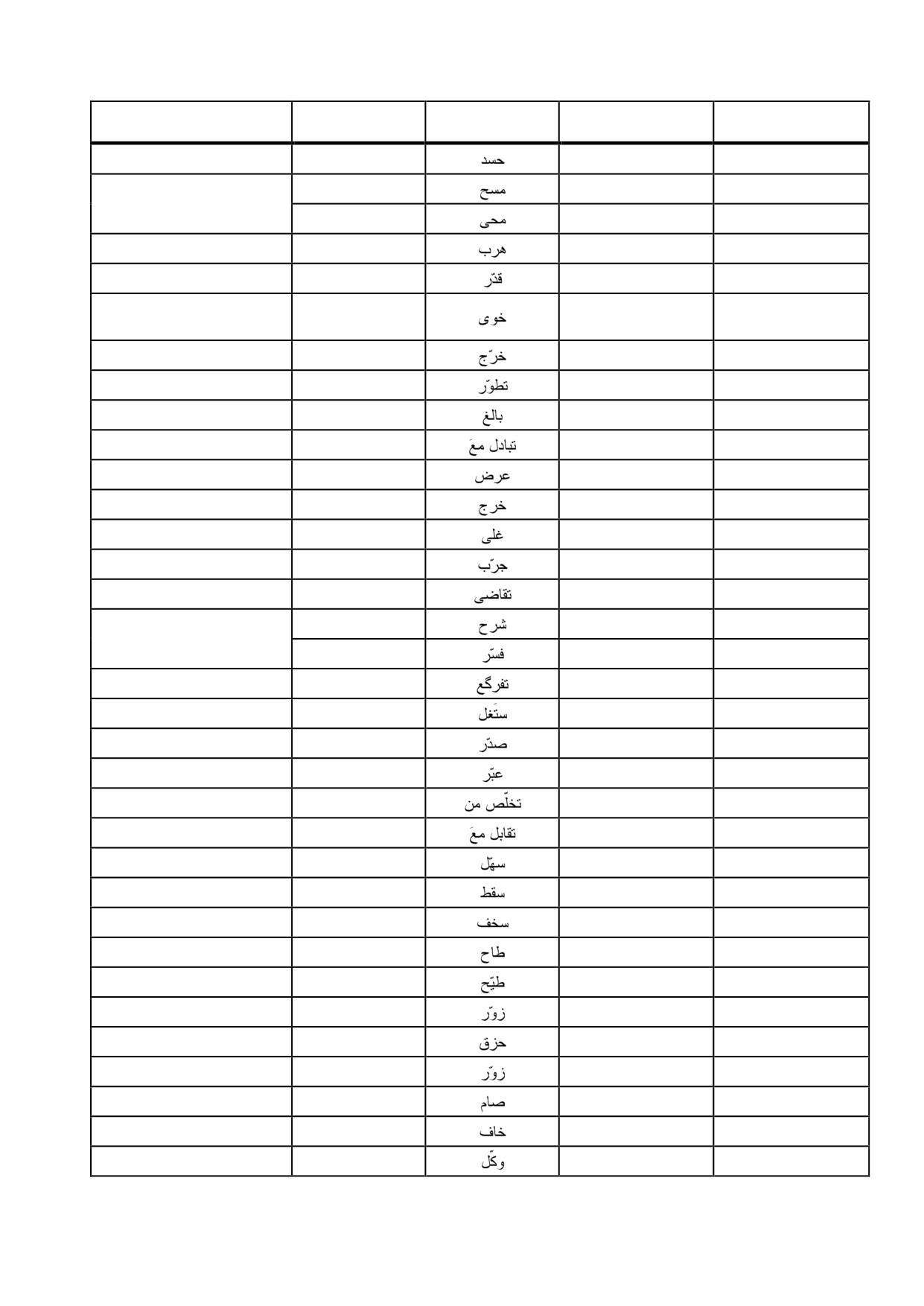
171
First Person
First Person
English
Transcription
Arabic
Present Tense
Past Tense
envy
нsd
kan-нsd
нsdt
erase
msн
kan-msн
msнt
mнa
kan-mнi
mнit
escape
hrb
kan-hrb
hrbt
estimate
qddr
kan-qddr
qddrt
evacuate
xwa
kan-xwi
xwit
(house/country)
evict
xrrj
kan-xrrj
xrrjt
evolve
ttuwr
kan-ttuwr
ttuwrt
exaggerate (slang)
balġ
kan-balġ
balġt
exchange
tbadl mعa
kan-tbadl
tbadlt
exhibit
عrd
kan-عrd
عrdt
exit
xrj
kan-xrj
xrjt
expensive, to get
ġla
kay-ġla
ġla
experience
jrrb
kan-jrrb
jrrbt
expire
tqada
kay-tqada
tqada
explain
šrн
kan-šrн
šrнt
fssr
kan-fssr
fssrt
explode
tfrgع
kan-tfrgع
tfrgعt
exploit
staġl
kan-staġl
staġlt
export
sddr
kan-sddr
sddrt
express
عbbr
kan-عbbr
عbbrt
exterminate
txlls mn
kan-txlls
txllst
face
tqabl mعa
kan-tqabl
tqablt
facilitate
shhl
kan-shhl
shhlt
fail
sqt
kan-sqt
sqtt
faint
sxf
kan-sxf
sxft
fall
taн
kan-tiн
tнt
fall, to make
tiyн
kan-tiyн
tiyнt
fake
zuwr
kan-zuwr
zuwrt
fart
нzq
kan-нzq
нzqt
falsify
zuwr
kan-zuwr
zuwrt
fast
sam
kan-sum
smt
fear
xaf
kan-xaf
xft
feed
wkkl
kan-wkkl
wkklt
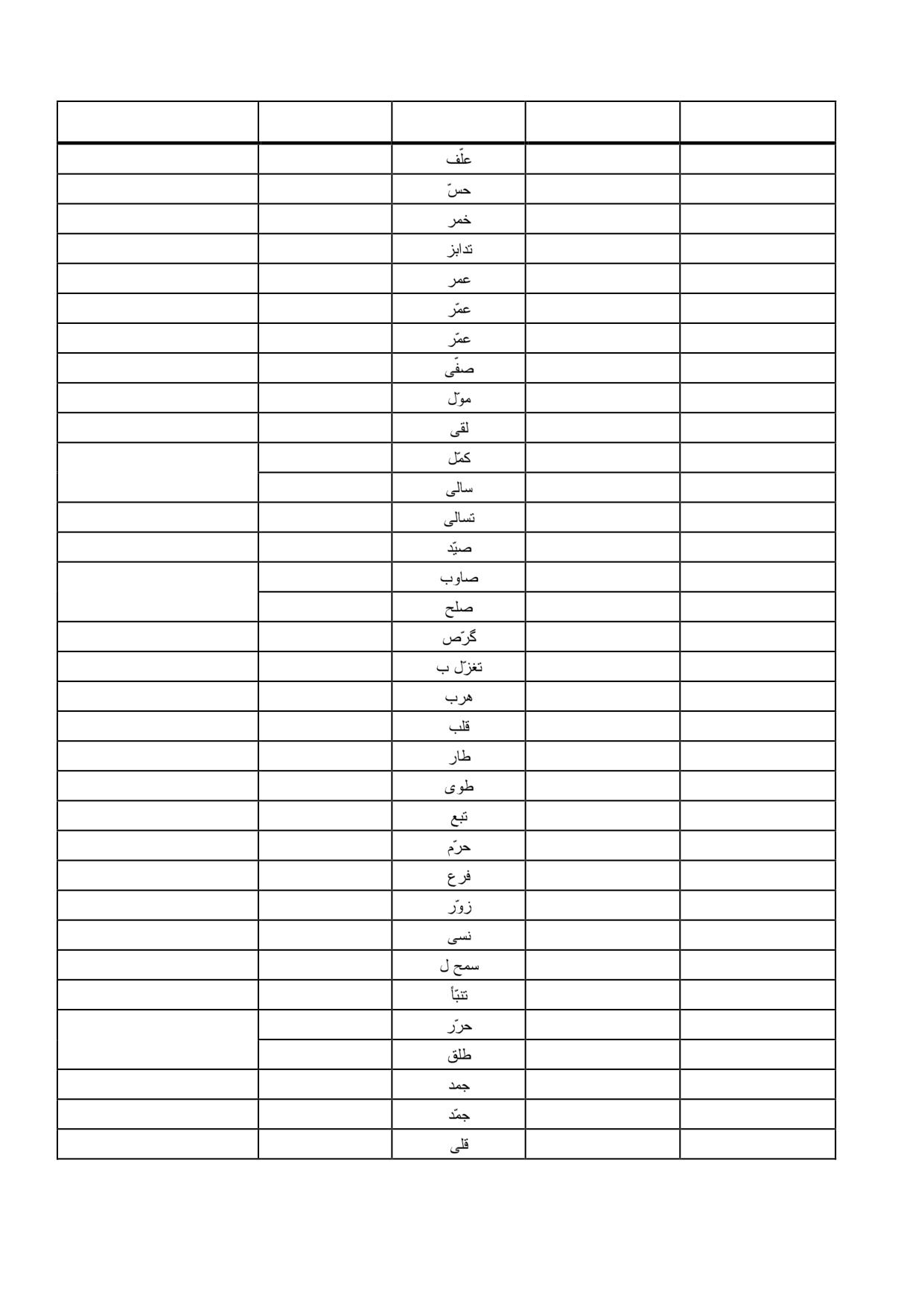
172 • Moroccan Arabic
First Person
First Person
English
Transcription
Arabic
Present Tense
Past Tense
feed fodder
عllf
kan-عllf
عllft
feel
нss
kan-нss
нssit
ferment
xmr
kan-xmr
xmrt
fight (physically)
tdabz
kan-tdabz
tdabzt
fill (intransitive)
عmr
kan-عmr
عmrt
fill out
عmmr
kan-عmmr
عmmrt
fill up
عmmr
kan-عmmr
عmmrt
filter
sffa
kan-sffi
sffit
finance
muwl
kan-muwl
muwlt
find
lqa
kan-lqa
lqit
finish
kmml
kan-kmml
kmmlt
sala
kan-sali
salit
finished, to be
tsala
kan-tsala
tsalit
fish
siyd
kan-siyd
siydt
fix
sawb
kan-sawb
sawbt
slн
kan-slн
slнt
flatten (bread)
grrs
kan-grrs
grrst
flatter (a female)
tġzzl b
kan-tġzzl
tġzzlt
flee
hrb
kan-hrb
hrbt
flip
qlb
kan-qlb
qlbt
fly
tar
kan-tir
trt
fold
twa
kan-twi
twit
follow
tbع
kan-tbع
tbعt
forbid
нrrm
kan-нrrm
нrrmt
force open
frع
kan-frع
frعt
forge (signature)
zuwr
kan-zuwr
zuwrt
forget
nsa
kan-nsa
nsit
forgive
smн l
kan-smн
smнt
foretell
tnbba
kan-tnbba'
tnbba't
free
нrrer
kan-нrrer
нrrert
tlq
kan-tlq
tlqt
freeze
jmd
kan-jmd
jmdt
freeze sth
jmmd
kan-jmmd
jmmdt
fry
qla
kan-qli
qlit
173
First Person
First Person
English
Transcription
Arabic
Present Tense
Past Tense
fulfill sth
нqqeq
kan-нqqeq
нqqeqt
full (of food), to be
šbع
kan-šbع
šbعt
fun, to make
dнk
kan-dнk
dнkt
nšt
kan-nšt
nštt
fun of, to make
dннk عla
kan-dннk
dннkt
tflla عla
kan-tflla
tfllit
gain
ksb
kan-ksb
ksbt
rbн
kan-rbн
rbнt
gamble
qmmr
kan-qmmr
qmmrt
gather
jmع
kan-jmع
jmعt
gather (with people)
jtamع
kan-jtamع
jtamعt
gaze
нnzez
kan-нnzez
нnzezt
generalize
عmmem
kan-عmmem
عmmemt
generate
wlld
kan-wlld
wlldt
get
xda
kan-axud
xdit
šdd
kan-šdd
šddit
get down
hbt
kan-hbt
hbtt
get off
nzl
kan-nzl
nzlt
get on
rkb
kan-rkb
rkbt
tlع
kan-tlع
tlعt
get rid of
thnna mn
kan-thnna
thnnit
txlls mn
kan-txlls
txllst
get sick
mrd
kan-mrd
mrdt
get through
daz mn
kan-duz
dzt
get up
nad
kan-nud
ndt
get used to
wllf
kan-wllf
wllft
give
عta
kan-عti
عtit
give a ride
dda
kan-ddi
ddit
wssl
kan-wssl
wsslt
give a speech
xtb
kan-xtb
xtbt
give back
rjjع
kan-rjjع
rjjعt
rdd
kan-rdd
rddit
give off
tllq
kan-tllq
tllqt
give pain
drr
kan-drr
drrit
174 • Moroccan Arabic
First Person
First Person
English
Transcription
Arabic
Present Tense
Past Tense
glare at
xnzr f
kan-xnzr
xnzrt
gleam
lmع
kan-lmع
lmعt
dwa
kan-dwi
dwit
glue
lssq
kan-lssq
lssqt
go
mša
kan-mši
mšit
go ahead of/in front of
sbq
kan-sbq
sbqt
go by
daz عla
kan-duz
dzt
go out
xrj
kan-xrj
xrjt
go through
daz mn
kan-duz
dzt
go up
tlع
kan-tlع
tlعt
gossip about
hdr f
kan-hdr
hdrt
govern
нkm عla
kan-нkm
нkmt
grab
qbt
kan-qbt
qbtt
šdd
kan-šdd
šddit
graze
rعa
kay-rعa
rعa
greet
sllm عla
kan-sllm
sllmt
greet one another
tsalm
kan-tsalm
tsalmt
grill
šwa
kan-šwi
šwit
grind
tнn
kan-tнn
tнnt
grow (get older/bigger)
kbr
kan-kbr
kbrt
guarantee
dmn
kan-dmn
dmnt
guard
عss
kan-عss
عssit
hand
mdd
kan-mdd
mddit
hang
عllq
kan-عllq
عllqt
hang to dry
nšr
kan-nšr
nšrt
happen
wqع
kay-wqع
wqع
jra
kay-jra
jra
tra
kay-tra
tra
happy, to be
frн
kan-frн
frнt
happy, to make
frrн
kan-frrн
frrнt
harvest
нsd
kan-нsd
нsdt
hatch
tfqqs
kay-tfqqs
tfqqs
hate
krh
kan-krh
krht
have
عnd
عndi
kan عndi
175
First Person
First Person
English
Transcription
Arabic
Present Tense
Past Tense
hear
smع
kan-smع
smعt
heat
sxxn
kan-sxxn
sxxnt
help
عawn
kan-عawn
عawnt
herd
srн
kan-srн
srнt
hesitate
trdded
kan-trdded
trddedt
hide sth
xbba
kan-xbba
xbbit
hide (oneself)
txbba
kan-txbba
txbbit
hire (a car)
kra
kan-kri
krit
hit
drb
kan-drb
drbt
hit, to be
tdrb
kan-tdrb
tdrbt
hold
šdd
kan-šdd
šddit
honor
šrrf
kan-šrrf
šrrft
hope
tmnna
kan-tmnna
tmnnit
house
skkn
kan-skkn
skknt
hug
عnnq
kan-عnnq
عnnqt
hug one another
tعanq
kan-tعanq
tعanqt
hungry, to be
jaع
kan-juع
jعt
hunt
siyd
kan-siyd
siydt
hurry
zrb
kan-zrb
zrbt
hurt
drr
kan-drr
drrit
ignore (slang)
miyk عla
kan-miyk
miykt
ill, to be
mrd
kan-mrd
mrdt
ill, to make
mrrd
kan-mrrd
mrrdt
imagine
tsuwr
kan-tsuwr
tsuwrt
txayl
kan-txayl
txaylt
imitate
qlld
kan-qlld
qlldt
import
stawrd
kan-stawrd
stawrdt
impose
frd
kan-frd
frdt
imprison
sjn
kan-sjn
sjnt
šdd f l нbs
kan-šdd
šddit
improve
нssn
kan-нssn
нssnt
tнssn
kan-tнssn
tнssnt
improvise
rtajl
kan-rtajl
rtajlt
increase
zad
kan-zid
zdt
176 • Moroccan Arabic
First Person
First Person
English
Transcription
Arabic
Present Tense
Past Tense
indicate
biyn
kan-biyn
biynt
infect
عada
kan-عadi
عadit
inform
عlm
kan-عlm
عlmt
xbr
kan-xbr
xbrt
inherit
wrt
kan-wrt
wrtt
injure
jrн
kan-jrн
jrнt
inspect (education)
fttš
kan-fttš
fttšt
install
blasa
kan-blasi
blasit
rkkb
kan-rkkb
rkkbt
insult
عayr
kan-عayr
عayrt
sbb
kan-sbb
sbbit
integrate
dmj
kan-dmj
dmjt
interest
httm
kay-httm
httm
interfere
tdxxl
kan-tdxxl
tdxxlt
interrupt
qatع
kan-qatع
qatعt
introduce
qddm
kan-qddm
qddmt
invent
xtarع
kan-xtarع
xtarعt
invite
عrd عla
kan-عrd
عrdt
iron
нdded
kan-нdded
нddedt
irrigate
sga
kan-sgi
sgit
sqa
kan-sqi
sqit
irritate
qllq
kan-qllq
qllqt
irritated, to be
tqllq
kan-tqllq
tqllqt
isolate
hmmš
kan-hmmš
hmmšt
عzl
kan-عzl
عzlt
jealous, to be
ġar عla
kan-ġir
ġrt
joke
dнk
kan-dнk
dнkt
tflla
kan-tflla
tfllit
judge
нkm عla
kan-нkm
нkmt
нasb
kan-нasb
нasbt
jump
nqqz
kan-nqqz
nqqzt
justify
brrer
kan-brrer
brrert
keep
нtafd b
kan-нtafd
нtafdt
нafd عla
kan-нafd
нafdt
177
First Person
First Person
English
Transcription
Arabic
Present Tense
Past Tense
keep house
qabl d-dar
kan-qabl
qablt
gabl d-dar
kan-gabl
gablt
kick (a ball)
šat
kan-šut
štt
qdf
kan-qdf
qdft
kidnap
xtf
kan-xtf
xtft
kiss
bas
kan-bus
bst
knead
عjn
kan-عjn
عjnt
know
عrf
kan-عrf
عrft
last (time)
bqa
kan-bqa
bqit
dam
kan-dum
dmt
late, to be
tعttl
kan-tعttl
tعttlt
late, to make
عttl
kan-عttl
عttlt
laugh
dнk
kan-dнk
dнkt
laugh, to make
dннk
kan-dннk
dннkt
lay down
нtt
kan-нtt
нttit
lay eggs
biyd
kan-biyd
biydt
lead
tzععm
kan-tzععm
tzععmt
leak
sal
kan-sil
slt
qtr
kan-qtr
qtrt
lean
tkka عla
kan-tkka
tkkit
learn
tعllm
kan-tعllm
tعllmt
leave
xrj
kan-xrj
xrjt
leave (a house/city for
rнl
kan-rнl
rнlt
another)
leave alone
xlla
kan-xlli
xllit
leave behind
xlla
kan-xlli
xllit
lend
sllf
kan-sllf
sllft
lengthen
tuwl
kan-tuwl
tuwlt
lessen
qllel
kan-qllel
qllelt
let
xlla
kan-xlli
xllit
let go of
tlq mn
kan-tlq
tlqt
liberate
нrrer
kan-нrrer
нrrert
lie
kdb
kan-kdb
kdbt
lift
hzz
kan-hzz
hzzit
light
šعl
kan-šعl
šعlt
178 • Moroccan Arabic
First Person
First Person
English
Transcription
Arabic
Present Tense
Past Tense
like
bġa
kan-bġi
knt baġi
عjb
kay عjbni
عjbni
lighten (weight)
xffef
kan-xffef
xffeft
limit
нdded
kan-нdded
нddedt
нbs
kan-нbs
нbst
limp
عrj
kan-عrj
عrjt
line, to draw a
sttr
kan-sttr
sttrt
live (reside)
skn
kan-skn
sknt
loan
sllf
kan-sllf
sllft
lock
sdd
kan-sdd
sddit
surt
kan-surt
surtt
look
šaf
kan-šuf
šft
look after
thlla f
kan-thlla
thllat
нda
kan-нdi
нdit
look alike
tšabh
kan-tšabh
tšabht
look behind
tlfft
kan-tlfft
tlfftt
look down (on sb)
нgr
kan-нgr
нgrt
look for
qllb عla
kan-qllb
qllbt
look like
šbh
kan-šbh
šbht
ban bнal
kan-ban
bnt
look out (window)
tll
kan-tll
tllit
loosen
tlq
kan-tlq
tlqt
rxa
kan-rxi
rxit
rxf
kan-rxf
rxft
lose
wddr
kan-wddr
wddrt
tllf
kan-tllf
tllft
lost, to be
twddr
kan-twddr
twddrt
love
bġa
kan-bġi
knt baġi
mat عla
kan-mut
mtt
lower
nzzl
kan-nzzl
nzzlt
hbbt
kan-hbbt
hbbtt
nqs
kan-nqs
nqst
magnify
kbbr
kan-kbbr
kbbrt
maintain
нafd عla
kan-нafd
нafdt
179
First Person
First Person
English
Transcription
Arabic
Present Tense
Past Tense
make
sawb
kan-sawb
sawbt
dar
kan-dir
drt
snع
kan-snع
snعt
make difficult for sb
tkrfs عla
kan-tkrfs
tkrfst
maltreat (destroy)
krfs
kan-krfs
krfst
manipulate
tнkkm
kan-tнkkm
tнkkmt
manufacture
snع
kan-snع
snعt
mark
nqqt
kan-nqqt
nqqtt
ršm
kan-ršm
ršmt
marry (with)
tzuwj (b)
kan-tzuwj
tzuwjt
marry off (daughter, etc.)
zuwj
kan-zuwj
zuwjt
massage (hammam)
kssl
kan-kssl
ksslt
mean
عna
kan-عni
عnit
measure
عbr
kan-عbr
عbrt
mediate
twsst
kan-twsst
twsstt
meet
tlaqa
kan-tlaqa
tlaqit
meeting, to have
jtamع
kan-jtamع
jtamعt
melt
dab
kan-dub
dbt
memorize
нfd
kan-нfd
нfdt
menace
hdded
kan-hdded
hddedt
mess up
krfs
kan-krfs
krfst
migrate
hjr
kan-hjr
hjrt
milk
нlb
kan-нlb
нlbt
mistake, to make a
ġlt
kan-ġlt
ġltt
miss (a bus) 3rd person
mša عla
kay-mši عliya
mša عliya
mix
xllt
kan-xllt
xlltt
monitor (exam)
нda
kan-нdi
нdit
нrs
kan-нrs
нrst
monopolize
нtakr
kan-нtakr
нtakrt
motivate
нffz
kan-нffz
нffzt
move sth
нrrk
kan-нrrk
нrrkt
kннz
kan-kннz
kннzt
move
tнrrk
kan-tнrrk
tнrrkt
tkннz
kan-tkннz
tkннzt
180 • Moroccan Arabic
First Person
First Person
English
Transcription
Arabic
Present Tense
Past Tense
move away from
bعd mn
kan-bعd
bعdt
move residence
tнuwl
kan-tнuwl
tнuwlt
rнl
kan-rнl
rнlt
murder
qtl
kan-qtl
qtlt
name
smma
kan-smmi
smmit
need
нtaj
kan-нtaj
нtajt
neglect
smн f
kan-smн
smнt
frrt
kan-frrt
frrtt
noise, to make
sdع
kan-sdع
sdعt
nominate
rššн
kan-rššн
rššнt
notice
laнd
kan-laнd
laнdt
obey
taع
kan-tiع
tعt
object
عard
kan-عard
عardt
oblige
frd عla
kan-frd
frdt
bzzez عla
kan-bzzez
bzzezt
observe
laнd
kan-laнd
laнdt
occupy
нtll
kan-нtll
нtllt
occur
wqع
kay wqع
wqع
jra
kay jra
jra
offer
hda
kan-hdi
hdit
oil
ziyt
kan-ziyt
ziytt
old, to get
šrf
kan-šrf
šrft
open
нll
kan-нll
нllit
ftн
kan-ftн
ftнt
operate (surgical)
ftн
kan-ftн
ftнt
oppress
عddb
kan-عddb
عddbt
order sth
tlb
kan-tlb
tlbt
order sb
amr
kan-amr
amrt
organize
nddm
kan-nddm
nddmt
overcome
tġllb عla
kan-tġllb
tġllbt
owe
tsal
kan-tsal
tsalt
owed, to be
sal
kan-sal
slt
own
mlk
kan-mlk
mlkt
pacify
hddn
kan-hddn
hddnt
181
First Person
First Person
English
Transcription
Arabic
Present Tense
Past Tense
pack
jmع
kan-jmع
jmعt
paint
sbġ
kan-sbġ
sbġt
park (a car)
blasa
kan-blasa
blasit
participate
šark
kan-šark
šarkt
party
нtafl
kan-нtafl
нtaflt
pass
daz
kan-duz
dzt
fat
kan-fut
ftt
pass (exam)
njн f
kan-njн
njнt
pass by
daz عla
kan-duz
dzt
paste
lssq
kan-lssq
lssqt
patient, to be
sbr
kan-sbr
sbrt
pay
xlls
kan-xlls
xllst
paid, to be
txlls
kan-txlls
txllst
pay back
rdd l
kan-rdd
rddit
peel
qššr
kan-qššr
qššrt
peel (skin)
tqššr
kan-tqššr
tqššrt
permit
xlla
kan-xlli
xllit
smн l
kan-smн
smнt
persuade
qnع
kan-qnع
qnعt
photograph
suwr
kan-suwr
suwrt
photographed, to be
tsuwr
kan-tsuwr
tsuwrt
pick (light fruit)
jna
kan-jni
jnit
pierce
tqb
kan-tqb
tqbt
pile up
عrrm
kan-عrrm
عrrmt
plan
xttet
kan-xttet
xttett
plant
zrع
kan-zrع
zrعt
play
lعb
kan-lعb
lعbt
please
عjb
kan-عjb
عjbt
plow
нrt
kan-нrt
нrtt
pluck
riyš
kan-riyš
riyšt
poison
smmem
kan-smmem
smmemt
poisoned, to be
tsmmem
kan-tsmmem
tsmmemt
pollute
luwt
kan-luwt
luwtt
possess
mlk
kan-mlk
mlkt
182 • Moroccan Arabic
First Person
First Person
English
Transcription
Arabic
Present Tense
Past Tense
postpone
ajjl
kan-ajjl
ajjlt
pour
kbb
kan-kbb
kbbit
xwa
kan-xwi
xwit
practice
tbbq
kan-tbbq
tbbqt
praise
mdн
kan-mdн
mdнt
pray
slla
kan-slli
sllit
precede
sbq
kan-sbq
sbqt
prefer
fddl
kan-fddl
fddlt
prepare
wjjd
kan-wjjd
wjjdt
sawb
kan-sawb
sawbt
pressure
dġt
kan-dġt
dġtt
pretend
dar bнal
kan-dir
drt
biyn blli
kan-biyn
biynt
prevent
mnع
kan-mnع
mnعt
print
tbع
kan-tbع
tbعt
produce
ntj
kan-ntj
ntjt
profit
rbн
kan-rbн
rbнt
stafd
kan-stafd
stafdt
progress
tqddm
kan-tqddm
tqddmt
prohibit
mnع
kan-mnع
mnعt
promise
waعd
kan-waعd
waعdt
pronounce
ntq
kan-ntq
ntqt
propose
qtarн
kan-qtarн
qtarнt
proud, to be
ftaxr
kan-ftaxr
ftaxrt
prune
zbr
kan-zbr
zbrt
publish
nšr
kan-nšr
nšrt
pull
jrr
kan-jrr
jrrit
jbd
kan-jbd
jbdt
punish
عaqb
kan-عaqb
عaqbt
push
dfع
kan-dfع
dfعt
push (a button)
wrrk عla
kan-wrrk
wrrkt
brk عla
kan-brk
brkt
put
нtt
kan-нtt
нttit
put down
нtt
kan-нtt
нttit
183
First Person
First Person
English
Transcription
Arabic
Present Tense
Past Tense
put out (light)
tfa
kan-tfi
tfit
put together (parts)
rkkb
kan-rkkb
rkkbt
quarrel
txasm
kan-txasm
txasmt
quiet, to be
skt
kan-skt
sktt
quiet, to make
skkt
kan-skkt
skktt
quit
mša bнalu
kan-mši bнali
mšit bнali
rain
taн (l-šta)
kat-tiн
taнt
raise
hzz
kan-hzz
hzzit
raise (children)
rbba
kan-rbbi
rbbit
raised, to be
trbba
kan-trbba
trbbit
rape
ġtasb
kan-ġtasb
ġtasbt
read
qra
kan-qra
qrit
receive (a letter)
šdd
kan-šdd
šddit
recognize
tعrrf
kan-tعrrf
tعrrft
record
sjjl
kan-sjjl
sjjlt
reduce
nqs
kan-nqs
nqst
reform
slн
kan-slн
slнt
refuse
rfd
kan-rfd
rfdt
refute
nfa
kan-nfi
nfit
regret
ndm
kan-ndm
ndmt
reimburse
عuwd
kan-عuwd
عuwdt
rejoice
frн
kan-frн
frнt
relax
rtaн
kan-rtaн
rtaнt
release
tlq
kan-tlq
tlqt
rely on
عuwl عla
kan-عuwl
عuwlt
remain
bqa
kan-bqa
bqit
remember
عql عla
kan-عql
عqlt
tfkkr
kan-tfkkr
tfkkrt
remind
fkkr
kan-fkkr
fkkrt
remove
нiyd
kan-нiyd
нiydt
zuwl
kan-zuwl
zuwlt
renew
jdded
kan-jdded
jddedt
rent
kra
kan-kri
krit
184 • Moroccan Arabic
First Person
First Person
English
Transcription
Arabic
Present Tense
Past Tense
repair
sawb
kan-sawb
sawbt
slн
kan-slн
slнt
repeat
عawd
kan-عawd
عawdt
repent
tab
kan-tub
tbt
reply
rdd
kan-rdd
rddit
request
tlb mn
kan-tlb
tlbt
require
ttlb
kan-ttlb
ttlbt
resemble
šbh
kan-šbh
šbht
resign
staql
kan-staql
staqlt
resist
qawm
kan-qawm
qawmt
respect
нtarm
kan-нtarm
нtarmt
respond
jawb
kan-jawb
jawbt
rest
rtaн
kan-rtaн
rtaнt
retire
tqaعd
kan-tqaعd
tqaعdt
return (to a place)
rjع
kan-rjع
rjعt
return sth
rdd
kan-rdd
rddit
rjjع
kan-rjjع
rjjعt
review
rajع
kan-rajع
rajعt
ride
rkb
kan-rkb
rkbt
ride, to give a
dda
kan-ddi
ddit
rkkb
kan-rkkb
rkkbt
wssl
kan-wssl
wsslt
rinse
šllel
kan-šllel
šllelt
rise (like the sun)
tlع
kan-tlع
tlعt
rise (to wake up)
faq
kan-fiq
fqt
rot
fsd
kan-fsd
fsdt
round, to go
duwr
kan-duwr
duwrt
rub
нkk
kan-нkk
нkkit
run
jra
kan-jri
jrit
run away
hrb
kan-hrb
hrbt
run out of
tqada
kan-tqada
tqadit
rush
zrb
kan-zrb
zrbt
sacrifice
dннa
kan-dннi
dннit
satisfy
qnع
kan-qnع
qnعt
185
First Person
First Person
English
Transcription
Arabic
Present Tense
Past Tense
save
xbba
kan-xbbi
xbbit
xzn
kan-xzn
xznt
xbbع
kan-xbbع
xbbعt
save (money)
jmع l flus
kan-jmع
jmعt
wffr
kan-wffr
wffrt
say
gal
kan-gul
glt
scratch
нkk
kan-нkk
нkkit
scream
ġuwt
kan-ġuwt
ġuwtt
screw
ziyr
kan-ziyr
ziyrt
see
šaf
kan-šuf
šft
see one another
tšawf
kan-tšawf
tšawft
sell
baع
kan-biع
bعt
send
sift
kan-sift
siftt
separate
frrq
kan-frrq
frrqt
serve
srba
kan-srbi
srbit
set a bone
jbbr
kan-jbbr
jbbrt
set (the sun)
ġrb
kan-ġrb
ġrbt
set up
rkkb
kan-rkkb
rkkbt
settle
staqr
kan-staqr
staqrt
sew
xiyt
kan-xiyt
xiytt
shake (palsy)
trععd
kan-trععd
trععdt
rjf
kan-rjf
rjft
shake hands with
sllm عla
kan-sllm
sllmt
shake out
нrrk
kan-нrrk
нrrkt
share
qsm
kan-qsm
qsmt
sharpen
njr
kan-njr
njrt
mdda
kan-mddi
mddit
shave
нssn
kan-нssn
нssnt
shepherd
srн
kan-srн
srнt
shine
lmع
kan-lmع
lmعt
shiver
trععd
kan-trععd
trععdt
rjf
kan-rjf
rjft
shop (weekly market)
tsuwq
kan-tsuwq
tsuwqt
shop (food)
tqdda
kan-tqdda
tqddit
186 • Moroccan Arabic
First Person
First Person
English
Transcription
Arabic
Present Tense
Past Tense
shorten
qssr
kan-qssr
qssrt
shout
ġuwt
kan-ġuwt
ġuwtt
shovel
hzz b l bala
kan-hzz
hzzit
show
wrra
kan-wrri
wrrit
shower
duwš
kan-duwš
duwšt
shut
sdd
kan-sdd
sddit
shut eyes
ġmmd
kan-ġmmd
ġmmdt
shut up
skt
kan-skt
sktt
sift
ġrbl
kan-ġrbl
ġrblt
sightsee
tsara
kan-tsara
tsarit
sign
sna
kan-sni
snit
wqqع
kan-wqqع
wqqعt
silence sb
skkt
kan-skkt
skktt
silent, to be
skt
kan-skt
sktt
simplify
shhl
kan-shhl
shhlt
sing
ġnna
kan-ġnni
ġnnit
sink
ġts
kan-ġts
ġtst
ġrq
kan-ġrq
ġrqt
sit
gls
kan-gls
glst
skin
slx
kan-slx
slxt
skip
nqqz
kan-nqqz
nqqzt
slap (in the face)
srfq
kan-srfq
srfqt
trrš
kan-trrš
trršt
slaughter
dbн
kan-dbн
dbнt
sleep
nعs
kan-nعs
nعst
sleep, to make
nععs
kan-nععs
nععst
slide
zlq
kan-zlq
zlqt
slip
zlq
kan-zlq
zlqt
smear
lttx
kan-lttx
lttxt
smell
šmm
kan-šmm
šmmit
smile
btasm
kan-btasm
btasmt
smoke
kma
kan-kmi
kmit
smuggle
hrrb
kan-hrrb
hrrbt
sneeze
عts
kan-عts
عtst
187
First Person
First Person
English
Transcription
Arabic
Present Tense
Past Tense
solder
lннm
kan-lннm
lннmt
solve
нll
kan-нll
нllit
speak
tkllm
kan-tkllm
tkllmt
hdr
kan-hdr
hdrt
dwa
kan-dwi
dwit
specialize
txsses
kan-txsses
txssest
spend money
srf
kan-srf
srft
spend the night
bat
kan-bat
btt
spend time
duwz
kan-duwz
duwzt
spin
ġzl
kan-ġzl
ġzlt
spit
dfl
kan-dfl
dflt
splash
ršš
kan-ršš
rššit
spoil (a child)
fššeš
kan-fššeš
fššešt
sprain
dfع
kan-dfع
dfعt
spray
ršš
kan-ršš
rššit
squeeze
عsr
kan-عsr
عsrt
ziyr
kan-ziyr
ziyrt
stamp
tbع
kan-tbع
tbعt
stand
wqf
kan-wqf
wqft
stare angrily
xnzr f
kan-xnzr
xnzrt
start
bda
kan-bda
bdit
startle
xlع
kan-xlع
xlعt
startled, to be
txlع
kan-txlع
txlعt
stay
bqa
kan-bqa
bqit
gls
kan-gls
glst
stay up late
shr
kan-shr
shrt
steal
srq
kan-srq
srqt
šffr
kan-šffr
šffrt
step on
عft
kan-عft
عftt
عfs
kan-عfs
عfst
sting
qrs
kan-qrs
qrst
stink
xnz
kan-xnz
xnzt
stir
нrrk
kan-нrrk
нrrkt
188 • Moroccan Arabic
First Person
First Person
English
Transcription
Arabic
Present Tense
Past Tense
stop
wqf
kan-wqf
wqft
нbs
kan-нbs
нbst
stop speaking with
txasm mعa
kan-txasm
txasmt
store
xzn
kan-xzn
xznt
strangle
qjj
kan-qjj
qjjit
xnq
kan-xnq
xnqt
strike (from work)
dar l idrab
kan-dir
drt
stroll
tmšša
kan-tmšša
tmššit
stretch
jbbd
kan-jbbd
jbbdt
kssl
kan-kssl
ksslt
study
qra
kan-qra
qrit
drs
kan-drs
drst
succeed at
njн f
kan-njн
njнt
suck
mss
kan-mss
mssit
sue
dعa
kan-dعi
dعit
suffer
tعddb
kan-tعddb
tعddbt
suggest
qtarн
kan-qtarн
qtarнt
sunbathe
tšmmš
kan-tšmmš
tšmmšt
surprise
faj'a
kan-faj'a
faj'at
surrender
staslm
kan-staslm
staslmt
survive
nja
kan-nja
njit
عaš
kan-عiš
tعš
swallow
srt
kan-srt
srtt
swarm (bees)
rtع
kan-rtع
rtعt
swear
нlf b llah
kan-нlf
нlft
عahd
kan-عahd
عahdt
swear (oath)
qsm
kan-qsm
qsmt
sweat
عrg
kan-عrg
عrgt
عrq
kan-عrq
عrqt
sweep
šttb
kan-šttb
šttbt
swell
tnffx
kan-tnffx
tnffxt
swim
عam
kan-عum
tعm
switch (off)
tfa
kan-tfi
tfit
switch (on)
šعl
kan-šعl
šعlt
189
First Person
First Person
English
Transcription
Arabic
Present Tense
Past Tense
sympathize with
tعatf mعa
kan-tعatf
tعatft
take
xda
kan-axud
xdit
take away/off
нiyd
kan-нiyd
нiydt
zuwl
kan-zuwl
zuwlt
take care of
thlla f
kan-thlla
thllat
take charge of
tkllf b
kan-tkllf
tkllft
talk
tkllm
kan-tkllm
tkllmt
hdr
kan-hdr
hdrt
talk nonsense
xrbq
kan-xrbq
xrbqt
tame
ruwd
kan-ruwd
ruwdt
tape (record)
sjjl
kan-sjjl
sjjlt
tape (scotch)
lssq
kan-lssq
lssqt
taste
daq
kan-duq
dqt
teach
qrra
kan-qrri
qrrit
عllm
kan-عllm
عllmt
tear something
qttع
kan-qttع
qttعt
tear (to be torn)
tqttع
kan-tqttع
tqttعt
tease
qššb
kan-qššb
qššbt
tflla
kan-tflla
tfllit
telephone
عiyt f
kan-عiyt
عiytt
drb t
kan-drb
drbt
tilifun
tell
gal
kan-gul
glt
عawd
kan-عawd
عawdt
thaw
dab
kan-dub
dbt
think
fkkr
kan-fkkr
fkkrt
xmmem
kan-xmmem
xmmemt
think that
dnn blli
kan-dnn
dnnit
threaten
hdded
kan-hdded
hddedt
thresh
drs
kan-drs
drst
throw
laн
kan-luн
lнt
rma
kan-rmi
rmit
tickle
hrr
kan-hrr
hrrit
tie
rbt
kan-rbt
rbtt
tie (belt)
нzm
kan-нzm
нzmt
190 • Moroccan Arabic
First Person
First Person
English
Transcription
Arabic
Present Tense
Past Tense
tighten
ziyr
kan-ziyr
ziyrt
tired, to be
عya
kan-عya
عyit
tired, to make
عiya
kan-عiya
عiyit
torture
عddb
kan-عddb
عddbt
touch
qas
kan-qis
qst
mss
kan-mss
mssit
trade
tajr
kan-tajr
tajrt
train
drrb
kan-drrb
drrbt
translate
trjm
kan-trjm
trjmt
travel
safr
kan-safr
safrt
treat (people)
tعaml mعa
kan-tعaml
tعamlt
trick
šmt
kan-šmt
šmtt
trip
عtr
kan-عtr
عtrt
trust
taq f
kan-tiq
tqt
try (to attempt to do sth)
нawl
kan-нawl
нawlt
try (to experience sth)
jrrb
kan-jrrb
jrrbt
try on
qiys
kan-qiys
qiyst
turn
dar
kan-dur
drt
turn around
duwr
kan-duwr
duwrt
turn down (volume)
nqs mn
kan-nqs
nqst
turn off
tfa
kan-tfi
tfit
turn on
šعl
kan-šعl
šعlt
turn over sth
qlb
kan-qlb
qlbt
glb
kan-glb
glbt
twist
lwa
kan-lwi
lwit
understand
fhm
kan-fhm
fhmt
understand, to make
fhhm
kan-fhhm
fhhmt
unite
wннd
kan-wннd
wннdt
upset
qllq
kan-qllq
qllqt
upset, to be
tqllq
kan-tqllq
tqllqt
use
staعml
kan-staعml
staعmlt
use (land)
staġl
kan-staġl
staġlt
use to, to be of
slн l
kan-slн
slнt
used to, to become
wllf
kan-wllf
wllft
191
First Person
First Person
English
Transcription
Arabic
Present Tense
Past Tense
useful, to be
nfع
kan-nfع
nfعt
vaccinate
lqqн
kan-lqqн
lqqнt
visit
zar
kan-zur
zrt
vomit
tqiya
kan-tqiya
tqiyit
rdd
kan-rdd
rddit
wait
tsnna
kan-tsnna
tsnnit
عayn
kan-عayn
عaynt
wake someone
fiyq
kan-fiyq
fiyqt
wake up
faq
kan-fiq
fqt
walk
tmšša
kan-tmšša
tmššit
walk around
tsara
kan-tsara
tsarit
tmšša
kan-tmšša
tmššit
want
bġa
kan-bġi
bġit
warm / heat
sxxn
kan-sxxn
sxxnt
warm, to be
sxn
kan-sxn
sxnt
warn
нddr
kan-нddr
нddrt
water
sqa
kan-sqi
sqit
sga
kan-sgi
sgit
wash
ġsl
kan-ġsl
ġslt
wash (clothes)
sbbn
kan-sbbn
sbbnt
wash (floor)
siyq
kan-siyq
siyqt
waste
diyع
kan-diyع
diyعt
watch (TV)
tfrrj
kan-tfrrj
tfrrjt
wave
šiyr l
kan-šiyr
šiyrt
wear
lbs
kan-lbs
lbst
weave
nsj
kan-nsj
nsjt
weep
bka
kan-bki
bkit
weigh
عbr
kan-عbr
عbrt
wzn
kan-wzn
wznt
welcome
rннb
kan-rннb
rннbt
staqbl
kan-staqbl
staqblt
weld
suda
kan-sudi
sudit
well, to be
bra
kan-bra
brit
wet, to make
fzzg
kan-fzzg
fzzgt
192 • Moroccan Arabic
First Person
First Person
English
Transcription
Arabic
Present Tense
Past Tense
wet, to be
fzg
kan-fzg
fzgt
whistle
sffr
kan-sffr
sffrt
widen
wssع
kan-wssع
wssعt
win
rbн
kan-rbн
rbнt
wipe dry (floor)
jffef
kan-jffef
jffeft
wipe off
msн
kan-msн
msнt
mнa
kan-mнi
mнit
wiped out, to be
sxf
kan-sxf
sxft
wish
tmnna
kan-tmnna
tmnnit
wither
ybs
kan-ybs
ybst
lwa
kan-lwa
lwit
witness
šhd
kan-šhd
šhdt
wonder at
tعjjb
kan-tعjjb
tعjjbt
xmmem f
kan-xmmem
xmmemt
work
xdm
kan-xdm
xdmt
worry
tštn
kan-tštn
tštnt
wormy, to get
duwd
kan-duwd
duwdt
worth, to be
swa
kan-swa
swit
wound
jrн
kan-jrн
jrнt
write
ktb
kan-ktb
ktbt
yawn
tfuwh
kan-tfuwh
tfuwht
193
Grammar Index
Active Participles, 151
Participles, 151
Adjectives
Active, 151
Comparative, 81
ġadi, 104
Masculine and Feminine, 78
Kayn, 37
Singular and Plural, 78
Passive, 153
Superlative, 82
Passive Participles, 153
Comparative Adjectives, 81
Passive Verbs, 149
Comparing Like Objects, 81
Past Progressive, 150
Conditional, 111
Past Tense
Conjunctions, 154
Irregular Verbs, 48
Definite Article, 147
Regular Verbs, 46
Demonstrative Adjectives, 16
Possession
Demonstrative Pronouns, 14
Dyal, 13
Duration, 17
Pronouns, 8
Dyal, 13
Questions, 17
Future Tense, 102
Possessive Pronouns, 8
Negation, 103
Prepositions, 42
ġadi, 104
With Pronoun Endings, 115
Have you ever..., 54
With Verbs, 115
I‘ve never..., 54
Present Tense
Imperative, 69
Irregular Verbs with Final ‗a‘, 64
In order to, 68
Irregular Verbs with Middle ‗a‘, 60
Independent Pronouns, 7
Regular Verbs, 58
Infinitive, 46
Pronouns
Intransitive Verbs
Independent, 7
Making into Transitive Verbs, 148
Object, 55
With Only One Participle, 153
Possessive, 8
Kayn, 37
Question Words, 56
Moon Letters, 147
Sun Letters, 147
Negation, 52
Superlative Adjectives, 82
Nouns
There is, 37
Masculine and Feminine, 9
Time, 30
Numbers
Using One Verb after Another, 68
1 thru 10, 22
Verbs
100, 200, 300 ... 999, 26
Participles, 151
1000, 2000, 3000 ..., 27
to have, 40
11 thru 19, 24
to need/have to/should, 95
20, 30, 40 ... 99, 25
to please, 92
Fractions, 30
to remain, 151
Ordinal, 29
to want, 36
Object Pronouns, 55
to want/like, 96
Using One after Another, 68
194 • Moroccan Arabic
Vocabulary Index
Adjectives, 78
Meat, 88
Bargaining, 72
Money, 33
Body Parts, 97
Months, 45
Bus, 108
Nationalities, 10
Butagas, 135
Nighttime, 20
Butcher, 88
Peace Corps, 120
Buying Produce, 86
Places in Town, 43
Café, 89
Police Station, 137
Cities, 10
Political Harassment, 141
City bus, 108
Post Office, 113
Clothing, 73
Prepositions, 42
Colors, 75
Question Words, 56
Communication, 21
Restaurant, 90
Congratulations, 21
Seasons, 45
Days of the Week, 45
Sexual Harassment, 129
Directions, 43
Shopping, 34
Doors and Windows, 139
Sick, 21, 98
Drinks, 89
Site Visit, 100
Environment Sector, 122
Sleeping, 20
Family, 38
Small Business Development, 124
Finding a House, 125
Spices, 88
Food, 34, 84, 85, 88, 89
Taxi, 107, 131
Fruit, 85
Thanking, 19
Furniture, 127
Theft, 137
God Phrases, 157
Time Expressions
Greetings, 5
Future, 105
Hanoot Items, 34
Past, 46
Health, 98
Present, 59
Health Sector, 123
Toiletries, 34
Help, 20
Train, 109
Hotel, 110
Transportation, 21
Household Items, 127
Travel, 107
Hygiene, 20
Units of Measurement, 86
Islamic Calendar, 159
Vegetables, 84
Kitchenware, 127
Verbs, 47, 49, 50, 51, 61, 62, 63, 64, 66, 67
Marital Status, 10
Youth Development, 121
Mealtime, 19