Kia Soul (2024 year). Manual in english - page 9
 

  Index      Kia     Kia Soul (2024 year). Manual in english


Search            copyright infringement  


Content      ..     7      8      9      10     ..


Kia Soul (2024 year). Manual in english - page 9


Driver assistance system

14

6

Forward Collision-Avoidance Assist (FCA) (Front Camera Only)

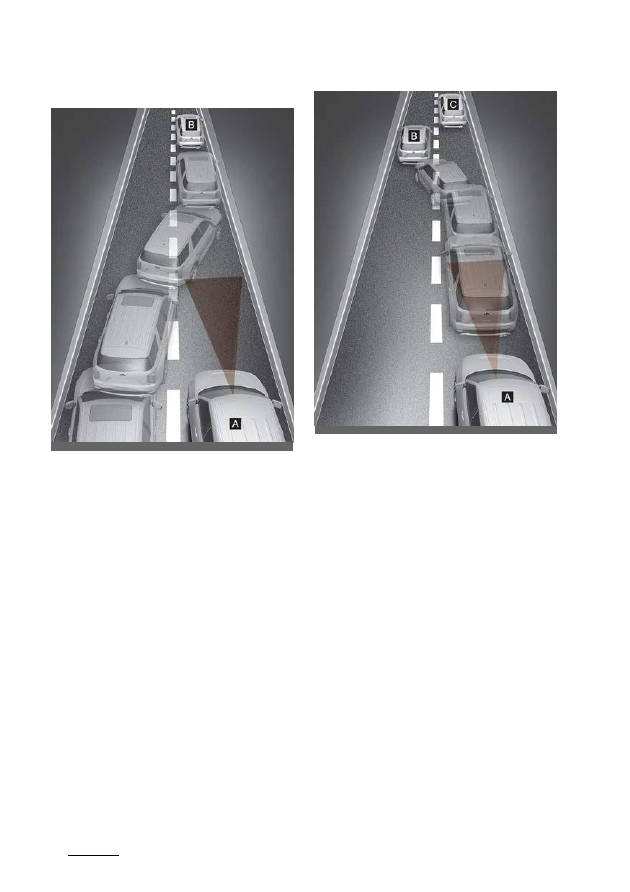
• Changing lanes

A.

: Your vehicle,

B.

: Lane changing vehicle

When a vehicle (B) moves into your 
lane from an adjacent lane, it cannot 
be detected by the sensor until it is in 
the sensor's detection range.

Forward Collision-Avoidance Assist 
may not immediately detect the vehi

-

cle when the vehicle changes lanes 
abruptly. In this case, you must main

-

tain a safe braking distance, and if 
necessary, steer your vehicle and 
depress the brake pedal to reduce 
your driving speed in order to main

-

tain a safe distance.

A.

: Your vehicle,

B.

: Lane changing vehicle, 

[C]: Same lane vehicle
When a vehicle (B) in front of you 
merges out of the lane, Forward Colli

-

sion-Avoidance Assist may not imme

-

diately detect the vehicle (C) that is 
now in front of you. In this case, you 
must maintain a safe braking dis

-

tance, and if necessary, steer your 
vehicle and depress the brake pedal 
to reduce your driving speed in order 
to maintain a safe distance.

OSK3052392L

OSK3052401L

15

6

6

Driver assistance system

Forward Collision-Avoidance Assist (FCA) (Front Camera Only)

• Detecting vehicle

If the vehicle in front of you has cargo 
that extends rearward from the cab,
or when the vehicle in front of you has 
higher ground clearance, additional 
special attention is required. Forward 
Collision-Avoidance Assist may not be 
able to detect the cargo extending 
from the vehicle. In these instances, 
you must maintain a safe braking dis

-

tance from the rearmost object, and if 
necessary, steer your vehicle and 
depress the brake pedal to reduce 
your driving speed in order to main

-

tain distance.

W ARNING

• When you are towing a trailer or 

another vehicle, turn off Forward Col

-

lision-Avoidance Assist for safety rea

-

sons. If you tow a European spec 
trailer, the function may be limited.

• Forward Collision-Avoidance Assist 

may operate if objects that are similar 
in shape or characteristics to vehicles, 
pedestrians and cyclists are detected.

• Forward Collision-Avoidance Assist 

does not operate on bicycles, or 
smaller wheeled objects, such as lug

-

gage bags, shopping carts, or stroll

-

ers.

• Forward Collision-Avoidance Assist 

may not operate properly if interfered 
by strong electromagnetic waves.

• Forward Collision-Avoidance Assist 

may not operate for 15 seconds after 
the vehicle is started, or the front view 
camera is initialized.

OSK3052167N

Driver assistance system

16

6

Forward Collision-Avoidance Assist (FCA) (Sensor Fusion)

Forward Collision-Avoidance 
Assist (FCA) (Sensor Fusion) 
(if equipped)

Basic function

Forward Collision-Avoidance Assist is 
designed to help detect and monitor the 
vehicle ahead or help detect pedestrian 
or cyclist in the roadway and warn the 
driver that a collision is imminent with a
warning message and warning and 
apply emergency braking.

Junction Turning function

Junction Turning function can help avoid 
a collision with an oncoming vehicle in an
adjacent lane when turning left at a

crossroad with the turn signal on by 
applying emergency braking.

Detecting sensor

Front view camera

Front radar

Refer to the picture above for the 
detailed location of the detecting sen

-

sors.

CAUTION

Take the following precautions to main

-

tain optimal performance of the detect

-

ing sensor:
• Never disassemble the detecting sen

-

sor or sensor assembly, or cause any
damage to it.

OSK3052377L

OSK3052378L

OSK3052374L

OSK3052014L

17

6

6

Driver assistance system

Forward Collision-Avoidance Assist (FCA) (Sensor Fusion)

• If the detecting sensors have been 

replaced or repaired, have the vehicle 
inspected by an authorized Kia dealer.

• Never install any accessories or stick

-

ers on the front windshield, or tint the
front windshield.

• Pay extreme caution to keep the front

view camera dry.

• Never place any reflective objects (for

example, white paper, mirror) over the
dashboard.

• Do not place any objects near the front

windshield or install any acces

-

sories

on the front windshield. It can affect the
performance of the defog

-

ging and

defrosting function of the cli

-

mate

control system, which may prevent the
Driver Assistance systems from 
operating.

• Do not apply license plate frame or 

objects, such as a bumper sticker, film 
or a bumper guard, near the front 
radar cover.

• Always keep the front radar and cover 

clean and free of dirt and debris.

Use only a soft cloth to wash the vehi

-

cle. Do not spray pressurized water 
directly on the sensor or sensor cover.

• If the radar or around the radar has 

been damaged or impacted in any 
way, Forward Collision-Avoidance 
Assist may not properly operate even 
though a warning message does not 
appear on the cluster. Have the vehi

-

cle inspected by an authorized Kia 
dealer.

• The genuine Kia front radar sensor 

covers are parts with quality and per

-

formance ensured. If arbitrarily apply

-

ing paint on or changing the cover, 
Forward Collision-Avoidance Assist 
may not function properly. Use only 
Kia Genuine Parts or those of an

equivalent standard with proven qual

-

ity and performance to repair or replace
the radar sensor covers.

Forward Collision-Avoidance 
Assist settings

Forward safety

A: Driver Assistance

1 Driving Safety

2 Forward Safety
With the vehicle on, select Settings

Driver Assistance

→ Driving Safety on 

the instrument cluster or Settings

Vehicle

→ Driver Assistance → Driving

Safety on the infotainment system. The 
initial warning activation timing of For

-

OSK3052296N

OSK3052297N

Driver assistance system

18

6

Forward Collision-Avoidance Assist (FCA) (Sensor Fusion)

ward Collision-Avoidance Assist can be 
changed.
• Forward Safety: Depending on the 

collision risk levels, an audible warn

-

ing will sound and the braking will be 
assisted. If the following menu is 
deactivated, Forward Collision-Avoid

-

ance Assist will turn off and the warn

-

ing light (

) will appear on the 

cluster.

The driver can monitor Forward Colli

-

sion-Avoidance Assist On/Off status 
from the Settings menu. If the warning 
light (

) remains ON when Forward 

Collision-Avoidance Assist is on, have 
the vehicle inspected by an authorized 
Kia dealer.

W ARNING

When the vehicle is restarted, Forward 
Collision-Avoidance Assist will always 
turn on. However, if Forward Safety is 
deselected, the driver should always be 
aware of the surroundings and drive 
safely.

CAUTION

When the trailer is connected, Forward 
Collision-Avoidance Assist automatically 
turns off (if equipped). In this case, you 
cannot get help from Forward Collision-
Avoidance Assist. Always drive with care.

NOTICE

Driving safety systems refer to Forward 
Collision-Avoidance Assist, Lane Keeping 
Assist, Rear Cross-Traffic Collision-
Avoidance Assist, and Driver Attention 
Warning.

Forward Safety Warning Timing

A: Driving safety

1 Forward Safety Warning Timing

2 Standard

3 Late
With the vehicle on, touch Settings

Driver assistance

→ Driving safety →

Forward Safety Warning Timing on the
instrument cluster or Settings

→ Vehicle

→ Driver assistance → Driving safety
→ Forward Safety Warning Timing on
the infotainment system to change the
initial warning activation tim

-

ing of

Forward Collision-Avoidance Assist.
• Use Standard in normal driving con

-

ditions. If the Warning Timing seems
sensitive, change it to Late.

OSK3052420L

OSK3052421N

19

6

6

Driver assistance system

Forward Collision-Avoidance Assist (FCA) (Sensor Fusion)

• If Late is selected, Forward Collision-

Avoidance Assist, warns the driver 
more slowly.

CAUTION

• Even though Normal is selected for 

Warning Timing, if the front vehicle 
suddenly stops, the warning may 
seem late.

• Select Late for Warning Timing when

traffic is light and when driving speed
is slow.

INFORMATION

Warning timing will maintain its last set

-

ting even if the vehicle is restarted.

Warning methods

A: Driver Assistance

1 Warning Volume

2 Driving Safety Priority

3 High

4 Medium

5 Low
With the vehicle on, select Settings

Driver Assistance

→ Warning Volume

on the instrument cluster or Settings

Vehicle

→ Driver Assistance → Warn

-

ing Methods on the infotainment sys

-

tem to change the Warning Sound.
• Warning Volume: You can adjust the 

Warning Volume.

• Driving Safety Priority: For safe driv

-

ing, the audio volume will temporarily 
decrease to warn the driver with the 
audible warning.

CAUTION

• Ensure that Warning Methods you 

have set may apply to the Warning 
Methods of other Driver Assistance 
systems.

• Warning Methods will maintain its last 

setting even if the vehicle is restarted.

• The setting menu may not be avail

-

able for your vehicle depending on 
the vehicle features and specifica

-

tions.

Forward Collision-Avoidance 
Assist operation

Basic function

The basic function for Forward Collision-
Avoidance Assist is warned and con

-

trolled by the following level.
• Collision warning
• Emergency braking
• Stopping vehicle and ending brake 

control

OSK3052320L

OMQ4A052388

Driver assistance system

20

6

Forward Collision-Avoidance Assist (FCA) (Sensor Fusion)

Collision warning

A: Collision Warning
Collision warning will alert the driver with
a warning message, and an audible 
warning.

Collision warning will be activated 
depending on the detected object and 
your vehicle driving speed.
• Vehicle: approximately 6~124 mph 

(10~200 km/h)

• Pedestrian or cyclist: approximately 

6~53 mph (10~85 km/h)

Emergency braking

A: Emergency Braking
The warning message, and an audible 
warning will warn the driver that emer

-

gency braking will be assisted. The
brake assist will be activated and it helps

avoiding collision of a vehicle, pedestrian 
and cyclist.

Emergency braking will be activated 
depending on the detected object and 
your vehicle driving speed.
• Vehicle:

• Pedestrian or cyclist: approximately 

6~53 mph (10~65 km/h)

CAUTION

The function operation range may 
decrease due to the front traffic condi

-

tion or the surroundings of the vehicle.

Stopping vehicle and ending 
brake control

A: Drive carefully
When the vehicle is stopped due to 
emergency braking, the warning mes

-

sage will appear on the cluster.

For your safety, the driver should 
depress the brake pedal immediately 
and check the surroundings.

OSK3052298N

OSK3052299N

Driving target

Stopped target

Weak braking

power

approximately 6~124 mph (10~200 km/

h)

Strong braking

power

approximately

6~80 mph (10~130

km/h)

approximately

6~47 mph (10~75

km/h)

OSK3052319L

21

6

6

Driver assistance system

Forward Collision-Avoidance Assist (FCA) (Sensor Fusion)

• Brake control will end after the vehicle 

is stopped by emergency braking for 
approximately 2 seconds.

Junction Turning function

The basic function for Junction turning 
function is warned and controlled by the 
following level.
• Collision warning
• Emergency braking
• Stopping vehicle and ending brake 

control

Collision warning

A: Collision Warning
Collision warning will alert the driver with 
a warning message and an audible 
warning.

Collision warning will be activated 
depending on your vehicle driving speed 
and oncoming vehicle speed.
• Your driving speed: approximately 

6~19 mph (10~30 km/h)

• Oncoming vehicle speed: 19~44 mph 

(30~70 km/h)

Emergency braking

A: Emergency Braking
The warning message and an audible 
warning will warn the driver that emer

-

gency braking will be assisted. The
brake assist will be activated and it helps 
avoiding collision of a vehicle.

Emergency braking will be activated 
depending on your vehicle driving speed 
and oncoming vehicle speed.
• Your driving speed: approximately 

6~19 mph (10~30 km/h)

• Oncoming vehicle speed: approxi

-

mately 19~44 mph (30~70 km/h)

Stopping vehicle and ending 
brake control

A: Drive carefully

OSK3052302N

OSK3052303N

OSK3052319L

Driver assistance system

22

6

Forward Collision-Avoidance Assist (FCA) (Sensor Fusion)

When the vehicle is stopped due to 
emergency braking, the warning mes

-

sage will appear on the cluster. For your 
safety, the driver should depress the 
brake pedal immediately and check the 
surroundings.
• Brake control will end after the vehicle

is stopped by emergency braking for
approximately 2 seconds.

NOTICE

For more details on warning messages, 
refer to "Collision warning" on page 6-
20.

W ARNING

• For your safety, change the Settings 

after parking the vehicle at a safe 
location.

• Forward Collision-Avoidance Assist

does not operate in all situations or
cannot avoid all collisions.

• The driver should hold the responsi

-

bility to control the vehicle. Do not 
solely depend on Forward Collision-
Avoidance Assist. Rather, maintain a
safe braking distance, and if neces

-

sary, depress the brake pedal to 
reduce driving speed or to stop the 
vehicle.

• Never deliberately operate Forward 

Collision-Avoidance Assist on people, 
objects, etc. It may cause serious 
injury or death.

• Forward Collision-Avoidance Assist 

may not operate if the driver 
depresses the brake pedal to avoid 
collision.

• Depending on the road and driving 

conditions, Forward Collision-Avoid

-

ance Assist may warn the driver late 
or may not warn the driver.

• During Forward Collision-Avoidance 

Assist operation, the vehicle may stop 
suddenly injuring passengers and 
shifting loose objects. Always have the 
seat belt on and keep loose objects 
secured.

• If any other function's warning mes

-

sage is displayed or audible warning
is generated, Forward Collision-Avoid

-

ance Assist warning message may not 
be displayed and audible warning
may not be generated.

• You may not hear the warning sound

of Forward Collision-Avoidance Assist
if the surrounding is noisy.

• Forward Collision-Avoidance Assist 

may turn off or may not operate prop

-

erly or may operate unnecessarily 
depending on the road conditions and 
the surroundings.

• Even if there is a problem with For

-

ward Collision-Avoidance Assist, the 
vehicle's basic braking performance 
will operate properly.

• During emergency braking, braking 

control by Forward Collision-Avoid

-

ance Assist will automatically cancel 
when the driver excessively depresses 
the accelerator pedal or sharply steers 
the vehicle.

CAUTION

• The operating of Forward Collision-

Avoidance Assist may be limited or 
disabled due to reduced speed range 
or recognition distance depending on 
the condition of vehicles, pedestrians, 
cyclists, and the surrounding environ

-

ment ahead.

• Forward Collision-Avoidance Assist 

will operate under certain conditions 
by judging the risk level based on the 
condition of the oncoming vehicle,

23

6

6

Driver assistance system

Forward Collision-Avoidance Assist (FCA) (Sensor Fusion)

driving direction, speed and sur

-

roundings.

• The operation of function may be lim

-

ited or disabled when the driving 
speed is too high or there is a signifi

-

cant speed difference with the oppos

-

ing vehicle.

NOTICE

• In a situation where collision is immi

-

nent, braking may be assisted by For

-

ward Collision-Avoidance Assist when 
braking is insufficient by the driver.

• The images and colors in the instru

-

ment cluster may differ depending on 
the cluster type or theme selected 
from the settings menu.

Forward Collision-Avoidance Assist
malfunction and limitations

Forward Collision-Avoidance 
Assist malfunction

A: Check forward safety systems
When Forward Collision-Avoidance 
Assist is not working properly, the warn

-

ing message will appear, and the (

)

and ( ) warning lights will appear on the
cluster. Have the vehicle inspected by an
authorized Kia dealer.

Forward Collision-Avoidance 
Assist disabled

A: Forward safety systems disabled.
Camera obscured

When the front windshield where the front
view camera is located, front radar cover,
or sensor is covered with foreign 
material, such as snow or rain, it can 
reduce the detecting performance due to
weather conditions such as fog or heavy
rain.

If this occurs the warning message, and 
the (

) and (

) warning lights will 

appear on the cluster.

Forward Collision-Avoidance Assist will 
operate properly when snow, rain or for

-

eign material is removed.

If Forward Collision-Avoidance Assist 
does not operate properly after obstruc

-

tion (snow, rain, or foreign material) is 
removed, have the vehicle inspected by 
an authorized Kia dealer.

W ARNING

• Even though the warning message or 

warning light does not appear on the 
cluster, Forward Collision-Avoidance 
Assist may not operate properly.

• Forward Collision-Avoidance Assist 

may not operate properly in an area 
(e.g. open terrain), where there is

OSK3052300N

OSK3052301N

Driver assistance system

24

6

Forward Collision-Avoidance Assist (FCA) (Sensor Fusion)

nothing to detect, or detecting sensor 
is covered in foreign material after 
turning ON the vehicle.

• Even after starting the engine again, 

Forward Collision-Avoidance Assist 
may not function properly when the 
obstruction or malfunction condition 
persists.

Limitations of Forward Collision-
Avoidance Assist

Forward Collision-Avoidance Assist may 
not operate properly, or it may operate 
unexpectedly under the following cir

-

cumstances:
• The detecting sensor or the surround

-

ings are contaminated or damaged

• The temperature around the front view

camera is high or low due to sur

-

rounding environment

• The camera lens is contaminated due 

to tinted, filmed or coated windshield, 
damaged glass, or sticky foreign 
material (sticker, bug, etc.) on the 
glass

• Moisture is not removed or frozen on 

the windshield

• Washer fluid is continuously sprayed, 

or the wiper is on

• Driving in heavy rain or snow, or thick 

fog

• The field of view of the front view 

camera is obstructed by sun glare

• Street light or light from an oncoming

traffic is reflected on the wet road sur

-

face, such as a puddle on the road

• An object is placed on the dashboard

Your vehicle is being towed

• The surrounding is very bright or the

surrounding is very dark, such as in a
tunnel, etc.

• The brightness changes suddenly, for 

example when entering or exiting a
tunnel

• The brightness outside is low, and the 

headlamps are not on or are not bright

• Only part of the vehicle, pedestrian or 

cyclist is detected

• The vehicle in front is a bus, heavy 

truck, truck with an unusually shaped 
cargo, trailer, etc.

• The vehicle in front has no tail lights, 

tail lights are located unusually, etc.

• The brightness outside is low, and the 

tail lamps are not on or are not bright

• The rear of the front vehicle is small or 

the vehicle does not look normal, such 
as when the vehicle is tilted, over

-

turned, or the side of the vehicle is vis

-

ible, etc.

• The front vehicle's ground clearance 

is low or high

• A vehicle, pedestrian or cyclist sud

-

denly cuts in front

• The bumper around the front radar is

impacted, damaged or the front radar
is out of position

• The temperature around the front 

radar is high or low

• Driving through a tunnel or iron 

bridge

• Driving in vast areas where there are

few vehicles or structures (for exam

-

ple, desert, meadow, suburb, etc.)

• Driving near areas containing metal 

substances, such as a construction 
zone, railroad, etc.

• A material is near that reflects very 

well on the front radar, such as a
guardrail, nearby vehicle, etc.

25

6

6

Driver assistance system

Forward Collision-Avoidance Assist (FCA) (Sensor Fusion)

• The cyclist in front is on a bicycle 

made of material that does not reflect 
on the front radar

• The vehicle in front is detected late

The vehicle in front is suddenly
blocked by an obstacle

• The vehicle in front suddenly changes 

lane or suddenly reduces speed

• The vehicle in front is bent out of 

shape

• The front vehicle speed is fast or slow

The vehicle in front steers in the
opposite direction of your vehicle to 
avoid a collision

• With a vehicle in front, your vehicle 

changes lane at low speed

• The vehicle in front is covered with 

snow

• You are departing or returning to the 

lane

• Unstable driving
• You are on a roundabout and the 

vehicle in front is not detected

• You are continuously driving in a cir

-

cle

• The vehicle in front has an unusual 

shape

• The vehicle in front is driving uphill or 

downhill

• The pedestrian or cyclist is not fully 

detected, for example, if the pedes

-

trian is leaning over or is not fully 
walking upright

• The pedestrian or cyclist is wearing

clothing or equipment that makes it
difficult to detect

The illustration above shows the image 
the front view camera and front radar 
are capable of detecting as a vehicle, 
pedestrian and cyclist.
• The pedestrian or cyclist in front is 

moving very quickly

• The pedestrian or cyclist in front is 

short or is posing a low posture

• The pedestrian or cyclist in front has 

impaired mobility or moving inter

-

sected with the driving direction

• There is a group of pedestrians, 

cyclists or a large crowd in front

• The pedestrian or cyclist is wearing 

clothing that easily blends into the 
background, making it difficult to 
detect

• The pedestrian or cyclist is difficult to

distinguish from the similarly shaped
structure in the surroundings

• You are driving by a pedestrian, 

cyclist, traffic signs, structures, etc., 
near the intersection

• When driving in the following places

- Driving through steam, smoke or

shadow

- Driving through a tunnel or iron

bridge

- Driving in large areas where there

are few vehicles or structures (i.e.
desert, meadow, suburb, etc.)

OADAS044

Driver assistance system

26

6

Forward Collision-Avoidance Assist (FCA) (Sensor Fusion)

- Driving in a parking lot
- Driving through toll gate, construc

-

tion areas, partially paved roads, 
bumpy roads, speed bumps, etc.

- Driving near areas containing metal

substances, such as a construction
zone, railroad, etc.

- Driving on an incline road, curved

road, etc.

- Driving through a roadside with 

trees or streetlights

- Driving through a narrow road where

trees or grass are overgrown

- There is interference by electro

-

magnetic waves, such as driving in 
an area with strong radio waves or 
electrical noise

• The adverse road conditions cause 

excessive vehicle vibrations while 
driving

• Your vehicle height is low or high due 

to heavy loads, abnormal tire pres

-

sure, etc.

W ARNING

• Driving on a curved road

Forward Collision-Avoidance Assist 
may not detect other vehicles, pedes

-

trians or cyclists in front of you when 
driving on curved roads adversely 
affecting the performance of the sen

-

sors. This may result in no warning, 
braking assist when necessary.

When driving on a curve, you must 
maintain a safe braking distance, and 
if necessary, steer the vehicle and 
depress the brake pedal to reduce 
your driving speed in order to main

-

tain a safe distance.

OSK3052170L

ODEEV069238NR

ODEEV069239NR

27

6

6

Driver assistance system

Forward Collision-Avoidance Assist (FCA) (Sensor Fusion)

Forward Collision-Avoidance Assist 
may detect a vehicle, pedestrian or 
cyclist in the next lane or outside the 
lane when driving on a curved road.

If this occurs, Forward Collision-Avoid

-

ance Assist may unnecessarily warn 
the driver and control the brake.

Always check the traffic conditions 
around the vehicle.

• Driving on an inclined road

Forward Collision-Avoidance Assist 
may not detect other vehicles, pedes

-

trians or cyclists in front of you while 
driving uphill or downhill, adversely

ODEEV069240NR

ODEEV069241NR

ODEEV069242NR

OSK3052168L

ODEEV069244NR

ODEEV069245NR

Driver assistance system

28

6

Forward Collision-Avoidance Assist (FCA) (Sensor Fusion)

affecting the performance of the sen

-

sors.

This may result in unnecessary warn

-

ing, braking assist or no warning, 
braking assist when necessary.

Also, vehicle speed may rapidly 
decrease when a vehicle, pedestrian 
or cyclist ahead is suddenly detected.

Always have your eyes on the road 
while driving uphill or downhill and if 
necessary, steer your vehicle and 
depress the brake pedal to reduce 
your driving speed in order to main

-

tain a safe distance.

• Changing lanes

A.

: Your vehicle,

B.

: Lane changing vehicle

When a vehicle (B) moves into your 
lane from an adjacent lane, it cannot 
be detected by the sensor until it is in 
the sensor's detection range.

Forward Collision-Avoidance Assist 
may not immediately detect the vehi

-

cle when the vehicle changes lanes 
abruptly. In this case, you must main

-

tain a safe braking distance, and if 
necessary, steer your vehicle and 
depress the brake pedal to reduce 
your driving speed in order to main

-

tain a safe distance.

A.

: Your vehicle,

B.

: Lane changing vehicle, 

[C]: Same lane vehicle
When a vehicle (B) in front of you 
merges out of the lane, Forward Colli

-

sion-Avoidance Assist may not imme

-

diately detect the vehicle (C) that is 
now in front of you. In this case, you 
must maintain a safe braking dis

-

tance, and if necessary, steer your 
vehicle and depress the brake pedal 
to reduce your driving speed in order 
to maintain a safe distance.

OADAS030SDY

OADAS033SDY

29

6

6

Driver assistance system

Forward Collision-Avoidance Assist (FCA) (Sensor Fusion)

• Detecting vehicle

If the vehicle in front of you has cargo 
that extends rearward from the cab,
or when the vehicle in front of you has 
higher ground clearance, additional 
special attention is required. Forward 
Collision-Avoidance Assist may not be 
able to detect the cargo extending 
from the vehicle. In these instances, 
you must maintain a safe braking dis

-

tance from the rearmost object, and if 
necessary, steer your vehicle and 
depress the brake pedal to reduce 
your driving speed in order to main

-

tain distance.

W ARNING

• When you are towing a trailer or 

another vehicle, turn off Forward Col

-

lision-Avoidance Assist for safety rea

-

sons. If you tow a European spec 
trailer, the function may be limited.

• Forward Collision-Avoidance Assist 

may operate if objects that are similar 
in shape or characteristics to vehicles, 
pedestrians and cyclists are detected.

• Forward Collision-Avoidance Assist 

does not operate on bicycles, or 
smaller wheeled objects, such as lug

-

gage bags, shopping carts, or stroll

-

ers.

• Forward Collision-Avoidance Assist 

may not operate properly if interfered 
by strong electromagnetic waves.

• Forward Collision-Avoidance Assist 

may not operate for 15 seconds after 
the vehicle is started, or the front view 
camera is initialized.

This device complies with Part 15
of the FCC rules.

Operation is subject to the following
three conditions:

1. This device may not cause harmful

interference, and

2. This device must accept any interfer

-

ence received, including interference
that may cause undesired operation.

3. Changes or modifications not 

expressly approved by the party 
responsible for compliance could void 
the user's authority to operate the 
device.

Radio frequency radiation expo

-

sure information:

This equipment complies with FCC radi

-

ation exposure limits set forth for an 
uncontrolled environment. This equip

-

ment should be installed and operated 
with minimum distance of 8 inches (20 
cm) between the radiator (antenna) and 
your body. This transmitter must not be 
colocated or operating in conjunction 
with any other antenna or transmitter.

OSK3052402L

Driver assistance system

30

6

Lane Keeping Assist (LKA)

Lane Keeping Assist (LKA) (if 
equipped)

Lane Keeping Assist is designed to help 
detect lane markings (or road edges) 
while driving over a certain speed. Lane 
Keeping Assist will warn the driver if the 
vehicle leaves the lane without using the 
turn signal, or will automatically assist the
driver's steering to help prevent the 
vehicle from departing the lane.

Detecting sensor

Front view camera

The front view camera is used as a
detecting sensor to detect lane markings 
(or road edges).

Refer to the picture above for the detailed
location of the detecting sensor.

CAUTION

For more details on the precautions of 
the front view camera, refer to "Forward 
Collision-Avoidance Assist (FCA) (Front 
Camera Only) (if equipped)" on page 6-
4.

Lane Keeping Assist settings

Lane safety

A: Driver Assistance

1 Driving Safety

2 Lane Safety
With the vehicle on, select Settings

Driver Assistance

→ Driving Safety on 

the instrument cluster or Settings

Vehicle

→ Driver Assistance → Driving

Safety on the infotainment system.
• Lane Safety: If Lane safety is

selected, Lane Keeping Assist will 
automatically assist the driver's steer

-

ing when lane departure is detected to
help prevent the vehicle from mov

-

ing

out of its lane. If Lane safety is off,

OSK3052374L

OSK3052485L

OSK3052486L

31

6

6

Driver assistance system

Lane Keeping Assist (LKA)

the indicator light (

) will disap

-

pear on the cluster.

W ARNING

• Lane Keeping Assist does not control 

the steering wheel when the vehicle is 
driven in the middle of the lane.

• The driver should always be aware of 

the surroundings and steer the vehi

-

cle if Lane Safety is deselected.

NOTICE

When the trailer is connected, Lane 
Keeping Assist automatically turns off (if 
equipped). In this case, you cannot get 
help from Forward Collision-Avoidance 
Assist. Always drive with care.

Warning methods

A: Driver Assistance

1 Warning Volume

2 Driving Safety Priority

3 High

4 Medium

5 Low
With the vehicle on, select Settings

Driver Assistance

→ Warning Volume

on the instrument cluster or Settings

Vehicle

→ Driver Assistance → Warn

-

ing Methods on the infotainment sys

-

tem to change the Warning Sound.
• Warning Volume: You can adjust the 

Warning Volume.

• Driving Safety Priority: For safe driv

-

ing, the audio volume will temporarily 
decrease to warn the driver with the 
audible warning.

CAUTION

• Ensure that Warning Methods you 

have set may apply to the Warning 
Methods of other Driver Assistance 
systems.

• Warning Methods will maintain its last 

setting even if the vehicle is restarted.

• The setting menu may not be avail

-

able for your vehicle depending on 
the vehicle features and specifica

-

tions.

OSK3052320L

OMQ4A052388

Driver assistance system

32

6

Lane Keeping Assist (LKA)

• Descriptions of each Driver Assistance 

system may be slightly different from 
the owner's manual after updating the 
software of your infotainment system. 
In this case, scan the QR code in the 
infotainment system manual to
access the web manual for checking 
the changes.

Lane Keeping Assist operation

Turning Lane Keeping Assist On/
Off

• With the vehicle on, press and hold the

Lane Driving Assist button located on
the steering wheel to turn on Lane 
Keeping Assist. The white (

)

indicator light will appear on the clus

-

ter. Press and hold the Lane Driving 
Assist button again to turn off Lane 
Keeping Assist.

NOTICE

When the Lane Driving Assist button is 
pressed shortly, Lane Following Assist 
will turn on and off.

Warning and control

Left

Right

Lane Keeping Assist will warn and help
control the vehicle with Lane Departure
Warning and Lane Keeping Assist.

Lane Departure Warning

The green (

) indicator light and the 

lane line depending on which direction 
the vehicle is veering will blink on the 
cluster.

An audible warning will warn the driver 
that the vehicle is departing from the 
projected lane in front.

Lane departure warning will be activated 
in the following conditions.

OSK3052283L

OSK3052321L

OSK3052322L

33

6

6

Driver assistance system

Lane Keeping Assist (LKA)

• Your driving speed: Approximately 

40~120 mph (60~200km/h)

Lane Keeping Assist

The green (

) indicator light will blink 

on the cluster, and the steering wheel
will make adjustments to warn the driver 
that the vehicle is departing from the 
projected lane in front.

Lane Keeping Assist will be activated in 
the following conditions.
• Your driving speed: Approximately 

40~120 mph (60~200km/h)

Hands-off warning

A: Keep hands on steering wheel
If the driver takes their hands off the 
steering wheel for several seconds, the 
warning message will appear on the 
cluster, and an audible warning will 
sound in stages.

W ARNING

• The steering wheel may not be 

assisted if the steering wheel is held 
very tight or the steering wheel is 
steered over a certain degree.

• Lane Keeping Assist does not operate 

at all times. It is the responsibility of the
driver to safely steer the vehicle and to
maintain the vehicle in its lane.

• The hands–off warning message may

appear late depending on road condi

-

tions. Always have your hands on the
steering wheel while driving.

• If the steering wheel is held very lightly,

the hands

–off warning mes

-

sage may

appear because Lane Keep

-

ing Assist

may not recognize that the driver has
their hands on the steering wheel.

• If you attach objects to the steering 

wheel, the hands-off warning may not 
work properly.

NOTICE

• For more details on setting the func

-

tions in the infotainment system Vehi

-

cle Settings, refer to "LCD Display 
Modes" on page 4-46.

• When lane markings (or road edges) 

are detected, the lane lines on the 
cluster will change from grey to white 
and the green (

) indicator light 

will appear.

• When lane markings (or road edges)

are detected, the green lane lines on
the cluster may appear.

Lane undetected

OSK3052304N

OSK3052310N

Driver assistance system

34

6

Lane Keeping Assist (LKA)

Lane detected

• The images and colors in the instru

-

ment cluster may differ depending on 
the cluster type or theme selected 
from the settings menu.

• Even though the steering is assisted 

by Lane Keeping Assist, the driver 
may control the steering wheel.

• The steering wheel may feel heavier 

or lighter when the steering wheel is 
assisted by Lane Keeping Assist than 
when it is not.

Lane Keeping Assist malfunction 
and limitations

Lane Keeping Assist malfunction

A: Check Lane Safety system

When Lane Keeping Assist is not work

-

ing properly, the warning message will 
appear and the yellow (

) indicator 

light will appear on the cluster. If this 
occurs, have the function inspected by 
an authorized Kia dealer.

Limitations of Lane Keeping 
Assist

Lane Keeping Assist may not operate 
properly or may operate unexpectedly 
under the following circumstances:
• The lane is contaminated or difficult 

to detect because:

- The lane markings (or road edge) 

are covered with rain, snow, dirt, oil, 
etc.

- The color of the lane marking (or

road edge) is not distinguishable
from the road

- There are markings (or road edges) 

on the road near the lane or the 
markings (or road edges) on the 
road look similar to the lane mark

-

ings (or road edge)

- The lane marking (or road edge) is 

indistinct or damaged

- The shadow is on the lane marking 

(or road edge) by a median strip, 
trees, guardrail, noise barriers, etc.

• The lane number increases or 

decreases, or the lane markings (or 
road edges) are crossing

• There are more than two lane mark

-

ings (or road edges) on the road

• The lane markings (or road edges) are 

complicated or a structure substitutes 
for the lines, such as a construction 
area

• There are road markings, such as zig

-

zag lanes, crosswalk markings and 
road signs

OSK3052310N

OSK3052324L

35

6

6

Driver assistance system

Lane Keeping Assist (LKA)

• The lane suddenly disappears, such 

as at the intersection

• The lane (or road width) is very wide 

or narrow

• There is a road edge without a lane

There is a boundary structure in the

roadway, such as a tollgate, sidewalk,
curb, etc.

• The distance to the front vehicle is 

extremely short or the vehicle in front 
is covering the lane marking (or road 
edge)

NOTICE

For more details on the limitations of the 
front view camera, refer to "Forward Col

-

lision-Avoidance Assist (FCA) (Front 
Camera Only) (if equipped)" on page 6-
4.

W ARNING

• The driver should hold the responsi

-

bility to safely drive and control the 
vehicle. Do not solely rely on Lane 
Keeping Assist and drive dangerously.

• The operation of Lane Keeping Assist 

can be canceled or not work properly 
depending on road conditions and 
surroundings. Always be cautious 
while driving.

• Refer to “Limitations of Lane Keeping 

Assist” if the lane is not detected 
properly.

• When you are towing a trailer or 

another vehicle, turn off Lane Keeping 
Assist for safety reasons. If you tow a
European spec trailer, the function 
may be limited.

• If the vehicle is driven at high speed, 

the steering wheel will not be con

-

trolled. The driver must always follow

the speed limit when using Lane 
Keeping Assist.

• If any other function's warning mes

-

sage is displayed or audible warning 
is generated, Lane Keeping Assist 
warning message may not be dis

-

played and audible warning may not 
be generated.

• You may not hear the warning sound 

of Lane Keeping Assist if the sur

-

rounding is noisy. Adjust the vehicle 
volume moderately and always pay 
attention to the surrounding.

• If you attach objects to the steering

wheel, steering may not be assisted
properly.

• Lane Keeping Assist may not operate 

for 15 seconds after the vehicle is 
started, or the front view camera is 
initialized.

• Lane Keeping Assist will not operate 

when:

- When the turn signal or hazard 

warning lights are activated, or 
within a certain time after turning 
them off.

- The vehicle is not driven in the cen

-

ter of the lane when Lane Keeping 
Assist is turned on or right after 
changing a lane.

- ESC (Electronic Stability Control) or 

VSM (Vehicle Stability Manage

-

ment) is activated.

- The vehicle is driven on a sharp 

curve.

- Vehicle speed is below 35 mph (55 

km/h) or above 130 mph (210km/ 
h).

- The vehicle makes sharp lane 

changes.

- The vehicle brakes suddenly.

Driver assistance system

36

6

Blind-Spot Collision-Avoidance Assist (BCA)

Blind-Spot Collision-Avoid

-

ance Assist (BCA) (if 
equipped)

Blind-Spot Collision-Avoidance Assist is 
designed to help detect and monitor 
approaching vehicles in the driver's blind 
spot area and warn the driver of a possi

-

ble collision with a warning message and 
audible warning.

In addition, if there is a risk of collision 
when driving forward out of a parking 
space, Blind-Spot Collision-Avoidance 
Assist can help avoid a collision assisting 
with applying the brake.

Blind-Spot Collision-Avoidance Assist 
helps detect and informs the driver that a
vehicle is in the blind spot.

CAUTION

The detecting range may vary depend

-

ing on the speed of your vehicle. Even if 
there is a vehicle in the blind spot area, 
Blind-Spot Collision-Avoidance Assist 
may not warn you when you pass by at 
high speeds.

Blind-Spot Collision-Avoidance Assist 
helps detect and informs the driver that a
vehicle is approaching at high speed 
from the blind spot area.

CAUTION

Warning timing may vary depending on
the speed of the vehicle approaching at
high speed.

When you are driving forward out of a
parking space, if Blind-Spot Collision-
Avoidance Assist judges that there is a
collision risk with an approaching vehicle 
in the blind spot, it can help avoid colli

-

sion by applying the brake.

OSK3052380L

OSK3052381L

OSK3052382L

37

6

6

Driver assistance system

Blind-Spot Collision-Avoidance Assist (BCA)

Detecting sensor

Rear corner radar

Refer to the picture above for the 
detailed location of the detecting sen

-

sors.

CAUTION

• Never disassemble the detecting sen

-

sor assembly, or cause any damage to
it.

• If the detecting sensor or near the 

sensor has been damaged or 
impacted in any way, even though the 
warning message does not appear on 
the cluster, Blind-Spot Collision-Avoid

-

ance Assist may not operate properly. 
Have the function be inspected by an 
authorized Kia dealer.

• If the detecting sensors have been 

replaced or repaired, have the vehicle 
inspected by an authorized Kia dealer.

• The genuine Kia rear bumpers which 

the Rear corner radar sensors are 
mounted are parts with quality and 
performance ensured. If arbitrarily 
applying paint on or changing the 
bumper, the Blind-Spot Collision-
Avoidance Assist may not function 
properly. Use only Kia Genuine Parts 
or those of an equivalent standard

with proven quality and performance 
to repair or replace the bumper.

• Do not apply license plate frame or 

objects, such as a bumper sticker, film 
or a bumper guard near the rear cor

-

ner radar.

• Blind-Spot Collision-Avoidance Assist

may not work properly if the bumper
have been replaced, or the surround

-

ings of the rear corner radar has been
damaged or paint has been applied.

• If a trailer, carrier, etc., is installed, it 

may adversely affect the performance 
of the rear corner radar or Blind-Spot 
Collision-Avoidance Assist may not 
operate.

• For more details on the precautions of 

the front view camera, refer to "For

-

ward Collision-Avoidance Assist (FCA) 
(Front Camera Only) (if equipped)" on 
page 6-4.

Blind-Spot Collision-Avoidance 
Assist settings

Blind-spot safety

OSK3052028L

OSK3052487L

Driver assistance system

38

6

Blind-Spot Collision-Avoidance Assist (BCA)

A: Driver Assistance

1 Driving Safety

2 Blind-Spot Safety
With the vehicle on, touch Settings

Driver Assistance

→ Driving Safety on 

the instrument cluster or Settings

Vehicle

→ Driver Assistance → Driving

Safety on the infotainment system.
• Blind-Spot Safety: Blind-Spot Colli

-

sion-Avoidance Assist will warn and 
braking assist will be applied depend

-

ing on the collision risk levels.

A: Blind-Spot Safety System is Off
When activating Blind-Spot Collision-
Avoidance Assist or restarting the vehi

-

cle with this function activated, the 
warning light on the side mirrors will 
appear for approximately 3 seconds.

When the vehicle is restarted with Blind-
Spot Collision-Avoidance Assist inacti

-

vated, the warning message will appear 
on the cluster.

W ARNING

If Blind-Spot Safety is deselected, the 
driver should always be aware of the 
surroundings and drive safely.

NOTICE

If the vehicle is restarted, Blind-Spot Col

-

lision-Avoidance Assist will maintain the 
last setting.

Warning methods

OSK3052488L

OSK3052305N

OSK3052320L

OMQ4A052388

39

6

6

Driver assistance system

Blind-Spot Collision-Avoidance Assist (BCA)

A: Driver Assistance

1 Warning Volume

2 Driving Safety Priority

3 High

4 Medium

5 Low
With the vehicle on, select Settings

Driver Assistance

→ Warning Volume

on the instrument cluster or Settings

Vehicle

→ Driver Assistance → Warn

-

ing Methods on the infotainment sys

-

tem to change the Warning Sound.
• Warning Volume: You can adjust the 

Warning Volume.

• Driving Safety Priority: For safe driv

-

ing, the audio volume will temporarily 
decrease to warn the driver with the 
audible warning.

CAUTION

• Ensure that Warning Methods you 

have set may apply to the Warning 
Methods of other Driver Assistance 
systems.

• Warning Methods will maintain its last 

setting even if the vehicle is restarted.

• The setting menu may not be avail

-

able for your vehicle depending on
the vehicle features and specifica

-

tions.

Blind-Spot Collision-Avoidance 
Assist operation

Blind-Spot Collision-Avoidance Assist
will warn and control as following opera

-

tion.
• Vehicle detection

Collision warning

• Collision-avoidance assist (while 

departing)

Vehicle detection

First warning (Left/Right)

The warning light on the outside rear 
view mirror (side view mirror) will appear 
when the vehicle on both lanes is 
detected from the rear.

A vehicle is detected in the following 
conditions.
• Your driving speed: Above 12 mph (20 

km/h)

• The speed of the vehicle in your blind 

spot area: Above 7 mph (10 km/h)

Collision warning

With the vehicle detection state, Collision 
warning will alert the driver when the turn
signal is activated to make a lane

OSK3052366L

OSK3052461L

Driver assistance system

40

6

Blind-Spot Collision-Avoidance Assist (BCA)

change with an adjacent car in the blind
spot area.
• Collision warning will alert the driver

with the warning light on the outside
rear view mirrors (side view mirrors)
and an audible warning.

• When the turn signal is turned off or 

you move away from the lane, the col

-

lision warning will be canceled and
the function will return to Vehicle 
detection state.

Collision warning will be activated in the 
following circumstances:
• Your driving speed: Above 25 mph 

(40 km/h)

• The speed of the vehicle in your blind 

spot area: Above 7 mph (10 km/h)

W ARNING

• The detecting range of the front cor

-

ner radar or rear corner radar is deter

-

mined by a standard road width, 
therefore, on a narrow road, Blind-
Spot Collision-Avoidance Assist may 
detect other vehicles two lanes over 
and warn you. In contrast, on a wide 
road, Blind-Spot Collision-Avoidance 
Assist may not be able to detect a
vehicle driving in the next lane and 
may not warn you.

• When the hazard warning flasher is

on, the collision warning by the turn
signal will not operate.

NOTICE

• If the driver's seat is on the left side, 

the collision warning may occur when 
you turn left.

Maintain a proper distance with the 
vehicles in the lane.

• Images or colors may be displayed 

differently depends on the instrument
cluster specifications or theme.

Collision-avoidance assist (while 
departing)

A: Emergency Braking
The warning light on the outside rear 
view mirror (side view mirror) and an 
audible warning will warn the driver of a
collision. It assists in braking control to 
prevent a collision with a vehicle 
approaching from the blind spot area.

Collision-Avoidance Assist will be acti

-

vated in the following conditions.
• Your driving speed: Below 2 mph (3 

km/h)

• Speed of the vehicle in your blind spot 

area: Above 3 mph (5 km/h)

OSK3052303N

41

6

6

Driver assistance system

Blind-Spot Collision-Avoidance Assist (BCA)

A: Drive carefully
When the vehicle is stopped due to 
emergency braking, the warning mes

-

sage will appear on the cluster. For your 
safety, the driver should depress the 
brake pedal immediately and check the 
surroundings.
• Brake control will end after the vehicle 

is stopped by emergency braking for 
approximately 2 seconds.

W ARNING

• For your safety, change the Settings 

after parking the vehicle at a safe 
location.

• If any other function's warning mes

-

sage is displayed or audible warning 
is generated, Blind-Spot Collision-
Avoidance Assist's warning message 
may not be displayed and audible 
warning may not be generated.

• You may not hear the warning sound 

of Blind-Spot Collision-Avoidance 
Assist if the surrounding is noisy.

• Blind-Spot Collision-Avoidance Assist

may not operate if the driver applies
the brake pedal to avoid collision.

• When Blind-Spot Collision-Avoidance

Assist is operating, braking control by
the function will automatically cancel
when the driver excessively depresses

the accelerator pedal or sharply steers 
the vehicle.

• During Blind-Spot Collision-Avoidance 

Assist operation, the vehicle may stop 
suddenly injuring passengers and 
shifting loose objects. Always have the 
seat belt on and keep loose objects 
secured.

• Even if there is a problem with Blind-

Spot Collision-Avoidance Assist, the 
vehicle's basic braking performance 
will operate properly.

• Blind-Spot Collision-Avoidance Assist 

does not operate in all situations or 
cannot avoid all collisions.

• Blind-Spot Collision-Avoidance Assist 

may warn the driver late or may not 
warn the driver depending on the road
and driving conditions.

• Driver should maintain control of the 

vehicle at all times. Do not depend on 
Blind-Spot Collision-Avoidance Assist. 
Maintain a safe braking distance, and 
if necessary, depress the brake pedal 
to reduce driving speed or to stop the 
vehicle.

• Never operate Blind-Spot Collision-

Avoidance Assist on people, animal, 
objects, etc. It may cause serious 
injury or death.

W ARNING

The brake control may not operate 
properly depending on the status of ESC 
(Electronic Stability Control).

There will only be a warning when:
• The ESC (Electronic Stability

Control) warning light is on

• ESC (Electronic Stability Control)

is engaged in a different function

OSK3052319L

Driver assistance system

42

6

Blind-Spot Collision-Avoidance Assist (BCA)

Blind-Spot Collision-Avoidance 
Assist malfunction and limitations

Blind-Spot Collision-Avoidance 
Assist malfunction

A: Check blind-spot safety systems
When Blind-Spot Collision-Avoidance 
Assist is not working properly, the warn

-

ing message will appear on the cluster 
for several seconds, and the master ( )
warning light will appear on the cluster. If
this occurs, have Blind-Spot Collision-
Avoidance Assist be inspected by an 
authorized Kia dealer.

A: Check outside mirror warning icon
When the outside rearview mirror warn

-

ing light is not working properly, the 
warning message will appear on the 
cluster for several seconds, and the

master ( ) warning light will appear on 
the cluster. If this occurs, hhave Blind-
Spot Collision-Avoidance Assist be 
inspected by an authorized Kia dealer.

Blind-Spot Collision-Avoidance 
Assist disabled

A: Blind-spot safety systems disabled.
Radar blocked

When the rear bumper around the rear 
corner radar or sensor is covered with 
foreign material, such as snow or rain, or 
installing a trailer or carrier, it can reduce 
the detecting performance and tempo

-

rarily limit or disable Blind-Spot Colli

-

sion-Avoidance Assist.

If this occurs, the warning message will 
appear on the cluster.

Blind-Spot Collision-Avoidance Assist 
will operate properly when such foreign 
material or trailer, etc., is removed, and 
then the vehicle is restarted.

If Blind-Spot Collision-Avoidance Assist 
does not operate properly after it is 
removed, have Blind-Spot Collision-
Avoidance Assist be inspected by an 
authorized Kia dealer.

OSK3052307N

OSK3052308N

OSK3052312N

43

6

6

Driver assistance system

Blind-Spot Collision-Avoidance Assist (BCA)

W ARNING

• Even though the warning message 

does not appear on the cluster, Blind-
Spot Collision-Avoidance Assist may 
not properly operate.

• Blind-Spot Collision-Avoidance Assist 

may not properly operate in an area 
(for example, open terrain) where any 
objects are not detected right after the
vehicle is turned on, or when the 
detecting sensor is blocked with for

-

eign material right after the vehicle is 
turned on.

CAUTION

Turn off Blind-Spot Collision-Avoidance 
Assist to install or remove a trailer, car

-

rier, or another attachment. Turn on 
Blind-Spot Collision-Avoidance Assist 
when finished.

Limitations of Blind-Spot Colli

-

sion-Avoidance Assist

Blind-Spot Collision-Avoidance Assist 
may not operate properly, or it may 
operate unexpectedly under the follow

-

ing circumstances:
• There is inclement weather, such as

heavy snow, heavy rain, etc.

• The detecting sensor is covered with

snow, rain, dirt, etc.

• The temperature around the detect

-

ing sensor is high or low due to sur

-

rounding environment.

• The detecting sensor is blocked while

driving near a vehicle, pillar, or wall.

• Driving on a highway (or motorway)

ramp or driving through a tollgate.

• The road pavement (or the peripheral

ground) abnormally contains metallic

components (for example, possibly 
due to subway construction).

• There is a fixed object near the vehi

-

cle, such as sound barriers, guardrails, 
central dividers, entry barriers, street 
lamps, signs, tunnels, walls, etc. 
(including double structures)

• Driving through a narrow road where 

trees or grass are overgrown

• Driving in vast areas where there are

few vehicles or structures (for exam

-

ple, desert, meadow, suburb, etc.)

• Driving on a wet road surface, such as

a puddle on the road

• The other vehicle drives very close 

behind your vehicle, or the other vehi

-

cle passes by your vehicle in close 
proximity

• The speed of the other vehicle is very

fast that it passes by your vehicle in a
short time

• Your vehicle passes by the other vehi

-

cle

• Your vehicle changes lane
• Your vehicle has started at the same 

time as the vehicle next to you and 
has accelerated

• The vehicle in the next lane moves 

two lanes away from you, or when the 
vehicle two lanes away moves to the 
next lane from you

• A trailer or carrier is installed around 

the rear corner radar

• The bumper around the rear corner 

radar is covered with objects, such as 
a bumper sticker, bike rack, etc.

• The bumper around the rear corner 

radar is impacted, damaged or the 
radar is out of position

• Your vehicle height is low or high due 

to heavy loads, abnormal tire pres

-

sure, etc.

Driver assistance system

44

6

Blind-Spot Collision-Avoidance Assist (BCA)

• When the following objects are 

detected:

- A bicycle is detected
- A vehicle such as a flat trailer is 

detected

- A big vehicle such as a bus or truck 

is detected

- A moving obstacle such as a pedes

-

trian, animal, shopping cart or a
baby stroller is detected

- A vehicle with low height such as a

sports car is detected

Braking control may not work, driver's 
attention is required in the following cir

-

cumstances:
• The vehicle severely vibrates while

driving over a bumpy road, uneven
road or concrete patch

• Driving on a slippery surface due to

snow, water puddle, ice, etc.

• The tire pressure is low or a tire is 

damaged

• The braking system has been modi

-

fied

• The vehicle makes abrupt lane 

changes

W ARNING

• Driving on a curved road

Blind-Spot Collision-Avoidance Assist 
may not operate properly when driv

-

ing on a curved road. Blind-Spot Colli

-

sion-Avoidance Assist may not detect 
the vehicle in the next lane.

Always pay attention to road and driv

-

ing conditions while driving.

Blind-Spot Collision-Avoidance Assist 
may not operate properly when driv

-

ing on a curved road. Blind-Spot Colli

-

sion-Avoidance Assist may detect a
vehicle in the same lane.

Always pay attention to road and driv

-

ing conditions while driving.

• Driving on a sloped road

Blind-Spot Collision-Avoidance Assist
may not operate properly when driv

-

ing on a slope. The function may not
detect the vehicle in the next lane or

OSK3052383L

OSK3052384L

OSK3052031L

45

6

6

Driver assistance system

Blind-Spot Collision-Avoidance Assist (BCA)

may incorrectly detect the ground or 
structure.

Always pay attention to road and driv

-

ing conditions while driving.

• Driving where the road is merging/ 

dividing

Blind-Spot Collision-Avoidance Assist
may not operate properly when driv

-

ing where the road merges or divides.
The function may not detect the vehi

-

cle in the next lane.

Always pay attention to road and driv

-

ing conditions while driving.

• Driving where the heights of the lanes

are different

Blind-Spot Collision-Avoidance Assist
may not operate properly when driv

-

ing where the heights of the lanes are
different. The function may not detect

the vehicle on a road with different 
lane heights (underpass joining sec

-

tion, grade separated intersections, 
etc.).

Always pay attention to road and driv

-

ing conditions while driving.

W ARNING

• When you are towing a trailer or 

another vehicle, make sure that you 
turn off Blind-Spot Collision-Avoid

-

ance Assist. If you tow a European 
spec trailer, the function may be lim

-

ited.

• Blind-Spot Collision-Avoidance Assist

may not operate properly if interfered
by strong electromagnetic waves.

• Blind-Spot Collision-Avoidance Assist 

may not operate for 3 seconds after 
the vehicle is started, or the front view 
camera or rear corner radars are ini

-

tialized.

This device complies with Part 15
of the FCC rules.

Operation is subject to the following two
conditions:

1. This device may not cause harmful

interference, and

2. This device must accept any interfer

-

ence received, including interference
that may cause undesired operation.

OSK3052030L

OSK3052032N


Content      ..     7      8      9      10     ..